Gilbert & Sullivan
Gilbert and Sullivan refers to the Victorian-era theatrical partnership of the dramatist W. S. Gilbert (1836–1911) and the composer Arthur Sullivan (1842–1900) and to the works they jointly created. The two men collaborated on fourteen comic operas between 1871 and 1896, of which H.M.S. Pinafore, The Pirates of Penzance and The Mikado are among the best known.[1]
Gilbert, who wrote the libretti for these operas, created fanciful "topsy-turvy" worlds where each absurdity is taken to its logical conclusion—fairies rub elbows with British lords, flirting is a capital offence, gondoliers ascend to the monarchy, and pirates emerge as noblemen who have gone astray.[2]Sullivan, six years Gilbert's junior, composed the music, contributing memorable melodies[3] that could convey both humour and pathos.[4]
Their operas have enjoyed broad and enduring international success and are still performed frequently throughout the English-speaking world.[5][6] Gilbert and Sullivan introduced innovations in content and form that directly influenced the development of musical theatre through the 20th century.[7] The operas have also influenced political discourse, literature, film and television and have been widely parodied and pastiched by humorists.
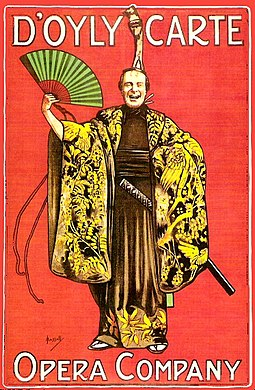
Producer Richard D'Oyly Carte brought Gilbert and Sullivan together and nurtured their collaboration.[8] He built the Savoy Theatre in 1881 to present their joint works (which came to be known as the Savoy Operas) and founded the D'Oyly Carte Opera Company, which performed and promoted Gilbert and Sullivan's works for over a century.
Beginnings
Gilbert before Sullivan
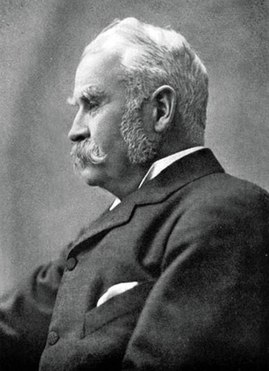
Main article: W. S. Gilbert
Gilbert was born in London on 18 November 1836. His father, William, was a naval surgeon who later wrote novels and short stories, some of which included illustrations by his son.[9] In 1861, to supplement his income, the younger Gilbert began writing illustrated stories, poems and articles of his own, many of which would later be mined as inspiration for his plays and operas, particularly Gilbert's series of illustrated poems, the Bab Ballads.[10]
In the Bab Ballads and his early plays, Gilbert developed a unique "topsy-turvy" style in which humour was derived by setting up a ridiculous premise and working out its logical consequences, however absurd. Director and playwright Mike Leigh described the "Gilbertian" style as follows:
With great fluidity and freedom, [Gilbert] continually challenges our natural expectations. First, within the framework of the story, he makes bizarre things happen, and turns the world on its head. Thus the Learned Judge marries the Plaintiff, the soldiers metamorphose into aesthetes, and so on, and nearly every opera is resolved by a deft moving of the goalposts... His genius is to fuse opposites with an imperceptible sleight of hand, to blend the surreal with the real, and the caricature with the natural. In other words, to tell a perfectly outrageous story in a completely deadpan way.[2]
Gilbert developed his innovative theories on the art of stage direction, following theatrical reformer Tom Robertson.[9] At the time Gilbert began writing, theatre in Britain was in disrepute.[11] Gilbert helped to reform and elevate the respectability of the theatre, especially beginning with his six short family-friendly comic operas, or "entertainments", for Thomas German Reed.[12]
At a rehearsal for one of these entertainments, Ages Ago, in 1870, the composer Frederic Clay introduced Gilbert to his friend, the young composer Arthur Sullivan.[13][14] Over the next year, before the two first collaborated, Gilbert continued to write humorous verse, stories and plays, including the comic operas Our Island Home (1870) and A Sensation Novel (1871), and the blank verse comedies The Princess (1870), The Palace of Truth (1870) and Pygmalion and Galatea (1871).
Sullivan before Gilbert
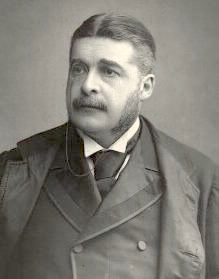
Main article: Arthur Sullivan
Sullivan was born in London on 13 May 1842. His father was a military bandmaster, and by the time Arthur had reached the age of eight, he was proficient with all the instruments in the band. In school he began to compose anthems and songs. In 1856, he received the first Mendelssohn Scholarship and studied at the Royal Academy of Music and then at Leipzig, where he also took up conducting. His graduation piece, completed in 1861, was a suite of incidental music to Shakespeare's The Tempest. Revised and expanded, it was performed at the Crystal Palace in 1862 and was an immediate sensation. He began building a reputation as England's most promising young composer, composing a symphony, a concerto, and several overtures, among them the Overture di Ballo, in 1870.^
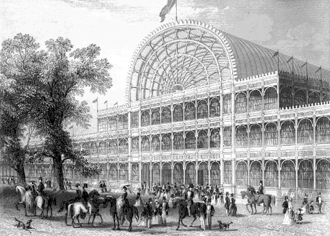
The Crystal Palace, where several early Sullivan works were first performed
His early major works for the voice included The Masque at Kenilworth (1864); an oratorio, The Prodigal Son (1869); and a dramatic cantata, On Shore and Sea (1871). He composed a ballet, L'Île Enchantée (1864) and incidental music for a number of Shakespeare plays. Other early pieces that were praised were his Symphony in E, Concerto for Cello and Orchestra, and Overture in C (In Memoriam) (all three of which premiered in 1866).[16] These commissions, however, were not sufficient to keep Sullivan afloat. He worked as a church organist and composed numerous hymns, popular songs, and parlour ballads.[17]
Sullivan's first foray into comic opera was Cox and Box (1866), written with librettist F. C. Burnand for an informal gathering of friends. Public performance followed, with W. S. Gilbert (then writing dramatic criticism for the magazine Fun) saying that Sullivan's score "is, in many places, of too high a class for the grotesquely absurd plot to which it is wedded."[18] Nonetheless, it proved highly successful, and is still regularly performed today. Sullivan and Burnand's second opera, The Contrabandista (1867) was not as successful.
Operas
First collaborations
Thespis
Main article: Thespis (opera)
In 1871, producer John Hollingshead brought Gilbert and Sullivan together to produce a Christmas entertainment, Thespis, at his Gaiety Theatre, a large West End house. The piece was an extravaganza in which the classical Greek gods, grown elderly, are temporarily replaced by a troupe of 19th-century actors and actresses, one of whom is the eponymous Thespis, the Greek father of the drama. Its mixture of political satire and grand opera parody mimicked Offenbach's Orpheus in the Underworld and La belle Hélène, which (in translation) then dominated the English musical stage.[19][20]
Thespis opened on Boxing Day and ran for 63 performances. It outran five of its nine competitors for the 1871 holiday season, and its run was extended beyond the length of a normal run at the Gaiety,[21] but no one at the time anticipated that this was the beginning of a great collaboration. Unlike the later Gilbert and Sullivan works, it was hastily prepared, and its nature was more risqué, like Gilbert's earlier burlesques, with a broader style of comedy that allowed for improvisation by the actors. Two of the male characters were played by women, whose shapely legs were put on display in a fashion that Gilbert later condemned.[22]
The musical score to Thespis was never published and is now lost, except for one song that was published separately, a chorus that was re-used in The Pirates of Penzance, and the Act II ballet music.[19]
Over the next three years, Gilbert and Sullivan did not have occasion to work together again, but each man became more eminent in his field. Gilbert worked with Frederic Clay on Happy Arcadia (1872) and with Alfred Cellier on Topsyturveydom (1874), and wrote The Wicked World (1873) Sweethearts (1874) and several other libretti, farces, extravaganzas, fairy comedies, dramas and adaptations. Sullivan completed his Festival Te Deum (1872); another oratorio, The Light of the World (1873); his only song cycle, The Window; or, The Song of the Wrens (1871); incidental music to The Merry Wives of Windsor (1874); and more songs, parlour ballads, and hymns, including "Onward, Christian Soldiers" (1872).
At the same time, the audience for theatre was growing because of the rapidly expanding British population; improvement in education and the standard of living, especially of the middle class; improving public transportation; and installation of street lighting, which made travel home from the theatre safer. The number of pianos manufactured in England doubled between 1870 and 1890 as more people began to play parlour music at home and more theatres and concert halls opened.[23][24]
Trial by Jury
Main article: Trial by Jury
In 1874, Gilbert wrote a short libretto on commission from producer-conductor Carl Rosa, whose wife would have played the leading role, but her death in childbirth cancelled the project. Not long afterwards, Richard D'Oyly Carte was managing the Royalty Theatre and needed a short opera to be played as an afterpiece to Offenbach's La Périchole. Carte knew about Gilbert's libretto for Rosa and suggested that Sullivan write a score for it. Gilbert read the piece to Sullivan in February 1875, and the composer was delighted with it; Trial by Jury was composed and staged in a matter of weeks.[25]
The piece is one of Gilbert's humorous spoofs of the law and the legal profession, based on his short experience as a barrister. It concerns a breach of promise of marriage suit. The defendant argues that damages should be slight, since "he is such a very bad lot," while the plaintiff argues that she loves the defendant fervently and seeks "substantial damages." After much argument, the judge resolves the case by marrying the lovely plaintiff himself. With Sullivan's brother, Fred, as the Learned Judge, the opera was a runaway hit, outlasting the run of La Périchole. Provincial tours and productions at other theatres quickly followed.[26]
Fred Sullivan was the prototype for the "patter" (comic) baritone roles in the later operas. F. C. Burnand wrote that he "was one of the most naturally comic little men I ever came across. He, too, was a first-rate practical musician.... As he was the most absurd person, so was he the very kindliest...."[27] Fred's creation would serve as a model for the rest of the collaborators' works, and each of them has a crucial comic little man role, as Burnand had put it. The "patter" baritone (or "principal comedian", as these roles later were called) would often assume the leading role in Gilbert and Sullivan's comic operas, and was usually allotted the speedy patter songs.
After the success of Trial by Jury, Gilbert and Sullivan were suddenly in demand to write more operas together. Over the next two years, Richard D'Oyly Carte and Carl Rosa were two of several theatrical managers who negotiated with the team but were unable to come to terms. Carte proposed a revival of Thespis for the 1875 Christmas season, which Gilbert and Sullivan would have revised, but he was unable to obtain financing for the project. In early 1876, Carte requested that Gilbert and Sullivan create another one-act opera on the theme of burglars, but this was never completed.[28]
Early successes
The Sorcerer
Main article: The Sorcerer
Carte's real ambition was to develop an English form of light opera that would displace the bawdy burlesques and badly translated French operettas then dominating the London stage. He assembled a syndicate and formed the Comedy Opera Company, with Gilbert and Sullivan commissioned to write a comic opera that would serve as the centrepiece for an evening's entertainment.

An early poster showing scenes from The Sorcerer, Pinafore, and Trial by Jury
Gilbert found a subject in one of his own short stories, "The Elixir of Love," which concerned the complications arising when a love potion is distributed to all the residents of a small village. The leading character was a Cockney businessman who happened to be a sorcerer, a purveyor of blessings (not much called for) and curses (very popular). Gilbert and Sullivan were tireless taskmasters, seeing to it that The Sorcerer (1877) opened as a fully polished production, in marked contrast to the under-rehearsed Thespis.[29] While The Sorcerer won critical acclaim, it did not duplicate the success of Trial by Jury. Nevertheless, Carte and his syndicate were sufficiently encouraged to commission another full-length opera from the team.
H.M.S. Pinafore
Main article: H.M.S. Pinafore
Gilbert and Sullivan scored their first international hit with H.M.S. Pinafore (1878), satirising the rise of unqualified people to positions of authority and poking good-natured fun at the Royal Navy and the English obsession with social status (building on a theme introduced in The Sorcerer, love between members of different social classes). As with many of the Gilbert and Sullivan operas, a surprise twist changes everything dramatically near the end of the story.
Gilbert oversaw the designs of sets and costumes, and he directed the performers on stage.[30] He sought realism in acting, shunned self-conscious interaction with the audience, and insisted on a standard of characterisation where the characters were never aware of their own absurdity.[31] Gilbert insisted that his actors know their words perfectly and obey his stage directions, which was something new to many actors of the day.[31] Sullivan personally oversaw the musical preparation. The result was a new crispness and polish in the English musical theatre.[32][33] As Jessie Bond wrote later:
Our stage discipline was strict and unbending. Gilbert's word was law; he thoroughly worked out in his own mind every bit of action, by-play and grouping, and allowed no deviation from his plan. He...made drawings and took measurements with the minutest care.... He had unlimited fertility of invention in comic business and would allow no gag, no clowning, no departure from his own definite conception. Sullivan's musical conception was equally clear-cut and decided. Every part must be made subservient to the whole, and his sarcasms overwhelmed the transgressor with scorn. "And now, might I trouble you to try over my music," he would say to a singer too anxious to display his or her top notes. But there was nothing to hurt or offend us in this unswerving discipline, we took their good-humoured raillery as our due when we failed in our rendering or overstepped the bounds; and the patience and enthusiasm of that artistic pair so infected all of us that we worked willingly for hours and hours at rehearsals, trying with all our might to realize the conceptions of those two brilliant minds.[34]
H.M.S. Pinafore ran in London for 571 performances,[35] the second longest run of any musical theatre piece in history up to that time (after the operetta Les cloches de Corneville).[36] Hundreds of unauthorised, or "pirated", productions of Pinafore appeared in America.[37] During the run of Pinafore, Richard D'Oyly Carte split up with his former investors. The disgruntled former partners, who had invested in the production with no return, staged a public fracas, sending a group of thugs to seize the scenery during a performance. Stagehands successfully managed to ward off their backstage attackers.[38] This event cleared the way for Carte, Gilbert and Sullivan to form the D'Oyly Carte Opera Company, which then produced all of their succeeding operas.
The libretto of H.M.S. Pinafore relied on stock character types, many of which were familiar from European opera (and some of which grew out of Gilbert's earlier association with the German Reeds): the heroic protagonist (tenor) and his love-interest (soprano); the older woman with a secret or a sharp tongue (contralto); the baffled lyric baritone—the girl's father; and a classic villain (bass-baritone). Gilbert and Sullivan added the element of the comic patter-singing character.
With the success of H.M.S. Pinafore, the D'Oyly Carte repertory and production system was cemented, and each opera would make use of these stock character types. Before The Sorcerer, Gilbert had constructed his plays around the established stars of whatever theatre he happened to be writing for, as had been the case with Thespis and Trial by Jury. Building on the team he had assembled for The Sorcerer, Gilbert no longer hired stars; he created them. He and Sullivan selected the performers, writing their operas for ensemble casts rather than individual stars.
The repertory system ensured that the comic patter character who performed the role of the sorcerer, John Wellington Wells, would become the ruler of the Queen's navy as Sir Joseph Porter in H.M.S. Pinafore, then join the army as Major-General Stanley in The Pirates of Penzance, and so on. Similarly, Mrs. Partlet in The Sorcerer transformed into Little Buttercup in Pinafore, then into Ruth, the piratical maid-of-all-work in Pirates. Relatively unknown performers whom Gilbert and Sullivan engaged early in the collaboration would stay with the company for many years, becoming stars of the Victorian stage. These included George Grossmith, the principal comic; Rutland Barrington, the lyric baritone; Richard Temple, the bass-baritone; and Jessie Bond, the mezzo-soprano soubrette.
*The Pirates of Penzance
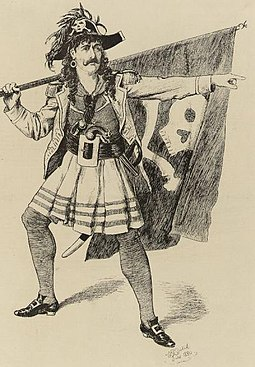
Main article: The Pirates of Penzance
The Pirates of Penzance (New Year's Eve, 1879) also poked fun at grand opera conventions, sense of duty, family obligation, the "respectability" of civilisation and the peerage, and the relevance of a liberal education. The story also revisits Pinafore's theme of unqualified people in positions of authority, in the person of the "modern Major-General" who has up-to-date knowledge about everything except the military. The Major-General and his many daughters escape from the tender-hearted Pirates of Penzance, who are all orphans, on the false plea that he is an orphan himself. The pirates learn of the deception and re-capture the Major-General, but when it is revealed that the pirates are all peers, the Major-General bids them: "resume your ranks and legislative duties, and take my daughters, all of whom are beauties!"
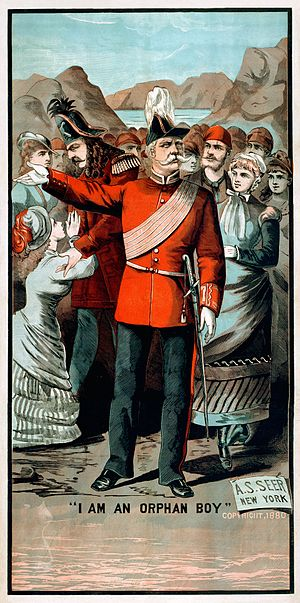
The piece premiered in New York rather than London, in an (unsuccessful) attempt to secure the American copyright,[39] and was another big success with both critics and audiences.[40]Gilbert, Sullivan and Carte tried for many years to control the American performance copyrights over their operas, without success.[41] Nevertheless, Pirates was a hit both in New York, again spawning numerous imitators, and then in London, and it became one of the most frequently performed, translated and parodied Gilbert and Sullivan works, also enjoying successful 1981 Broadway[42] and 1982 West End revivals by Joseph Papp that continue to influence productions of the opera.[43]
In 1880, Sullivan's cantata The Martyr of Antioch premiered at the Leeds Triennial Music Festival, with a libretto modified by Gilbert from an 1822 epic poem by Henry Hart Milman concerning the 3rd century martyrdom of St. Margaret of Antioch. Sullivan became the conductor of the Leeds festival beginning in 1880 and conducted the performance. The Carl Rosa Opera Company staged the cantata as an opera in 1898.[44]
Savoy Theatre opens
...
Dodging the magic lozenge
The Mikado
Main article: The Mikado

Poster for The Mikado
The most successful of the Savoy Operas was The Mikado (1885), which made fun of English bureaucracy, thinly disguised by a Japanese setting. Gilbert initially proposed a story for a new opera about a magic lozenge that would change the characters, which Sullivan found artificial and lacking in "human interest and probability", as well as being too similar to their earlier opera The Sorcerer.[n 11] As dramatised in the film Topsy-Turvy, the author and composer were at an impasse until 8 May 1884, when Gilbert dropped the lozenge idea and agreed to provide a libretto without any supernatural elements.[n 12]
The story focuses on a "cheap tailor", Ko-Ko, who is promoted to the position of Lord High Executioner of the town of Titipu. He loves his ward, Yum-Yum, but she loves a musician, who is really the son of the emperor of Japan (the Mikado) and who is in disguise to escape the attentions of the elderly and amorous Katisha. The Mikado has decreed that executions must resume without delay in Titipu. When news arrives that the Mikado will be visiting the town, Ko-Ko assumes that he is coming to ascertain whether Ko-Ko has carried out the executions. Too timid to execute anyone, Ko-Ko cooks up a conspiracy to misdirect the Mikado, which goes awry. Eventually, Ko-Ko must persuade Katisha to marry him to save his own life and the lives of the other conspirators.
With the opening of trade between England and Japan, Japanese imports, art and styles became fashionable, and a Japanese village exhibition opened in Knightsbridge, London, making the time ripe for an opera set in Japan. Gilbert said, "I cannot give you a good reason for our... piece being laid in Japan. It... afforded scope for picturesque treatment, scenery and costume, and I think that the idea of a chief magistrate, who is... judge and actual executioner in one, and yet would not hurt a worm, may perhaps please the public."[64]
Setting the opera in Japan, an exotic locale far away from Britain, allowed Gilbert and Sullivan to satirise British politics and institutions more freely by clothing them in superficial Japanese trappings. Gilbert wrote, "The Mikado of the opera was an imaginary monarch of a remote period and cannot by any exercise of ingenuity be taken to be a slap on an existing institution."[65] G. K. Chesterton compared it to Swift's Gulliver's Travels: "Gilbert pursued and persecuted the evils of modern England till they had literally not a leg to stand on, exactly as Swift did... I doubt if there is a single joke in the whole play that fits the Japanese. But all the jokes in the play fit the English. ... About England Pooh-bah is something more than a satire; he is the truth."[66] Several of the later operas are similarly set in foreign or fictional locales, including The Gondoliers, Utopia, Limited and The Grand Duke.
Favorite airs from *The Mikado 4:16 A 1914 Edison Records recording of selections from The Mikado. Includes parts of the overture, "A wand'ring minstrel", "Three little maids", "Tit-willow", and the Act II finale. -- |

The Mikado became the partnership's longest-running hit, enjoying 672 performances at the Savoy Theatre, and surpassing the runs of Pinafore and Patience. It remains the most frequently performed Savoy Opera.[67] It has been translated into numerous languages and is one of the most frequently played musical theatre pieces in history.[68]
Ruddigore
Main article: Ruddigore
Ruddigore (1887), a topsy-turvy take on Victorian melodrama, was less successful than most of the earlier collaborations with a run of 288 performances. The original title, Ruddygore, together with some of the plot devices, including the revivification of ghosts, drew negative comments from critics.[69][n 13] Gilbert and Sullivan respelled the title and made a number of changes and cuts.[71] Nevertheless, the piece was profitable,[72] and the reviews were not all bad. For instance, The Illustrated London News praised the work and both Gilbert and, especially, Sullivan: "Sir Arthur Sullivan has eminently succeeded alike in the expression of refined sentiment and comic humour. In the former respect, the charm of graceful melody prevails; while, in the latter, the music of the most grotesque situations is redolent of fun."[73] Further changes were made, including a new overture, when Rupert D'Oyly Carte revived Ruddigore after the First World War, and the piece was regularly performed by the D'Oyly Carte Opera Company thereafter.[74]...
Recordings and broadcasts
[
The first commercial recordings of individual numbers from the Savoy operas began in 1898.[n 1] In 1917 the Gramophone Company (HMV) produced the first album of a complete Gilbert and Sullivan opera, The Mikado, followed by recordings of eight more.[121] Electrical recordings of most of the operas were then issued by HMV and Victor, beginning in the late 1920s, supervised by [Rupert D'Oyly Carte].[122] The D'Oyly Carte Opera Company continued to produce well-regarded recordings until 1979, helping to keep the operas popular through the decades. Many of these recordings have been reissued on CD.[123] After the company was revived in 1988, it recorded seven of the operas.[111]
After the copyrights on the operas expired, numerous companies around the world released popular audio and video recordings of the operas.[111][124] In 1966 and again in the 1980s, BBC Radio presented complete cycles of the thirteen extant Gilbert and Sullivan operas, with dialogue.[125] Ad hoc casts of operatic singers conducted by Sir Malcolm Sargent in the 1950s and 60s[126] and Sir Charles Mackerras in the 1990s[111] have made audio sets of several Savoy operas, and in the 1980s Alexander Faris conducted video recordings of eleven of the operas (omitting the last two) with casts including show-business stars as well as professional singers.[127] Joseph Papp's Broadway production of The Pirates of Penzance was put on record in 1981.[128][129] Since 1994, the International Gilbert and Sullivan Festival has released numerous professional and amateur CDs and videos of its productions.[130] Ohio Light Opera has recorded several of the operas in the 21st century.[131]
Cultural Influence
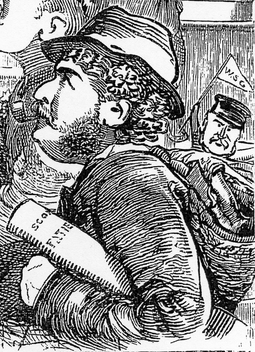
Detail from a Punch cartoon, showing Sullivan and Gilbert.
Main article: Cultural influence of Gilbert and Sullivan
In the past 125 years, Gilbert and Sullivan have pervasively influenced popular culture in the English-speaking world,[132] and lines and quotations from their operas have become part of the English language (even if not originated by Gilbert), such as "short, sharp shock", "What never? Well, hardly ever!", "let the punishment fit the crime", and "A policeman's lot is not a happy one".[15][133] The operas have influenced political style and discourse, literature, film and television, have been widely parodied by humorists, and have been quoted in legal rulings.[134]
The American and British musical owes a tremendous debt to G&S,[135][136] who were admired and copied by early musical theatre authors and composers such as Ivan Caryll, Adrian Ross, Lionel Monckton, P. G. Wodehouse,[137][138] Guy Bolton, and Victor Herbert, and later Jerome Kern, Ira Gershwin, Yip Harburg,[139] Irving Berlin, Ivor Novello, Oscar Hammerstein II, and Andrew Lloyd Webber.[140]
Gilbert's lyrics served as a model for such 20th-century Broadway lyricists as Cole Porter,[141] Ira Gershwin,[142] and Lorenz Hart.[7] Noël Coward wrote: "I was born into a generation that still took light music seriously. The lyrics and melodies of Gilbert and Sullivan were hummed and strummed into my consciousness at an early age. My father sang them, my mother played them, my nurse, Emma, breathed them through her teeth.... My aunts and uncles... sang them singly and in unison at the slightest provocation...."[143]
Professor Carolyn Williams has noted, however: "The influence of Gilbert and Sullivan – their wit and sense of irony, the send ups of politics and contemporary culture – goes beyond musical theater to comedy in general. Allusions to their work have made their way into our own popular culture".[144] Gilbert and Sullivan expert and enthusiast Ian Bradleyagrees:
The musical is not, of course, the only cultural form to show the influence of G&S. Even more direct heirs are those witty and satirical songwriters found on both sides of the Atlantic in the twentieth century like Michael Flanders and Donald Swann in the United Kingdom and Tom Lehrer in the United States. The influence of Gilbert is discernible in a vein of British comedy that runs through John Betjeman's verse via Monty Python and Private Eye to... television series like Yes, Minister... where the emphasis is on wit, irony, and poking fun at the establishment from within it in a way which manages to be both disrespectful of authority and yet cosily comfortable and urbane.[101]
The works of Gilbert and Sullivan are themselves frequently pastiched and parodied.[145][146] Well known examples of this include Tom Lehrer's The Elements and Clementine;[147] Allan Sherman's I'm Called Little Butterball, When I Was a Lad, You Need an Analyst and The Bronx Bird-Watcher;[148][149] and The Two Ronnies' 1973 Christmas Special.[150] Other comedians have used Gilbert and Sullivan songs as a key part of their routines, including Hinge and Bracket,[151] Anna Russell,[152] and the HMS Yakko episode of the animated TV series Animaniacs.
Songs from Gilbert and Sullivan are often pastiched in advertising, and elaborate advertising parodies have been published, as have the likenesses of various Gilbert and Sullivan performers throughout the decades.[153] Gilbert and Sullivan comic operas are commonly referenced in literature, film and television in various ways that include extensive use of Sullivan's music or where action occurs during a performance of a Gilbert and Sullivan opera, such as in the film The Girl Said No.[154]
There are also a number of Gilbert and Sullivan biographical films, such as Mike Leigh's Topsy-Turvy (2000) and The Story of Gilbert and Sullivan (1953), as well as shows about the partnership, including a 1938 Broadway show, Knights of Song[155] and a 1975 West End show called Tarantara! Tarantara![156][157]
It is not surprising, given the focus of Gilbert on politics, that politicians and political observers have often found inspiration in these works. Chief Justice of the United States William Rehnquist added gold stripes to his judicial robes after seeing them used by the Lord Chancellor in a production of Iolanthe.[158]
Alternatively, Lord Chancellor Charles Falconer is recorded as objecting so strongly to Iolanthe's comic portrayal of Lord Chancellors that he supported moves to disband the office.[133] British politicians, beyond quoting some of the more famous lines, have delivered speeches in the form of Gilbert and Sullivan pastiches. These include Conservative Peter Lilley's speech mimicking the form of "I've got a little list" from The Mikado, listing those he was against, including "sponging socialists" and "young ladies who get pregnant just to jump the housing queue".[133] Political humour based on Gilbert and Sullivan's style and characters continues to be written.[159]
^...^