Forbes-Robertson
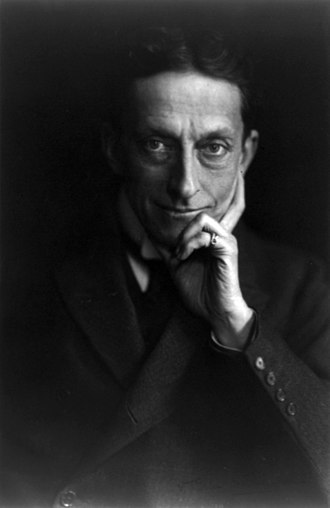
NAME: Forbes-Robertson, Sir Johnston.
ACHIEVEMENTS: Acting and producing, painting.
NICKNAME/ALIAS: None.
DATE AND PLACE OF BIRTH: 16th January 1853, in Crutched Friars, London, England.
DATE/PLACE OF DEATH/AGE AT DEATH: 6th November 1937, near Dover, England. Aged 84.
DISCIPLINE: Actor.
FIELD: Theater.
LANGUAGE: English.
PARENTS: Father, John Forbes-Robertson, mother Frances Cott.
SIBLINGS: 4 brothers, Norman, Ian, Eric, Leonard, 3 sisters.
SPOUSE: May Gertrude Dermot (the actress, Gertrude Elliott).
CHILDREN: 4 daughters: Chloe, Jean, Diana, Maxine.
EDUCATION: Charterhouse, London; Royal Academy.
MAJOR WORK: ‘A Player Under Three Reigns’ (1925).
LIFE AND TIMES:
Even as a child, Forbes-Robertson seemed destined to become an actor, presenting his own productions of Shakespearean tragedies to family and friends, including important people from the world of art and literature such as <knew> Dante Gabriel Rossetti* and the young <knew> Swinburne*.
His first ventures into professional acting came in 1874, when he was given a part in the play ‘Mary Stuart’, then, in the same year, he played opposite <played opposite> Ellen Terry* in ‘The Wandering Heir.’
He had considered taking up painting as his main occupation, but that changed when he took a job with a theatre company in Manchester and was greatly helped by the actor Samuel Phelps.
At the end of his first year in acting, Forbes-Robertson went back to London, where he performed at the Gaiety Theatre with Phelps. In 1876, he joined the Haymarket Theatre company and appeared in his first big hit, as Geoffrey Wynyard in W S Gilbert’s ‘Daniel Druce’. While he was on tour in ‘Daniel Druce’ in Glasgow a few years later, he met the American writer <met> Harte*.
At that time, it was the custom for theatre managers to go on vacation for the month of August. It was normal for actors committed to the profession to run the theatres in their absence and Forbes-Robertson did this for four years.
In this period he concentrated mainly on portraiture and picked up several commissions with the help of <helped by> Millais*, a member of the Pre-Raphaelite Brotherhood. His portraits included one of <painted> Ellen Terry* and another of <painted> Henry Irving* and his son.
In the early 1880's, he saw a great deal of <a pal of> Whistler* and attended his celebrated breakfasts in Chelsea, where he got to know <a pal of> Wilde*.
In 1882, Irving asked Forbes-Robertson to take part in his production of Shakespeare's ‘Much Ado About Nothing’ and at the same time gave him the job of painting a scene from the play.
The next year, Forbes-Robertson went on a painting holiday in Trouville, in northern France, together with George Munn, where he studied the techniques of landscape painting in the open.
In 1885 Forbes-Robertson made his first trip to the United States. While he was on an extended tour playing opposite Mary Anderson, he made a number of literary and artistic contacts, including the writer <met> Howells*, whom he met in Boston, Massachusetts. He also made the acquaintance of the daughters of General Robert E. Lee, as well as the widow of President Jefferson Davis.
Forbes-Robertson was now considered to be one of London’s leading actors and, when he came back to England, was much in demand. In 1895, he went into theatre management when Irving, who was about to tour America, asked him to take over the Lyceum Theater in his absence. His first production there was Shakespeare's ‘Romeo and Juliet’.
A couple of years later, Forbes-Robertson took over the Lyceum again and, after many misgivings, produced a revival of ‘Hamlet’, in which he played the lead role for the first time. Before the play opened, he received a letter from the writer and critic <advised by> Shaw*.
In his letter, Shaw gave Forbes-Robertson advice on how he should play the part, much of which he followed. The result was his greatest triumph, with his performance later acclaimed as the greatest Hamlet ever played. From then on he staged plays by Shaw long before Shaw became famous.
In 1898, Forbes-Robertson went on tour in Germany and Holland in ‘Hamlet’, ‘Macbeth’ and Arthur Pinero's ‘The Second Mrs Tanqueray’. The following year, he fell ill and went to Sicily to recover. Back in good health, he visited Naples, Pompeii, Rome, Florence and Venice. A year after that, he married an American actress soon after he gave her a job with the company.
In 1902, he staged ‘Mice and Men’, a very successful dramatization of <dramatized work by> Rudyard Kipling*’s book. In 1908 he had another great triumph, when he played the lead role in <acted play by> Jerome K Jerome*'s ‘The Passing of the Third Floor Back’.
Forbes-Robertson retired after a long career on the London stage in 1913 and was rewarded with a knighthood. His last stage appearance was in 1916, at Harvard University, in the role that he had made his own, that of Hamlet.
ASSESSMENT: Forbes-Robertson was acknowledged for his fine natural delivery of Shakespearean blank verse.
EXTRA CONNECTIONS: None
ONELINER: Johnston Forbes-Robertson, well-known Victorian actor
BIBLIOGRAPHY:
Findlater, Richard, Six Great Actors, Hamish Hamilton, London, 1957
Forbes-Robertson, Johnston, A Player Under Three Reigns, T Fisher Unwin
Ltd., London, 1925.
Johnston Forbes-Robertson - Wikipedia
Multimedia:
Partial filmography
- Hamlet (1913)
- Masks and Faces (1917)
- The Passing of the Third Floor Back (1918)