Ceramics
Pottery is the process and the products of forming vessels and other objects with clay and other raw materials, which are fired at high temperatures to give them a hard and durable form. The place where such wares are made by a potter is also called a pottery (plural potteries). The definition of pottery, used by the ASTM International, is "all fired ceramic wares that contain clay when formed, except technical, structural, and refractory products".[1] End applications include tableware, decorative ware, sanitaryware, and in technology and industry such as electrical insulators and laboratory ware. In art history and archaeology, especially of ancient and prehistoric periods, pottery often means vessels only, and sculpted figurines of the same material are called terracottas.
Pottery is one of the oldest human inventions, originating before the Neolithic period, with ceramic objects such as the Gravettian culture Venus of Dolní Věstonice figurine discovered in the Czech Republic dating back to 29,000–25,000 BC. [2] However, the earliest known pottery vessels were discovered in Jiangxi, China, which date back to 18,000 BC. Other early Neolithic and pre-Neolithic pottery artifacts have been found, in Jōmon Japan (10,500 BC),[3] the Russian Far East (14,000 BC),[4] Sub-Saharan Africa (9,400 BC),[5] South America (9,000s–7,000s BC),[6] and the Middle East (7,000s–6,000s BC).
Pottery is made by forming a clay body into objects of a desired shape and heating them to high temperatures (600–1600 °C) in a bonfire, pit or kiln, which induces reactions that lead to permanent changes including increasing the strength and rigidity of the object. Much pottery is purely utilitarian, but some can also be regarded as ceramic art. An article can be decorated before or after firing.
Pottery is traditionally divided into three types: earthenware, stoneware and porcelain. All three may be glazed and unglazed. All may also be decorated by various techniques. In many examples the group a piece belongs to is immediately visually apparent, but this is not always the case; for example fritware uses no or little clay, so falls outside these groups. Historic pottery of all these types is often grouped as either "fine" wares, relatively expensive and well-made, and following the aesthetic taste of the culture concerned, or alternatively "coarse", "popular", "folk" or "village" wares, mostly undecorated, or simply so, and often less well-made.
Cooking in pottery became less popular once metal pots became available,[7] but is still used for dishes that benefit from the qualities of pottery cooking, typically slow cooking in an oven, such as biryani, cassoulet, daube, tagine, jollof rice, kedjenou, cazuela and types of baked beans.[7]
- Main types
- Archaeology
- Clay bodies and raw materials
- Production
- History
- See also
- References
- Further reading
- External links
Main types
Earthenware
Main article: Earthenware
 Earthenware jar from the Neolithic Majiayao culture China, 3300 to 2000 BCE.
The earliest forms of pottery were made from clays that were fired at low temperatures, initially in pit-fires or in open bonfires. They were hand formed and undecorated. Earthenware can be fired as low as 600 °C, and is normally fired below 1200 °C.[8] Because unglazed earthenware is porous, it has limited utility for the storage of liquids or as tableware. However, earthenware has had a continuous history from the Neolithic period to today. It can be made from a wide variety of clays, some of which fire to a buff, brown or black colour, with iron in the constituent minerals resulting in a reddish-brown. Reddish coloured varieties are called terracotta, especially when unglazed or used for sculpture. The development of ceramic glaze made impermeable pottery possible, improving the popularity and practicality of pottery vessels. Decoration has evolved and developed through history.
Stoneware
Main article: Stoneware
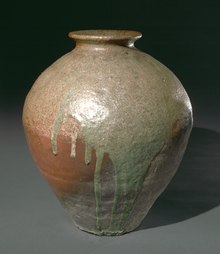 ])15th-century Japanese stoneware storage jar, with partial ash glaze
Stoneware is pottery that has been fired in a kiln at a relatively high temperature, from about 1,100 °C to 1,200 °C, and is stronger and non-porous to liquids.[9] The Chinese, who developed stoneware very early on, classify this together with porcelain as high-fired wares. In contrast, stoneware could only be produced in Europe from the late Middle Ages, as European kilns were less efficient, and the right type of clay less common. It remained a speciality of Germany until the Renaissance.[10]
Stoneware is very tough and practical, and much of it has always been utilitarian, for the kitchen or storage rather than the table. But "fine" stoneware has been important in China, Japan and the West, and continues to be made. Many utilitarian types have also come to be appreciated as art.
Porcelain
Main article: Porcelain
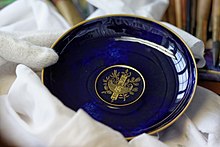 ] Contemporary porcelain plate by Sèvres
Porcelain is made by heating materials, generally including kaolin, in a kiln to temperatures between 1,200 and 1,400 °C (2,200 and 2,600 °F). This is higher than used for the other types, and achieving these temperatures was a long struggle, as well as realizing what materials were needed. The toughness, strength and translucence of porcelain, relative to other types of pottery, arises mainly from vitrification and the formation of the mineral mullite within the body at these high temperatures.
Although porcelain was first made in China, the Chinese traditionally do not recognise it as a distinct category, grouping it with stoneware as "high-fired" ware, opposed to "low-fired" earthenware. This confuses the issue of when it was first made. A degree of translucency and whiteness was achieved by the Tang dynasty (AD 618–906), and considerable quantities were being exported. The modern level of whiteness was not reached until much later, in the 14th century. Porcelain was also made in Korea and in Japan from the end of the 16th century, after suitable kaolin was located in those countries. It was not made effectively outside East Asia until the 18th century.[11]
Archaeology
 Archaeologist cleaning an early mediaeval pottery sherd from Chodlik, Poland.
The study of pottery can help to provide an insight into past cultures. Fabric analysis (see section below), used to analyse the fabric of pottery, is important part of archaeology for understanding the archaeological culture of the excavated site by studying the fabric of artifacts, such as their usage, source material composition, decorative pattern, color of patterns, etc. This helps to understand characteristics, sophistication, habits, technology, tools, trade, etc. of the people who made and used the pottery. Carbon dating reveals the age. Sites with similar pottery characteristics have the same culture, those sites which have distinct cultural characteristics but with some overlap are indicative of cultural exchange such as trade or living in vicinity or continuity of habitation, etc. Examples are black and red ware, redware, Sothi-Siswal culture and Painted Grey Ware culture. The six fabrics of Kalibangan is a good example of use of fabric analysis in identifying a differentiated culture which was earlier thought to be typical Indus Valley civilisation (IVC) culture.
Pottery is durable, and fragments, at least, often survive long after artifacts made from less-durable materials have decayed past recognition. Combined with other evidence, the study of pottery artefacts is helpful in the development of theories on the organisation, economic condition and the cultural development of the societies that produced or acquired pottery. The study of pottery may also allow inferences to be drawn about a culture's daily life, religion, social relationships, attitudes towards neighbours, attitudes to their own world and even the way the culture understood the universe.
[ ](https://en.wikipedia.org/wiki/File:Qin_Terracotta_Army,_Pit_1_%289892085143%29.jpg)Terracotta Army following excavation
It is valuable to look into pottery as an archaeological record of potential interaction between peoples. When pottery is placed within the context of linguistic and migratory patterns, it becomes an even more prevalent category of social artifact.[12] As proposed by Olivier P. Gosselain, it is possible to understand ranges of cross-cultural interaction by looking closely at the chaîne opératoire of ceramic production.[13]
...
East Asia[edit]
Main articles: Chinese ceramics, Korean pottery, and Japanese pottery
 Chinese Ming dynasty blue-and-white porcelain dish with a dragon
 Group of 13th-century pieces of Longquan celadon
In Japan, the Jōmon period has a long history of development of Jōmon pottery which was characterized by impressions of rope on the surface of the pottery created by pressing rope into the clay before firing. Glazed Stoneware was being created as early as the 15th century BC in China. A form of Chinese porcelain became a significant Chinese export from the Tang Dynasty (AD 618–906) onwards.[9] Korean potters adopted porcelain as early as the 14th century AD.[67] Japanese porcelain was made in the early 16th century after Shonzui Goradoyu-go brought back the secret of its manufacture from the Chinese kilns at Jingdezhen.[68]
In contrast to Europe, the Chinese elite used pottery extensively at table, for religious purposes, and for decoration, and the standards of fine pottery were very high. From the Song dynasty (960–1279) for several centuries elite taste favoured plain-coloured and exquisitely formed pieces; during this period porcelain was perfected in Ding ware, although it was the only one of the Five Great Kilns of the Song period to use it. The traditional Chinese category of high-fired wares includes stoneware types such as Ru ware, Longquan celadon and Guan ware. Painted wares such as Cizhou ware had a lower status, though they were acceptable for making pillows.
The arrival of Chinese blue and white porcelain was probably a product of the Mongol Yuan dynasty (1271–1368) dispersing artists and craftsmen across its large empire. Both the cobalt stains used for the blue colour, and the style of painted decoration, usually based on plant shapes, were initially borrowed from the Islamic world, which the Mongols had also conquered. At the same time Jingdezhen porcelain, produced in Imperial factories, took the undisputed leading role in production. The new elaborately painted style was now favoured at court, and gradually more colours were added.
The secret of making such porcelain was sought in the Islamic world and later in Europe when examples were imported from the East. Many attempts were made to imitate it in Italy and France. However it was not produced outside of the Orient until 1709 in Germany.[69]
...
West Asia[edit]
See also: Levantine pottery, Persian pottery, and Pottery of ancient Cyprus
Around 8000 BC during the Pre-pottery Neolithic period, and before the invention of pottery, several early settlements became experts in crafting beautiful and highly sophisticated containers from stone, using materials such as alabaster or granite, and employing sand to shape and polish. Artisans used the veins in the material to maximum visual effect. Such objects have been found in abundance on the upper Euphrates river, in what is today eastern Syria, especially at the site of Bouqras.[83]
The earliest history of pottery production in the Fertile Crescent starts the Pottery Neolithic and can be divided into four periods, namely: the Hassuna period (7000–6500 BC), the Halaf period (6500–5500 BC), the Ubaid period (5500–4000 BC), and the Uruk period (4000–3100 BC). By about 5000 BC pottery-making was becoming widespread across the region, and spreading out from it to neighbouring areas.
Pottery making began in the 7th millennium BC. The earliest forms, which were found at the Hassuna site, were hand formed from slabs, undecorated, unglazed low-fired pots made from reddish-brown clays.[56] Within the next millennium, wares were decorated with elaborate painted designs and natural forms, incising and burnished.
 Earthenware Ubaid jar. c. 5,300-4,700 BCE
The invention of the potter's wheel in Mesopotamia sometime between 6,000 and 4,000 BC (Ubaid period) revolutionised pottery production. Newer kiln designs could fire wares to 1,050 °C (1,920 °F) to 1,200 °C (2,190 °F) which enabled increased possibilities. Production was now carried out by small groups of potters for small cities, rather than individuals making wares for a family. The shapes and range of uses for ceramics and pottery expanded beyond simple vessels to store and carry to specialized cooking utensils, pot stands and rat traps.[84] As the region developed, new organizations and political forms, pottery became more elaborate and varied. Some wares were made using moulds, allowing for increased production for the needs of the growing populations. Glazing was commonly used and pottery was more decorated.[85]
In the Chalcolithic period in Mesopotamia, Halafian pottery achieved a level of technical competence and sophistication, not seen until the later developments of Greek pottery with Corinthian and Attic ware.
Europe[edit]
Main articles: Minoan pottery, Pottery of ancient Greece, and Ancient Roman pottery
Greek red-figure vase in the krater shape, between 470 and 460 BC, by the Altamura Painter
Europe's oldest pottery, dating from circa 6700 BC, was found on the banks of the Samara River in the middle Volga region of Russia.[86] These sites are known as the Yelshanka culture.
The early inhabitants of Europe developed pottery in the Linear Pottery culture slightly later than the Near East, circa 5500–4500 BC. In the ancient Western Mediterranean elaborately painted earthenware reached very high levels of artistic achievement in the Greek world; there are large numbers of survivals from tombs. Minoan pottery was characterized by complex painted decoration with natural themes.[87] The classical Greek culture began to emerge around 1000 BC featuring a variety of well crafted pottery which now included the human form as a decorating motif. The pottery wheel was now in regular use. Although glazing was known to these potters, it was not widely used. Instead, a more porous clay slip was used for decoration. A wide range of shapes for different uses developed early and remained essentially unchanged during Greek history.[88]
Fine Etruscan pottery was heavily influenced by Greek pottery and often imported Greek potters and painters. Ancient Roman pottery made much less use of painting, but used moulded decoration, allowing industrialized production on a huge scale. Much of the so-called red Samian ware of the Early Roman Empire was produced in modern Germany and France, where entrepreneurs established large potteries. Excavations at Augusta Raurica, near Basel, Switzerland, have revealed a pottery production site in use from the 1st to the 4th century AD.[89]
Pottery was hardly seen on the tables of elites from Hellenistic times until the Renaissance, and most medieval wares were coarse and utilitarian, as the elites ate off metal vessels. Painted Hispano-Moresque ware from Spain, developing the styles of Islamic Spain, became a luxury for late medieval elites, and was adapted in Italy into maiolica in the Italian Renaissance. Both of these were faience or tin-glazed earthenware, and fine faience continued to be made until around 1800 in various countries, especially France, with Nevers faience and several other centres. In the 17th century, imports of Chinese export porcelain and its Japanese equivalent raised the market expectations of fine pottery, and European manufacturers eventually learned to make porcelain, often in the form of soft-paste porcelain, and from the 18th century European porcelain and other wares from a great number of producers became extremely popular, reducing Asian imports.
United Kingdom[edit]
Main articles: Wedgwood, Staffordshire figure, Royal Doulton, Mintons, Midwinter Pottery, and Spode
 Handpainted bone china cup. England, 1815–1820
The city of Stoke-on-Trent is widely known as "The Potteries" because of the large number of pottery factories or, colloquially, "Pot Banks". It was one of the first industrial cities of the modern era where, as early as 1785, two hundred pottery manufacturers employed 20,000 workers.[90][91] Josiah Wedgwood (1730–1795) was the dominant leader.[92]
In North Staffordshire hundreds of companies produced all kinds of pottery, from tablewares and decorative pieces to industrial items. The main pottery types of earthenware, stoneware and porcelain were all made in large quantities, and the Staffordshire industry was a major innovator in developing new varieties of ceramic bodies such as bone china and jasperware, as well as pioneering transfer printing and other glazing and decorating techniques. In general Staffordshire was strongest in the middle and low price ranges, though the finest and most expensive types of wares were also made.[93]
By the late 18th century North Staffordshire was the largest producer of ceramics in the UK, despite significant hubs elsewhere. Large export markets took Staffordshire pottery around the world, especially in the 19th century.[94] Production had begun to decline in the late 19th century, as other countries developed their industries, and declined notably after World War II. Employment fell from 45,000 in 1975 to 23,000 in 1991, and 13,000 in 2002.[95]
Islamic pottery
Main articles: Islamic pottery and Persian pottery
Early Islamic pottery followed the forms of the regions which the Muslims conquered. Eventually, however, there was cross-fertilization between the regions. This was most notable in the Chinese influences on Islamic pottery. Trade between China and Islam took place via the system of trading posts over the lengthy Silk Road. Islamic nations imported stoneware and later porcelain from China. China imported the minerals for Cobalt blue from the Islamic ruled Persia to decorate their blue and white porcelain, which they then exported to the Islamic world.
Likewise, Islamic art contributed to a lasting pottery form identified as Hispano-Moresque in Andalucia (Islamic Spain). Unique Islamic forms were also developed, including fritware, lusterware and specialized glazes like tin-glazing, which led to the development of the popular maiolica.[96]
One major emphasis in ceramic development in the Muslim world was the use of tile and decorative tilework.
...