Buffon, Georges Comte
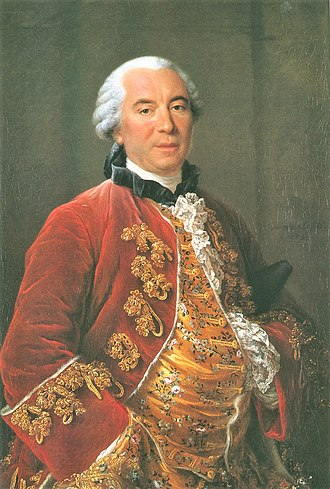
Georges-Louis Leclerc, Comte de Buffon
Nickname/Alias: born Georges-Louis Leclerc
Achievements: First suggestion of evolution.
Born: September 7, 1707; Montbard, France
Died: April 16, 1788; Paris, France (Aged 80)
Field & Discipline: Natural history
Language: French
Father: Benjamin-Francois Leclerc
Mother: Anne-Cristine Marlin
Siblings: Four younger siblings, three of whom entered the church
Spouse: Francoise de Saint-Belin-Malain (1732-69, m. 1752)
Children: One son, 1764-94
Education: College des Jesuites, Dijon, France (1717-23); University of Dijon, France (1723-26); College de l’Oratoire, Angers (1728-30)
Major Work:
“Histoire naturelle, générale et particuliere,” (“Natural History” 44 volumes, 1749-1804)
Life & Times:
Aged 25, Buffon settled on the family estate at Montbard, where he undertook his first research in mathematics and the physical sciences. His first work (on the tensile strength of timber) was written at the request of the minister of the navy, [worked for] Maurepas*. The work inspired Buffon to research plant physiology and husbandry in an attempt to improve the timber from his own forests in Burgundy.
In January 1734 his study of probability theory based on the work of [inspired by] Blaise Pascal* and [inspired by] Christiaan Huyghens*, won him admission to the Academie Royale des Sciences. In 1735 he published a French translation of [translated] Hales'* “Vegetable Staticks.”
During the 1730s Buffon wrote more papers on mathematics, and in 1738 completed a French translation of [translated] Newton's* treatise on “The Method of Fluxions and Infinite Series,” with a preface discussing the history of the differences between Newton and [discussed work of]Leibniz* over the discovery of the infinitesimal calculus. The work was approved for publication by [published by] Fontenelle* in 1740, but meanwhile Buffon had paid a short visit to England (December 1738-February 1739), during which he learned of the husbandry experiments by [inspired by] Tull* and was elected by to the Royal Society. He became a disciple of [inspired by] Locke*, and maintained contact with British scientists for the remainder of his life.
On his return to France, in June 1739, Buffon was appointed keeper of the Jardin du Roi (the royal botanical garden, now the Jardin des Plantes, where the famous botanist [succeeded] Bernard de Jussieu* had been demonstrator of plants since 1722), and of the museum that formed part of it. For almost the next 50 years, Buffon would spend each spring and summer on his estates, where he built a menagerie and a large aviary, and
transformed one of his outbuildings into a laboratory, and each autumn and
winter in Paris.
Buffon work to catalogue the royal natural history collections changed into an organized and accessible account of the whole of nature, and took shape as his great work, “Histoire naturelle, generale et particuliere” (1749-1804), the first modern attempt to present systematically all existing knowledge in the fields of natural history, geology, and anthropology in a single publication. It proved extremely popular, both with scientists and the general public.
Buffon devoted the rest of his life to enlarging the Jardin du Roi, doubling its area and spectacularly increasing its natural history collections, and writing his “Histoire naturelle,” on which he spent eight months of each year. Buffon was able to publish only 36 of the 50 volumes in his lifetime.
For the first 15 volumes (1749-67) he was assisted by [assisted by] Daubenton* and several other naturalists. The next seven volumes (published 1744-89) contained the most famous section of the entire work: “Epoques de la nature” (1778), the first work to reconstruct geological history in a series of stages. These first 22 volumes were translated into English by [translated by] Smellie*, and published as “Natural History of the Earth and of Men and Quadrupeds” (1781).
In these works Buffon proposed new theories. He was the first to theorize that a cosmic catastrophe created the Earth and argued that the planet was older than the 6,000 years suggested by the Book of Genesis. Observing that some animals retain parts which are no longer useful, he suggested that they evolved, rather than having been spontaneously generated. His idea of lost species also opened the way to the development of paleontology.
With the publication of the early volumes of “Histoire naturelle,” Buffon became internationally famous, and entered into the intellectual life of Paris, where he regularly dined with such men as the economist [a pal of] Quesnay*, the writer [a pal of] Diderot* the philosophers [a pal of] Helvetius* and [a pal of] Condillac*, and the entomologist [a pal of] Reaumur*.
He also attended the famous salons held by [a pal of] d'Holbach*, where he met and became friends with the philosopher and mathematician [a pal of] d'Alembert* and the philosopher [a pal of] Rousseau*.
In 1771 Louis XV made Buffon a Count, and from 1770-83 he succeeded in publishing another nine volumes (on birds) of his great work, followed by five volumes on minerals (1783-88). In 1784 he was joined at the Jardin du Roi by the chemist [worked with] Fourcroy*. A year later Buffon's health began to decline, but during the following three years he remained intellectually active, dining and arguing with the visiting [argued with] Jefferson*, for example, during 1786-87 over the quality of the people, flora and fauna of the New World.
By the beginning of 1788 he was seriously ill. He died, at the age of 80, in Paris attended by his friend [a pal of] Mme Necker* the wife of the finance minister [a pal of] Necker*, who was with him to the end.
The remaining eight volumes of the “Histoire naturelle” were written by the Count de Lacepede after Buffon's death in 1788, and covered reptiles, fishes, and cetaceans.
Extra Connections:
His work related to that of [work related to] Descartes*, [work related to] Vicq d'Azyr*, [work related to] Geoffroy St. Hilaire* and [work related to] Cuvier*.
He was a patron of [a patron of] Lamarck*
Assessment: His emphasis on the importance of natural history and the great length of geological time set the intellectual framework for most naturalists up to Darwin.
Oneliner: Count de Buffon, French natural history expert
Bibliography:
- Collier's Encyclopedia.
- Dictionary of Scientific Biography.
- Encyclopedia Britannica.
- Fellows, Otis E. and Stephen F. Milliken, Buffon, London, 1972.