D'Alembert
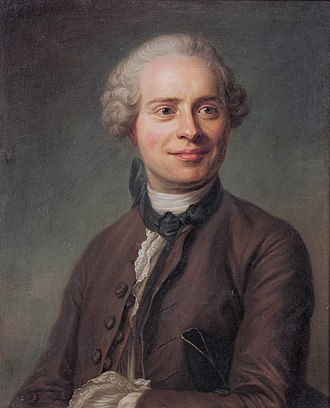
Name: Jean Le Rond d'Alembert
Nickname/Alias: Jean-Baptiste Daremberg
Achievements: A main contributor to ‘Encyclopédie’
Born: November 17, 1717; Paris, France
Died: October 29, 1783; Paris, France (Aged 65)
Field & Discipline: Mathematics; Philosophy
Language: French
Father: Louis-Camus Destouches
Mother: Mme de Tencin
Siblings: None
Spouse: None
Children: None
Education: Jansenist College des Quatre Nations, Paris to 1729-35; Law
School, 1736-38
Major Work:
'Traité de dynamique” (1743)
Life & Times:
D'Alembert was the illegitimate son of a famous hostess, Madame de Tencin and one of her lovers, the Chevalier Destouches-Canon. At the time of his birth in November 1717, Destouches was abroad and in order to free herself from the child, she abandoned the baby on the steps of the little Parisian church of St Jean le Rond.
The baby was quickly discovered and taken to the Foundlings Home, baptised Jean Le Rond and then sent out to be nursed for six weeks at Cremery in Picardy. Although never recognised by his mother, immediately upon his return to Paris Destouches took steps to find his son and entrusted him to a glazier's wife, named Madame Rousseau, whom d'Alembert always treated as his mother.
Through his father's influence, he was admitted to a prestige Jansenist school, enrolling first as Jean-Baptiste Daremberg and later changing his name to d'Alembert. Although Destouches never disclosed his identity as father of the child, he left his son an annuity of 1,200 livres when he died in 1726.
He spent two years studying law and qualified in 1738, although he never practised and, after taking up medicine for a year, he finally devoted himself to mathematics, the only occupation, he said later, which really interested him.
In 1739, aged twenty-two, d'Alembert read his first paper to the Academy of Sciences. He was made a member of the Academy two years later and in 1743 published “Traité de dynamique,” a fundamental treatise on dynamics containing the famous "d'Alembert's principle": that Newton's third law of motion is true both for both freely moving and fixed bodies.
Other mathematical works followed very rapidly and in 1744 he applied his principle to the theory of equilibrium and motion of fluids, in his “Traité de l'équilibre et du mouvement des fluides.”
D’Alembert was a Philosophe, a group of free-thinking rationalists who opposed religion and stood for tolerance and free discussion. The believed that science, the only trustworthy source of knowledge, should be made freely available, and it was in this tradition that D’Alembert became associated with [collaborated with] Diderot’s* “Encyclopédie,” in December 1745.
In the same year, he was, unusually, granted a pension by the Academy. The quality of his work was to spread his fame beyond his own country. [an admirer was] Maupertuis*, on a visit to Basle, is known to have talked to the veteran scientist [an admirer was] Daniel Bernoulli* about him.
Bernoulli was at first sceptical about the young man's powers and in September 1745, had written to another famous mathematician, [work was known to] Leonard Euler*, that d'Alembert had a “very confused grasp of principle.” By November 1746, however, he had revised his opinion sufficiently to suggest that he would be a great acquisition for the Berlin Academy.
D'Alembert’s next mathematical work concerned the development of partial differential equations, a branch of the theory of calculus, the first papers on which were published in 1747.
This won him a prize at the Berlin Academy, to which he was elected the same year. He applied his new calculus to the problem of vibrating strings, in his “Recherches sur les cordes vibrantes,” for which he gave a mathematical solution and which today still plays an important role in all branches of theoretical physics.
Two years later, d’Alembert demonstrated a method of applying his principles to the motion of any body of a given shape. He also published an explanation of the precession of the equinoxes (a gradual change in the position of the Earth's orbit), determined its characteristics, and explained the phenomenon of the oscillation of the Earth's axis, in “Recherches sur la précession des équinoxes et sur la nutation de l'axe de la terre.”
In 1746, d’Alembert met the scientist [met] Buffon*. The writer [helped by] Montesquieu* was at one of the salons d’Alembert frequented and it was largely through d'Alembert's efforts that he was persuaded to write for the Encyclopedie.
From 1749 on, D'Alembert was also invited to the dinners of d' [a pal of] Holbach* where he frequently met [knew] Rousseau* but the pair later fell out over over a controversy between Rousseau and another of d'Alembert's friends, [a pal of] Hume*.
In 1753 d'Alembert published a different kind of work. His literary and philosophical activity with the “Encyclopedie” led to his “Mélanges de littérature, d'histoire et de philosophie,” which contained the impressive “Essai sur les gens de lettres.” This exhorted writers to pursue "liberty, truth and poverty" and also urged aristocratic patrons to respect the talents and independence of such writers.
In his “Recherches sur différents points importants du système du monde” (1754-56) he perfected the solution of a problem of the variations of planetary orbit that he had presented to the Academy some years before. In 1754, d’Alembert was elected to the French Academy, where one of his roles was to write biographies of any members deceased between 1700 and 1772.
1757 saw "Genève" published, which contained information he had collected while staying at Ferney with Voltaire* the previous year about the practices of Genevan pastors.
D’Alembert was popular in royal circles and [was admired by] Frederick the Great* of Prussia was insistent on him taking the role as president of the Berlin Academy. He politely declined. In 1762, he also refused the post of tutor to the son of [refused job offer from] Catherine the Great* of Russia.
In 1765 France expelled the Jesuits, which gave rise to his “Sur la destruction des Jésuites en France” in 1766, in which d’Alembert blamed their demise on their power politics.
At this time, d’Alembert moved to an apartment at the Louvre, which was his right as secretary of the Academy and it was here that he died, on 29th October 1783.
Extra Connections: Was a friend of [a pal of] Condorcet*.
He was in love with Julie de [in love with] Lespinasse*
He knew Mme du [knew] Deffand*
Mde Pompadour defended Diderot and Encyclopedia
Assessment: As a “philosophical” scientist, he established the principle of the interconnectivity of various branches of science.
Oneliner: Jean le Rond d’Alembert, French mathematician
Bibliography:
- Grimsley, Ronald, “Jean d'Alembert, 1717-83,” Oxford: Clarendon Press, 1963.
Jean le Rond d'Alembert - Wikipedia