Anacreon
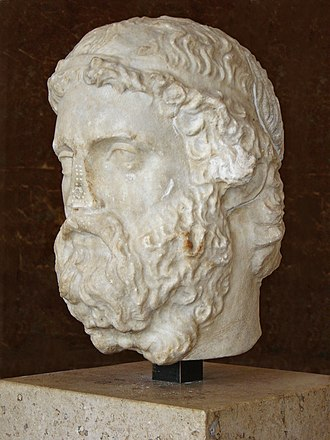
Achievements: Ancient Greek poet, one of the most important lyric poets in the Ionic dialect.
Born: c. 570 BC; Teos, Ionia (now Sighajik, Turkey)
Died: c. 485; Athens, Greece (Aged around 85)
Field & Discipline: Literature; Poetry
Language: Greek
Father: Unknown
Siblings: Unknown
Spouse: Unknown
Children: Unknown
Education: Unknown
Major Work:
Fragments of verse only
Life & Times:
Anacreon was born c. 570 B.C. in Teos, an Ionian city in Asia Minor. His life was frequently affected by the political instability of the time, and around 540 BC, when the Persians attacked the Greek coastal towns of Asia Minor and began to overrun Ionia, he fled with many other Teians to Thrace, where they founded the town of Abdera.
There, Anacreon made his name as a poet, and was invited by Polycrates of Samos (reigned 533-22 BC) to his court to teach his son poetry and music. Anacreon moved to Samos and from this point his career as a poet was mainly associated with the courts of tyrants, who were important patrons of art and literature in the 6th century BC. Reports from Strabo and Herodotus suggest that Anacreon and Polycrates were close friends and allies, but there remains very little poetry by Anacreon on the subject of Samian politics or public events. Instead, his verses relate a life of pleasure and private parties.
Anacreon stayed in Samos until the murder of Polycrates in 522 BC. He then moved to Athens, at the request of another tyrant Hipparchus, son of Pisistratus, who is said to have sent a fifty-oared galley to collect him.
In Athens he quickly became a popular figure, and continued to write songs on wine, love and the pleasures of life. Again, a political change altered his life again when, in 514 BC Hipparchus was assassinated, and although Anacreon may have remained in Athens for a period, it seems more likely that he fled to Thessaly, where he wrote two pieces on behalf of the Thessalian king Echecratidas and his queen.
The evidence suggests that Anacreon then returned to Athens under the democracy, and probably lived to the age of 85, well beyond the normal human lifespan of that time, dying in c. 485 BC from choking on a grape-pip. His body was buried in a tomb at Teos.
Immediately after his death, Anacreon became a symbolic figure of pleasure and human folly in Greek popular culture, as illustrated by a series of Attic vase paintings manufactured between 490 and 450 BC.
The Alexandrian scholar Aristarchus later edited Anacreon's poems into five books, all written in the Ionic Greek dialect. Only a few complete poems survive, mostly in the quotations of later writers, and although Anacreon may well have written serious poems, most of his surviving fragments are from poems composed in smooth, simple language and speaking of of love, wine and revelry. His lyrics included hymns and choral songs for girls and love songs and poems lamenting the passing of youth, and often contain an ironic enjoyment of life.
Anacreon was the successor to the work of poets Lesbos, Alcaeus and Sappho, but his poems have little of their intensity or passion, and instead, serious emotion is replaced by an urbane, witty attitude. But he was not the festive drunkard of tradition, a reputation due to his many Hellenistic and Byzantine imitators whose “Anacreontea” (a collection of 60 short poems composed by post-classical Greek writers at various dates and first published in modern times at Paris by [re-discovered by] Henri II Estienne* in 1554 as the work of Anacreon) exaggerated the drunken eroticism and frivolity in his work, and substituted sugary, though sometimes charming, frivolity for the graceful freshness of the original.
While the original poems by Anacreon had some influence on the poet Horace, it was the imitation-Anacreontic verse which was most influential on Renaissance French poetry, and was largely responsible for Anacreon's popularity in European literature in the 17th and 18th centuries.
The word "anacreontic" was first used in England in 1656 by Abraham Cowley to describe a verse measure supposedly used by Anacreon, and consisting of seven or eight syllables with three or four main stresses. Poets Robert Herrick, William Oldys, and William Shenstone wrote original anacreontics in English, and Thomas Moore provided perhaps the finest translation of the “Anacreontea” in 1800 under the title “Odes of Anacreon.”
The “Anacreontea” influenced Italian and German literature, particularly inspiring the work of several 18th-century German poets, as well as the late 18th-century British composer [inspired] JS Smith*, who wrote "To Anacreon in Heaven," a drinking song of the Anacreontic Society of London, the melody of which was later (1814) adapted to [work related to] Key's* “The Star-Spangled Banner” as the national anthem of the United States of America.
Assessment: An ancient Greek poet.
Oneliner: Anacreon, Ancient Greek poet
Bibliography:
- Collier’s Encyclopedia.
- Encyclopedia Britannica.
- Rosenmeyer, Patricia A., The Poetics of Imitation: Anacreon and the Anacreontic Tradition, Cambridge & New York: CUP, 1992.