Lillie Langtry
Emilie Charlotte, Lady de Bathe (née Le Breton, formerly Langtry; 13 October 1853 – 12 February 1929), known as Lillie (or Lily) Langtry and nicknamed "The Jersey Lily," was a British socialite, stage actress and producer.[1]^
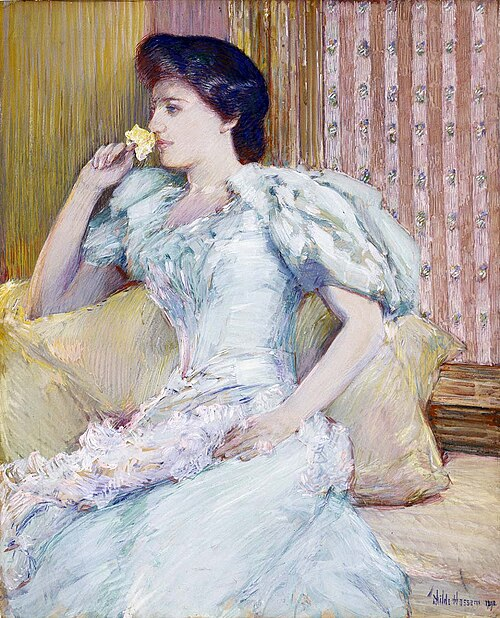
Born and raised on the island of Jersey, she moved to London in 1876, two years after marrying. Her looks and personality attracted interest, commentary, and invitations from artists and society hostesses, and she was celebrated as a young woman of great beauty and charm. During the aesthetic movement in England, she was painted by aesthete artists. In 1882, she became the poster-girl for Pears soap, and thus the first celebrity to endorse a commercial product.[1][2]
In 1881, Langtry became an actress and made her West End debut in the comedy She Stoops to Conquer, causing a sensation in London by becoming the first socialite to appear on stage.[3]^ She starred in many plays in both the United Kingdom and the United States, including The Lady of Lyons, and Shakespeare's As You Like It. Eventually she ran her own stage production company. In later life she performed "dramatic sketches" in vaudeville. From the mid-1890s until 1919, Langtry lived at Regal Lodge at Newmarket in Suffolk, England, where she maintained a successful horse racing stable. The Lillie Langtry Stakes horse race is named after her.
Considered one of the most glamorous British women of her era, Langtry was the subject of widespread public and media interest. Her acquaintances in London included Oscar Wilde, who encouraged Langtry to pursue acting. She was known for her relationships with royal figures and noblemen, including Albert Edward, Prince of Wales (the future King Edward VII), Lord Shrewsbury, and Prince Louis of Battenberg.
Langtry remains somewhat of an enigmatic personality despite having lived a public life as a ‘professional beauty’, royal mistress, actress, and racehorse owner. Opinions about her are contradictory. To some, she was simply a calculating and cold-hearted while to others she appeared charming and open.[4]^
Early life

Portrait of Langtry by Frank Miles, before 1891
Born in 1853 and known as Lillie from childhood, Emilie was the daughter of the Very Reverend William Corbet Le Breton and his wife Emilie Davis (née Martin).[5]^ Lillie's parents had eloped to Gretna Green in Scotland, and, in 1842, married at St Luke's Church, Chelsea, London.[6]^ The couple had lived in Southwark, London, before William was offered the post of rector and Dean of Jersey.
Lillie was born at the Old Rectory, St Saviour, on Jersey, and was baptised in St Saviour on 9 November 1853.[7]^
Lillie was the sixth of seven children and the only girl. Her brothers were Francis Corbet Le Breton (1843–1872), William Inglis Le Breton (1846–1924), Trevor Alexander Le Breton (1847–1870), Maurice Vavasour Le Breton (1849–1881), Clement Martin Le Breton (10 January 1851 – 1 July 1927), and Reginald Le Breton (1855–1876). Purportedly, one of their ancestors was Richard le Breton, allegedly one of the assassins in 1170 of Thomas Becket.[8]^
In an 1882-interview Lillie said: 'Yes, I was born and educated in Jersey, but it is not correct for you to say that I spent my bread-and-butter days there. I never had any bread-and-butter days. As the only sister of six stout brothers I shared their outdoor sports in a most boyish fashion. It would be more accurate to describe my girlhood as my "tomboy days," I think.'[9]^
Lillie's French governess was reputed to have been unable to manage her, so Lillie was educated by her brothers' tutor. This education was of a wider and more solid nature than that typically given to girls at that time.[10]^ Although their father held the respectable position of Dean of Jersey, he earned an unsavoury reputation as a philanderer, and fathered illegitimate (or natural) children by various of his parishioners. When his wife Emilie finally left him in 1880, he left Jersey.[11]^
Life in London

The yacht Red Gauntlet, owned by Edward Langtry, Lillie's husband.
On 9 March 1874, 20-year-old Lillie married 26-year-old Edward ‘Ned’ Langtry (1847–1897), a landowner from Ulster in the north of Ireland. Langtry was the widower of Jane Frances Price,[12]^ whose sister, Elizabeth Ann Price, was the wife of Lillie's brother William.[13]^ Lillie and Edward held their wedding reception at The Royal Yacht Hotel in St Helier, Jersey. Ned Langtry owned a large sailing yacht called Red Gauntlet, and Lillie insisted that he take her away from the Channel Islands.[14]^ In 1876 they rented an apartment in Eaton Place, Belgravia, London.[15]^
...
Another guest, Sir John Everett Millais, also a Jersey native, eventually painted her portrait, titling it A Jersey Lily after the Jersey lily flower (Amaryllis belladonna), a symbol of the country. The portrait popularised Jersey Lily as Langtry's nickname,[24]^ although Langtry was portrayed holding a Guernsey lily (Nerine sarniensis) in the painting, as no Jersey lilies were available.[25]^ According to tradition, the two Jersey natives spoke Jèrriais during the sittings. The painting attracted great interest when exhibited at the Royal Academy and had to be roped off to avoid damage by the crowds.[24]^ A friend of Millais, Rupert Potter (father of Beatrix Potter), was a keen amateur photographer and took pictures of Lillie during her visit to Millais in Scotland in 1879.[25]^ She also sat for Sir Edward Poynter and is depicted in works by Sir Edward Burne-Jones. In early 1878, the Langtrys moved to 17 Norfolk Street (now 19 Dunraven Street) off Park Lane to accommodate the growing demands of Lillie's society visitors.[15]^
Lillie Langtry arrived in the late 1870s, the heyday of 'the Professional Beauties'. Margot Asquith later explained that Langtry's youth was the time 'of the great beauties. London worshipped beauty like the Greeks'.[26]^ According to Asquith, Langtry became the centre of a social excitement excelling that around the other 'Beauties'. '"The Jersey Lily" – as Mrs. Langtry was called – had Greek features, a transparent skin, arresting eyes, fair hair, and a firm white throat. She held herself erect, refused to tighten her waist, and to see her walk was as if you saw a beautiful hound set upon its feet. It was a day of conspicuous feminine looks and the miniature beauties of to-day would have passed with praise, but without emotion.'[27]^
Her looks offered an opportunity for painters: '[m]y sketches of Lillie during her first London season', wrote Miles twenty years later, 'earned far more than I've ever made on the largest commissions for my most expensive paintings.' Lillie gained recognition for her photographic likenesses, a relatively new art. The 'Professional Beauties', all members of high society, were photographed in many different poses. The popularity of collecting these pictures – foreshadowing the popularity of first film stars and later pop stars – was not confined to the middle classes. Also many an aristocratic drawing room had a leather-bound, brass-locked album featuring the faces of the "Professional Beauties" of the season.[28]^
Asquith heard from her sister, Chartie Ribblesdale, about a ball at which ‘several fashionable ladies had stood upon their chairs to see Mrs. Langtry come into the room. In a shining top-hat, and skin-tight habit, she rode a chestnut thoroughbred of conspicuous action every evening in Rotten Row. Among her adorers were the Prince of Wales, (King Edward) and the present Earl of Lonsdale.’ Ribblesdale also remembered a story about Langtry and Lonsdale ‘paus[ing] at the railings in Rotten Row to talk to a man of her acquaintance. I do not know what she could have said to him, but after a brief exchange of words, Lord Lonsdale jumped off his horse, sprang over the railings, and with clenched fists hit Mrs. Langtry's admirer in the face. Upon this, a free fight ensued, and to the delight of the surprised spectators, Lord Lonsdale knocked his adversary down.'[27]^
Recollections of Daisy Greville, Countess of Warwick
"In the studio I found the loveliest woman I have ever seen. And how can any words of mine convey that beauty? I may say that she had dewy, violet eyes, a complexion like a peach, and a mass of lovely hair drawn back in a soft knot at the nape of her classic head. But how can words convey the vitality, the glow, the amazing charm, that made this fascinating woman the centre of any group that entered? She was in the freshness of her young beauty that day in the studio. She was poor, and wore a dowdy black dress, but my stepfather lost his heart to her [...] The friends we had invited to meet the lovely Lily Langtry were as willingly magnetised by her unique personality as we were. To show how little dress has to do with the effect she produced, I may say that for that evening she wore the same dowdy black dress as on the previous day, merely turned back at the throat and trimmed with a Toby frill of white lisse, as some concession to the custom of evening dress. Soon we had the most beautiful woman of the day down at Easton, and my sisters and myself were her admiring slaves. [...] [M]y own infatuation, for it was little less, for lovely Lily Langtry continued for many a day... [...] The average of good looks to-day is much higher, but there is none to equal Lily Langtry."[29]^
The royal biographer Theo Aronson has highlighted the importance of social changes that formed the backdrop of Langtry's success. In the late 1870s, high society became less exclusive following the example of the Prince of Wales, who preferred the company of 'very rich men', regardless of whether they had an aristocratic lineage. By the time Langtry was introduced, '[b]usiness acumen, beauty and, to a lesser extent, brains were becoming enough to get one accepted'. This 'opening-up' partially explains the success of Langtry. While she was not an aristocrat and would not have been welcomed during previous decades, her husband was a wealthy landowner and her father, as a clergyman, counted on the same level as landed gentry. Her behaviour was in line with aristocratic expectations: 'her air, despite her vivacity and sensuality, was well-bred: she knew how to conduct herself in public'.[30]^
In 1878, Langtry attracted a lot of attention during the Ascot races, being 'at the height of her beauty and fame'. Crowds followed her everywhere she went, and she became 'the most advertised beauty in Europe'. According to Lady Augusta Fane's recollections, Langtry was made so popular by her 'naturalness' and charm; 'she had no affectations and no "make-up," either of face or mind; she was just herself, so no one could help loving her, with her gay, light-hearted nature'.[31]^ However, there was another reason why Langtry attracted so much attention in 1878: the Prince of Wales was often seen in public with her.
Royal mistress

Portrait of Langtry by William Downey of Ebury Street, London, 1885

Cupboard in Langtry Manor Hotel - 2010
On 24 May 1877, while his wife was staying in Athens with her brother, King George I of the Hellenes, Albert Edward, Prince of Wales, took supper with the Arctic explorer Sir Allen Young. There, he met Edward and Lillie Langtry. The 23-year-old Lillie had been discovered only a month earlier but had already taken London society by storm. It was soon presumed that Langtry had become the mistress of the Prince of Wales, but no immediate scandal arose. The Prince's wife, Alexandra of Denmark, accepted the situation and received her at parties in Marlborough House, the couple's London residence.[32]^
However, there are some doubts. Jane Ridley has questioned the myth which Lillie Langtry created about herself, especially the role of the future Edward VII. She critiques Langtry's narrative of herself as an innocent country girl to whom success just happened. Ridley considers Langtry's entrance to London society to have been carefully planned, even if more successful than she could have hoped. In an 1882 interview, Langtry herself said that '[m]y pedigree was good and my person in Jersey society being assured, it was not surprising that I should be well-received'. At the same time, she denied that she had ever set herself up as a beauty. 'I never thought I was one, and I don't think I am now. I am never in the least surprised when I hear people say they are very much disappointed about my beauty'.[33]^
Ridley also expressed doubts on the nature of Langtry's relationship with the Prince of Wales. No letters from this time have survived,[34]^ and many of the stories seem to be exaggerated or wrong. For example, Langtry is alleged to have consummated her relationship with Prince Edward when his wife, Alexandra, refused to accompany him to a royal house party at Crichel in January 1878. In fact, Alexandra played a central role at this event.[35]^
According to Ridley, Langtry published a false story about her presentation at court to Queen Victoria. Langtry alleged that despite being presented towards the end of the evening, by when the Queen had usually retired, Victoria waited to see her. At a ball later that night, she was supposedly told that the Queen had 'had a great desire to see [her], and had stayed on in order to satisfy herself as to [Langtry's] appearance. It was even added that she was annoyed because [she] was so late in passing'.[36]^ Ridley concludes that this anecdote was made up by Langtry, as she alleged the presence of the Prince and Princess of Wales, who were in Paris at the time, probably on purpose to avoid embarrassing them by presenting the alleged mistress of Bertie.[37]^
In Ridley's view, Langtry invented stories implying that she was recognised as royal mistress.[38]^ Langtry Manor in Bournemouth, supposedly built for clandestine meetings between the Prince and Lillie at his orders, was in fact built for Emily Langton Langton.[39]^
Ridley could find no evidence about the exact nature of the relationship between Lillie Langtry and the Prince of Wales. However, there is correspondence between the Prince's private secretary, Francis Knollys, and the Prince's solicitor, George Lewis, which suggests that Edward Langtry used George Lewis as a broker, offering his silence and cash in exchange for the Prince's love letters. Lewis kept Knollys closely informed about the death of Edward Langtry in 1897. The Prince of Wales, meanwhile, maintained a lifelong friendship with Lillie.[40]^
Whatever it exactly was, Lillie's liaison with the Prince lasted from late 1877 to June 1880.[41][42]^
The Shrewsbury scandal
In July 1879, Langtry began an affair with Lord Shrewsbury; by January 1880, they were planning to run away together.[43]^ In the autumn of 1879, Adolphus Rosenberg wrote in Town Talk of rumours that her husband would divorce her and cite, among others, the Prince of Wales as co-respondent. The Prince of Wales instructed his solicitor George Lewis to sue. Rosenberg pleaded guilty and was sentenced to two years in prison.[44]^

Original poster - on show in Langtry Manor House in 2010.
In 1880, Langtry's reputation was tarnished by the Shrewsbury scandal, rumours of divorce, and a secret pregnancy. Many people refused to receive her, and with the withdrawal of royal favour, creditors started demanding their money. The Langtrys' finances were not equal to their lifestyle. In October 1880, Langtry sold many of her possessions to meet her debts, allowing him to avoid a declaration of bankruptcy.[45]^ Lillie went abroad to give birth. Afterwards, the Prince of Wales, staunch in friendship, procured an opening for her: he introduced her to the actor-manager Squire Bancroft, who controlled the Haymarket Theatre and the Prince of Wales’ theatres. The Prince of Wales encouraged her by visiting the theatre while she was on stage and did everything in his power to help her.[46]^
Daughter
Lillie Langtry had a short affair with Prince Louis of Battenberg from March 1880.[47]^
Letters from Lillie to Arthur Clarence Jones (1854–1930) give the impression she also had an affair, or at least an intimate friendship, with Jones, a childhood friend of her brothers who lived on Jersey. Arthur Jones was the brother of Lillie's sister-in-law; both were illegitimate children of Lord Ranelagh.[48]^
In June 1880, Lillie became pregnant. Her husband was not the father; Edward Langtry had walked out after a libel case. The obvious candidate was Prince Louis of Battenberg. Jane Ridley compared the dates with the diary of the Prince of Wales: Prince Louis was staying at Marlborough House on June 27, the likely conception date. Lillie led Prince Louis to believe he was the father of her child. She was lent £2000 by the Prince of Wales to pay her debts.
At the same time, Edward Langtry, who often visited unannounced, was prevented from seeing her. Edward was constantly occupied with invitations to shoot or fish. Keeping him in ignorance of the pregnancy was vital, as he was angry and resentful. The concern was that if he discovered that Lillie was pregnant by another man, he might sue for divorce, dragging the Prince of Wales into the law courts.
Lillie spent the summer holiday in Jersey. One Friday in October, by now four months pregnant, she visited London briefly and saw the Prince of Wales. On 17 October, the Prince met with his doctor, Oscar Clayton, and saw Louis Battenberg. The same day, Louis departed on a two-year voyage round the world on the warship HMS *Inconstant*. Lillie was spirited away to France. On 8 March 1881 she gave birth to a girl named Jeanne Marie.[49]^
The moment it became clear that Lillie was pregnant, Battenberg's parents acted promptly. An aide-de-camp was sent from the German Jugenheim to arrange a financial settlement. Louis was told that there could be no question of marriage. Suddenly, the Admiralty found an appointment for Louis Mountbatten on The Inconstant. The passionate affair was ended before the child was born and with Louis Battenberg out of the way.[50]^
The discovery in 1978 of Langtry's letters to Arthur Jones and publication of quotations from them by Laura Beatty in 1999 support the idea that Jones was the father of Langtry's daughter. Possibly, she told him he was the father of the child. In a letter, she pressed Jones to go a chemist to buy potions to make her miscarry. During her pregnancy she wrote him passionately written letters and assured him how much she needed him. Jones probably stayed with her in Paris after she wrote him a letter with the dates she would give birth, according to her doctor.[51]^
Prince Louis' son, Earl Mountbatten of Burma, however, had always maintained that his father was the father of Jeanne Marie.[52][53]
Jeanne Marie was only told who her father was by Margot Asquith when she was 20 years old.[54]^ A story around this discovery tells that Jeanne Marie complained bitterly of her illegitimacy. She was asked sharply by her mother, 'Who would you prefer to have as a father, a penniless drunken Irishman or a Royal Prince and the most handsome of all naval officers?'[55]...^