Edward VII
Edward VII (Albert Edward; 9 November 1841 – 6 May 1910) was King of the United Kingdom and the British Dominions, and Emperor of India, from 22 January 1901 until his death in 1910.
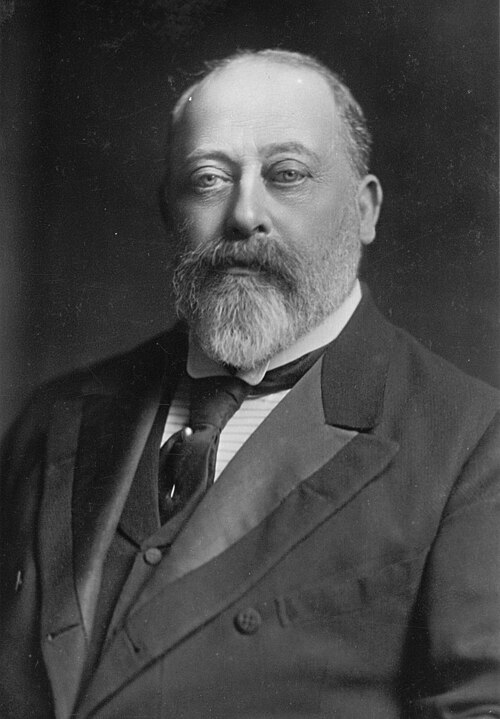
The second child and eldest son of Queen Victoria and Prince Albert of Saxe-Coburg and Gotha, Edward, nicknamed "Bertie", was Prince of Wales and heir apparent to the British throne for almost 60 years. During his mother's long reign, he was largely excluded from political influence and came to personify the leisured elite. He married Princess Alexandra of Denmark in 1863; the couple had six children. As Prince of Wales, Edward travelled throughout Britain performing ceremonial public duties and represented Britain on visits abroad. His tours of North America in 1860 and of the Indian subcontinent in 1875 proved popular successes. Despite this public approval, his reputation as a playboy prince soured his relationship with his mother.
Edward inherited the throne on his mother's death in 1901. He proved to be an effective constitutional monarch whose reign strengthened the popularity of the British monarchy. He played a role in the modernisation of the British Home Fleet and the reorganisation of the British Army after the Second Boer War of 1899 to 1902. He re-instituted traditional ceremonies as public displays and broadened the range of people with whom royalty socialised. He fostered good relations between Britain and other European countries, especially France, for which he was popularly called "Peacemaker", but his relationship with his nephew, German Emperor Wilhelm II, was poor.
The Edwardian era, which covered Edward's reign and was named after him, coincided with the start of a new century and heralded significant changes in technology and society, including steam turbine propulsion and the rise of socialism. Edward died in the midst of a constitutional crisis that was resolved by the Parliament Act 1911, which restricted the power of the unelected House of Lords. Edward was succeeded as king by his only surviving son, George V.
Early life and education

The Christening of the Prince of Wales in St. George's Chapel, Windsor, 25 January 1842

Portrait of Edward by Franz Xaver Winterhalter, 1846
Edward was born at 10:48 am on 9 November 1841 at Buckingham Palace, London,[1]^ the eldest son and second child of Queen Victoria and her husband, Prince Albert of Saxe-Coburg and Gotha. He was christened Albert Edward at St George's Chapel, Windsor Castle, on 25 January 1842.[a]^ He was named Albert after his father and Edward after his maternal grandfather, Prince Edward, Duke of Kent and Strathearn. He was known as "Bertie" to the royal family throughout his life.[3]^
The Queen and Prince Albert were determined that their eldest son should have an education that would prepare him to be a model constitutional monarch. At age seven, Edward embarked on a rigorous educational programme devised by Albert, and supervised by several tutors. Unlike his elder sister Victoria, he did not excel in his studies.[4]^ He tried to meet the expectations of his parents, but to no avail. Although Edward was not a diligent student – his true talents were those of charm, sociability and tact – Benjamin Disraeli described him as informed, intelligent and of sweet manner.[5]^ After the completion of his secondary-level studies, his tutor Frederick Waymouth Gibbs was replaced by Robert Bruce as his personal governor.[6]^
After an educational trip to Rome, undertaken in the first few months of 1859, Edward spent the summer of that year studying at the University of Edinburgh under, among others, the chemist Lyon Playfair. In October, he matriculated as an undergraduate at Christ Church, Oxford.[7]^ Now released from the educational strictures imposed by his parents, he enjoyed studying for the first time and performed satisfactorily in examinations.[8]^ In 1861, he transferred to Trinity College, Cambridge,[9]^ where he was tutored in history by Charles Kingsley, Regius Professor of Modern History.[10]^ Kingsley's efforts brought forth the best academic performances of Edward's life, and Edward actually looked forward to his lectures.[11]^
Early adulthood

Edward and his entourage at Niagara Falls, 1860

Edward in 1862
In 1860, Edward undertook the first tour of North America by a Prince of Wales. His genial good humour and confident bonhomie made the tour a great success.[12]^ He inaugurated the Victoria Bridge, Montreal, across the St Lawrence River, and laid the cornerstone of Parliament Hill, Ottawa. He watched Charles Blondin traverse Niagara Falls by highwire, and stayed for three days with President James Buchanan at the White House.
Buchanan accompanied the prince to Mount Vernon, to pay his respects at the tomb of George Washington. Vast crowds greeted Edward everywhere. He met Henry Wadsworth Longfellow, Ralph Waldo Emerson and Oliver Wendell Holmes Sr. Prayers for the royal family were said in Trinity Church, New York, for the first time since 1776.[12]^ The four-month tour throughout Canada and the United States considerably boosted Edward's confidence and self-esteem, and had many diplomatic benefits for Great Britain.[13]^
Edward had hoped to pursue a career in the British Army, but his mother vetoed an active military career.[14]^ He had been gazetted colonel on 9 November 1858[15]^ – to his disappointment, as he had wanted to earn his commission by examination.[8]^ In September 1861, he was sent to Germany, supposedly to watch military manoeuvres, but actually in order to engineer a meeting between him and Princess Alexandra of Denmark. The Queen and Prince Albert had already decided that Edward and Alexandra should marry. They met at Speyer on 24 September under the auspices of Edward's elder sister, Victoria, who had married the Crown Prince of Prussia in 1858.[16]^ Princess Victoria, acting upon instructions from her mother, had met Alexandra at Strelitz in June; Alexandra made a very favourable impression. She and Edward were friendly from the start, and marriage plans advanced.[17]^
Edward gained a reputation as a playboy. Determined to get some army experience, he attended manoeuvres in Ireland, during which he spent three nights with an actress, Nellie Clifden, who was hidden in the camp by his fellow officers.[18]^ Albert, though ill, was appalled and visited Edward at Cambridge to issue a reprimand. Albert died in December 1861, just two weeks after the visit. The Queen was inconsolable, wore mourning clothes for the rest of her life and blamed Edward for his father's death.[19]^ At first, she regarded her son with distaste as frivolous, indiscreet and irresponsible. She wrote to her eldest daughter, "I never can, or shall, look at him without a shudder."[20]^
Marriage
Main article: Wedding of Prince Albert Edward and Princess Alexandra
Once widowed, the Queen effectively withdrew from public life. Shortly after Prince Albert's death, she arranged for Edward to embark on an extensive tour of the Middle East, visiting Egypt, Jerusalem, Damascus, Beirut and Istanbul.[21]^ The British government wanted Edward to secure the friendship of Egypt's ruler, Said Pasha, to prevent French control of the Suez Canal if the Ottoman Empire collapsed. It was the first royal tour on which an official photographer, Francis Bedford, was in attendance.
As soon as Edward returned to Britain, preparations were made for his engagement, which was sealed at Laeken in Belgium on 9 September 1862.[22]^ Edward married Alexandra at St George's Chapel, Windsor Castle, on 10 March 1863. He was 21; she was 18.
...
"Uncle of Europe"

Relaxing at Balmoral Castle, photograph by Queen Alexandra
As King, Edward's main interests lay in the fields of foreign affairs and naval and military matters. Fluent in French and German, he reinvented royal diplomacy by numerous state visits across Europe.[79]^ He took annual holidays in Biarritz and Marienbad.[52]^ One of his most important foreign trips was an official visit to France in May 1903 as the guest of President Émile Loubet. Following a visit to Pope Leo XIII in Rome, this trip helped create the atmosphere for the Anglo-French Entente Cordiale, an agreement delineating British and French colonies in North Africa, and ruling out any future war between the two countries. The Entente was negotiated in 1904 between the French foreign minister, Théophile Delcassé, and the British foreign secretary, Lord Lansdowne. It marked the end of centuries of Anglo-French rivalry and Britain's splendid isolation from Continental affairs, and attempted to counterbalance the growing dominance of the German Empire and its ally, Austria-Hungary.[80]^
Edward was related to nearly every other European monarch, and came to be known as the "uncle of Europe".[34]^ German Emperor Wilhelm II and Emperor Nicholas II of Russia were his nephews; Queen Victoria Eugenia of Spain, Crown Princess Margaret of Sweden, Crown Princess Marie of Romania, Crown Princess Sophia of Greece, and Empress Alexandra of Russia were his nieces; King Haakon VII of Norway was both his nephew and his son-in-law; kings Frederick VIII of Denmark and George I of Greece were his brothers-in-law; kings Albert I of Belgium, Ferdinand I of Bulgaria, and Carlos I and Manuel II of Portugal were his second cousins. Edward doted on his grandchildren, and indulged them, to the consternation of their governesses.[81]^ However, there was one relation whom Edward did not like: Wilhelm II. His difficult relationship with his nephew exacerbated the tensions between Germany and Britain.[82]^
In April 1908, during Edward's annual stay at Biarritz, he accepted the resignation of British Prime Minister Sir Henry Campbell-Bannerman. In a break with precedent, Edward asked Campbell-Bannerman's successor, H. H. Asquith, to travel to Biarritz to kiss hands. Asquith complied, but the press criticised the action of the King in appointing a prime minister on foreign soil instead of returning to Britain.[83]^ In June 1908, Edward became the first reigning British monarch to visit the Russian Empire, despite refusing to visit in 1906, when Anglo-Russian relations were strained in the aftermath of the Russo-Japanese War, the Dogger Bank incident, and the Tsar's dissolution of the Duma.[84]^ The previous month, he visited the Scandinavian countries, becoming the first British monarch to visit Sweden.[85]^
Political opinions

Portrait in naval uniform by Vanity Fair magazine, 1902

Edward VII on British 1-penny stamp of 1902
While Prince of Wales, Edward had to be dissuaded from breaking with constitutional precedent by openly voting for W. E. Gladstone's Representation of the People Bill (1884) in the House of Lords.[8][86]^ On other matters, he was more conservative; for example, he did not favour giving votes to women,[8][87]^ although he did suggest that the social reformer Octavia Hill serve on the Commission for Working Class Housing.[88]^ He was also opposed to Irish Home Rule, instead preferring a form of dual monarchy.[8]^
As Prince of Wales, Edward had come to enjoy warm and mutually respectful relations with Gladstone, whom his mother detested,[89]^ but the statesman's son, Home Secretary Herbert Gladstone, angered the King by planning to permit Roman Catholic priests in vestments to carry the Host through the streets of London, and by appointing two ladies, Lady Frances Balfour and May Tennant (wife of H. J. Tennant), to serve on a Royal Commission on reforming divorce law – Edward thought divorce could not be discussed with "delicacy or even decency" before ladies. Edward's biographer Philip Magnus suggests that Gladstone may have become a whipping boy for the King's general irritation with the Liberal government. Gladstone was sacked in the reshuffle the following year and the King agreed, with some reluctance, to appoint him Governor-General of South Africa.[90]^
Edward involved himself heavily in discussions over army reform, the need for which had become apparent with the failings of the Second Boer War.[91]^ He supported the redesign of army command, the creation of the Territorial Force, and the decision to provide an Expeditionary Force supporting France in the event of war with Germany.[92]^ Reform of the Royal Navy was also suggested, partly due to the ever-increasing Naval Estimates, and because of the emergence of the Imperial German Navy as a new strategic threat.[93]^ Ultimately a dispute arose between Admiral Lord Charles Beresford, who favoured increased spending and a broad deployment, and the First Sea Lord Admiral Sir John Fisher, who favoured efficiency savings, scrapping obsolete vessels, and a strategic realignment of the Royal Navy relying on torpedo craft for home defence backed by the new dreadnoughts.[94][95]^
The King lent support to Fisher, in part because he disliked Beresford, and eventually Beresford was dismissed. Beresford continued his campaign outside of the navy and Fisher ultimately announced his resignation in late 1909, although the bulk of his policies were retained.[96]^ The King was intimately involved in the appointment of Fisher's successor as the Fisher-Beresford feud had split the service, and the only truly qualified figure known to be outside of both camps was Sir Arthur Wilson, who had retired in 1907.[97]^ Wilson was reluctant to return to active duty, but Edward persuaded him to do so, and Wilson became First Sea Lord on 25 January 1910.[98]^
...
Death
Main article: Death and state funeral of Edward VII

Deathbed photograph, May 1910
Duration: 3 minutes and 51 seconds.3:51Funeral procession of Edward VII, London, 1910
Edward habitually smoked twenty cigarettes and twelve cigars a day. In 1907, a rodent ulcer, a type of cancer affecting the skin next to his nose, was cured with radium.[117]^ Towards the end of his life he increasingly suffered from bronchitis.[8]^ He suffered a momentary loss of consciousness during a state visit to Berlin in February 1909.[118]^ In March 1910, he was staying at Biarritz when he collapsed. He remained there to convalesce, while in London Asquith tried to get the Finance Bill passed. The King's continued ill health was unreported, and he attracted criticism for staying in France while political tensions were so high.[8]^ On 27 April he returned to Buckingham Palace, still suffering from severe bronchitis. Alexandra returned from visiting her brother, George I of Greece, in Corfu a week later on 5 May.
On 6 May, Edward suffered several heart attacks, but refused to go to bed, saying, "No, I shall not give in; I shall go on; I shall work to the end."[119]^ Between moments of faintness, his son the Prince of Wales (shortly to be King George V) told him that his horse, Witch of the Air, had won at Kempton Park that afternoon. The King replied, "Yes, I have heard of it. I am very glad": his final words.[8]^ At 11:30 pm he lost consciousness for the last time and was put to bed. He died 15 minutes later, aged 68.[119]^
Alexandra refused to allow Edward's body to be moved for eight days afterwards, though she allowed small groups of visitors to enter his room.[120]^
On 11 May, the late king was dressed in his uniform and placed in a massive oak coffin, which was moved on 14 May to the throne room, where it was sealed and lay in state, with a guardsman standing at each corner of the bier. Despite the time that had elapsed since his death, Alexandra noted his body remained "wonderfully preserved".[121]^ On the morning of 17 May, the coffin was placed on a gun carriage and drawn by black horses to Westminster Hall, with the new king, his family and Edward's favourite dog, Caesar, walking behind. Following a brief service, the royal family left, and the hall was opened to the public; over 400,000 people filed past the coffin over the next two days.[122]^ As Barbara W. Tuchman noted in The Guns of August, his funeral, held on 20 May 1910, marked "the greatest assemblage of royalty and rank ever gathered in one place and, of its kind, the last". A royal train conveyed the King's coffin from London to Windsor Castle, where Edward was buried at St George's Chapel.[123]^
Legacy
Further information: Cultural depictions of Edward VII and Royal eponyms in Canada

Statue in Queen Victoria Gardens, Melbourne

Statue outside Holyrood Palace, Edinburgh

Statue of Edward VII, Bangalore, India
Statues of Edward can be found throughout the former empire.
Before his accession to the throne, Edward was the longest-serving heir apparent in British history. He was surpassed by his great-great-grandson Charles III on 20 April 2011.[124]^ The title Prince of Wales is not automatically held by the heir apparent; it is bestowed by the reigning monarch at a time of their choosing.[125]^ Edward was the longest-serving holder of that title until surpassed by Charles on 9 September 2017.[126]^ Edward was Prince of Wales between 8 December 1841 and 22 January 1901 (59 years, 45 days); Charles held the title between 26 July 1958 and 8 September 2022 (64 years, 44 days).[125][127][128]^
As king, Edward VII proved a greater success than anyone had expected,[129]^ but he was already past the average life expectancy and had little time left to fulfil the role. In his short reign, he ensured that his second son and heir, George V, was better prepared to take the throne. Contemporaries described their relationship as more like affectionate brothers than father and son,[130]^ and on Edward's death George wrote in his diary that he had lost his "best friend and the best of fathers ... I never had a [cross] word with him in my life. I am heart-broken and overwhelmed with grief".[131]^
Edward has been recognised as the first truly constitutional British sovereign and the last sovereign to wield effective political power.[132]^ Though lauded as "Peacemaker",[133]^ he had been afraid that German Emperor Wilhelm II, who was one of his nephews, would tip Europe into war.[134]^ Four years after Edward's death, the First World War broke out.
The naval reforms he had supported and his part in securing the Triple Entente between Britain, France, and Russia, as well as his relationships with his extended family, fed the paranoia of the German Emperor, who blamed Edward for the war.[135]^ Publication of the official biography of Edward was delayed until 1927 by its author, Sidney Lee, who feared German propagandists would select material to portray Edward as an anti-German warmonger.[136]^ Lee was also hampered by the extensive destruction of Edward's personal papers; Edward had left orders that all his letters should be burned on his death.[137]^ Subsequent biographers have been able to construct a more rounded picture of Edward by using material and sources that were unavailable to Lee.[138]^