Shackleton
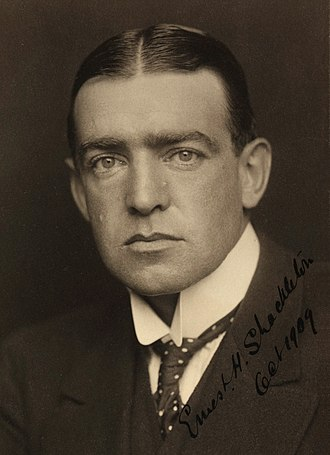
Shackleton, Sir Ernest Henry.
ACHIEVEMENTS: Explorations in the Antarctic.
NICKNAME/ALIAS: None.
DATE AND PLACE OF BIRTH: 5th February 1874, in Kilkea, County Kildare, Ireland.
DATE/PLACE OF DEATH /AGE AT DEATH: 5th January 1922, in Grytviken, South Georgia. Aged 48.
DISCIPLINE: Explorer.
FIELD: Exploration.
LANGUAGE: English.
PARENTS: Father, Henry Shackleton, mother, Henrietta Letitia Sophia Gavan.
SIBLINGS: 1 brother and 8 sisters.
SPOUSE: Emily Mary Dorman.
CHILDREN: 2 sons, Raymond and Edward, 1 daughter, Cecily
EDUCATION: Private governess; Fir Lodge Preparatory School, Sydenham, Kent;
Dulwich College, London.
MAJOR WORK: "The Heart of the Antarctic" (1909), "South" (1919).
LIFE AND TIMES:
In 1898, Shackleton applied to join <explored with> RF Scott* on an expedition to the South Pole and they left Britain on the Discovery in August 1901, reaching McMurdo Sound, on Ross Island, Antarctica the following February.
Much to his annoyance, a year later he was invalided back to Britain on the relief ship Morning. In 1906, he put himself up for election to Parliament, but failed to win a seat.
He was instead given a job by <employed by> Beardmore* in his engineering works in Glasgow.
Shackleton’s great ambition was to return to the Antarctic and he talked Beardmore into putting up enough money for him to start fund-raising. In August 1907, he set sail on the whaler Nimrod, reaching the Ross Barrier in January the following year. They had planned to land on King Edward Land but pack ice barred the way, so Shackleton set up base camp at McMurdo.
With four other men, he led a sledging party south onto the Antarctic plateau, reaching latitude 88 degrees, 23' south on 9 January 1909. On the way, they discovered a glacier, which Shackleton named after his principal benefactor Beardmore. When he got back to Stewart Island, New Zealand, on 23rd March 1909, he was welcomed as a hero for having come closer to the South Pole than anybody before, having got within 97 miles.
In October of the same year, Shackleton spoke in Christiana in Norway to an audience that included the great Norwegian explorers <met> Amundsen* and <met> Nansen* and Amundsen publicly praised him. He still wanted fame and fortune, and started to organise another expedition, raising the finance from the British and Canadian governments.
His plan this time was to lead a party across the continent, via the South Pole to McMurdo Sound, from a base camp on the Weddell Sea. When World War I began in 1914, Shackleton offered his ships and men to the British Admiralty, but was told to go ahead with the expedition.
Sailing in the Endurance, the expedition reached the island of South Georgia and then sailed south. On 18th January 1915, they found themselves trapped in pack ice and drifted for months, before being crushed on 27th October, two hundred miles from land and a thousand miles from human assistance.
Shackleton went off in a twenty-two foot whaling boat with five of his crew to get help. They fought their way eight hundred miles through the roughest seas in the world, finally landing on South Georgia.
They then trekked right across the unknown interior and found a Norwegian whaling station on the north coast. By now, they were so wild looking that some small boys, on seeing them walking into the settlement, ran away in terror.
Shackleton made three unsuccessful bids to rescue the remainder of the expedition and, on his fourth attempt, on 30th August 1916, managed to reach the Endurance, with the help of a Chilean crew who then took them to Punta Arenas in Chile. Shackleton took his men on triumphal visits to Santiago and Valparaiso, where they were given rapturous welcomes. The expedition may have been a failure, but the rescue was recognised as heroic. Fridtjof Nansen sent an effusive private letter to Emily Shackleton, praising the "unique expedition which has been such a complete success in every respect."
Shackleton then sailed from New Zealand in the Aurora to rescue the team that had previously gone via the Ross Sea to set up a provisions depot for the original expedition, as far as latitude 83 degrees 30' south. In January 1817, he found his men at Cape Evans and his rescue party was the first human contact the team had had in over two years, during which time three of their men had died.
Shackleton went off on what was to be his final expedition in September 1921, on board the Quest and landed in South Georgia on 4th January 1922, only to die the next morning of a sudden heart attack. He was buried there at his widow’s request.
ASSESSMENT: He was the bridge between the classic age of polar exploration and the age of machines.
EXTRA CONNECTIONS: Inspired later explorer <influenced> Ronne*
His father treated <father attended> Eleanor Marx’s suicide*
In 1910, Shackleton made a series of three recordings describing the expedition using an Edison phonograph.[60]
Several mostly intact cases of whisky and brandy left behind in 1909 were recovered in 2010, for analysis by a distilling company. A revival of the vintage—and since lost—formula for the particular brands found has been offered for sale with a portion of the proceeds to benefit the New Zealand Antarctic Heritage Trust which discovered the lost spirits
ONELINER: Ernest Shackleton, Antarctic explorer
BIBLIOGRAPHY:
Huntford, Roland, Shackleton, Hodder & Stoughton Ltd., London, 1985.