Marx E, Marx, Eleanor
Full Name:Eleanor Marx
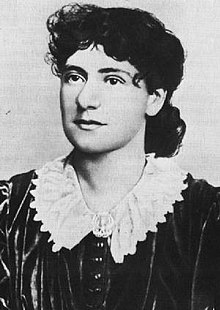
Nickname/Alias: Tussy
Achievements: Early socialist, and daughter of Karl Marx.
Born: January 16, 1855; London, England
Died: March 31, 1898; Sydenham, Kent, England (Aged 43)
Field & Discipline: Politics; Socialist
Language: English
Father: Karl Marx
Mother: Jenny von Westphalen
Siblings: 2 sisters survived infancy: Jenny, Laura
Spouse: None
Children: None
Education: South Hampstead College for Ladies
Life & Times:
Eleanor was familiar with her father [father was] Karl Marx’s* socialist principles from an early age but first became emotionally engaged in politics in 1867 when three Irish nationalists were hanged in Manchester in one of the last public executions in Britain.When she was fourteen she made a long visit to her father’s great friend, [family friend was] Engels*, whose financial hand-outs kept the Marx family afloat.Eleanor had an affectionate relationship with Engels and his companion, Lizzie Burns, and visited Ireland with them in 1869. In 1870, her passion for Ireland was replaced by her identification with the French Communards during the seige of Paris. Her French brother-in-law was involved with the Communards and on a visit to see her sister Laura Eleanor underwent several hours of interrogation by the French police.
When she returned to England she read her father’s tribute to the Communards in his “Civil War in France” and became a fervent supporter of their cause. In 1872 she became engaged to Hippolite Lissagaray, a French refugee and ex-Communard who had escaped to England.
Her parents did not approve and Eleanor went off to support herself by teaching in Brighton. After a short time, she had the first of her nervously ill, or depressive, episodes and was treated by Elizabeth Garrett Anderson, the first woman to qualify as a doctor in England. She returned to her parents’ home in London and recovered as she began to be more involved in socialism.
She was drawn into educational matters by Garrett Anderson and canvassed hard for the election of a liberal female candidate to the London School Boards. In 1877 Eleanor received a reader’s ticket for the British Museum and for the rest of her life spent a great deal of time there. She undertook research for her father, worked for the Shakespearean Society, the Philological Society and the Chaucer Society, and also worked on a translation of Lissagaray’s history of the Commune.
In 1880, an amnesty was granted to ex-Communards in France and Lissagaray went back to Paris. Eleanor was now in her mid-twenties and of striking appearance with a vivid personality.She made several acquaintances in the Reading Room, among them the writer [a pal of]Shaw* but she now entered another period of uncertainty and depression. She ended her engagement to Lissagaray. In January 1883 her sister Jenny died and in March of that year her father died.For the first time, Eleanor was now free to live in her own home. She joined the Socialist Democractic Federation in 1883 and began to speak at socialist meetings. By now she had also become involved with Edward Aveling, an active socialist who was also married. In the summer of 1884 they began openly living together.
Eleanor earned her living by lecturing, writing articles, and doing editorial work, research and translations. She became an expert on the Factory Acts and gave her first public lecture on this subject in 1885.In 1886 her translation of [translated] Flaubert’s* “Madame Bovary” was published. Schreiner had introduced Eleanor to the work of playwright [gave readings of] Ibsen*, and Eleanor was determined to present him to a wider audience. In January 1886, she and Aveling gave readings of Ibsen’s “A Doll’s House” in their apartment. She also co-wrote (with [collaborated with] Zangwill*) a satirical piece based on Ibsen’s work. Shaw, like most of Eleanor’s friends, disliked Aveling and used him as the model for his cad in “The Doctor’s Dilemma” (1906).
Later in 1886, Eleanor and Aveling went on a lecture tour in America sponsored by the Socialist Labour Party of North America. Reports of their progress were supplied by [spied on by] Pinkerton’s* detective agency to German officials in the US who sent them on to Berlin.In 1894, she served briefly on the executive committee of the Socialist Democratic Federation before she joined [co-socialist with] William Morris*, Aveling and others in forming the Socialist League.
A legacy from Engels in 1895 gave Eleanor independent means for the first time in her life. She bought a house in the London suburb of Lewisham and moved there with Aveling. She now lectured publicly all over Britain, sang in the local socialist choir and taught at the Battersea socialist Sunday school. In the first half of 1897 she gave forty-one lectures, visited Holland, worked on translating her father’s writings and presided over numerous socialist meetings.
In June 1897, while she was attending a miners’ international congress, Aveling married a young woman called Eva Frye. The ceremony took place at Chelsea Registry Office and Aveling, who was still married to his former wife, used a false name and address. He returned to Lewisham and Eleanor remained in ignorance of this event until September 1897.
On 31 March, 1898, Eleanor committed suicide by taking prussic acid. (The doctor who was called to the house was Henry Shackleton, the father of the explorer Ernest [treated by father of] Shackleton*.)
Assessment: Eleanor Marx was an active pioneer socialist.
Oneliner: Eleanor Marx, daughter of Karl Marx
Bibliography:
- Kapp, Yvonne, Eleanor Marx, Vols 1 & II, Virago, London, 1979.
- Stokes, John, ed., Eleanor Marx, Life, Work, Contacts, Ashgate, Aldershott, 2000.