Amundsen
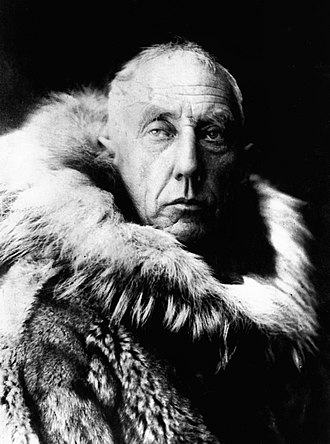
Amundsen, Roald Engelbregt Gravning
ACHIEVEMENTS: First to reach the South Pole; first to sail through the Northwest Passage
NICKNAME/ALIAS: None
DATE AND PLACE OF BIRTH: July 16, 1872, Borge, Norway
DATE/PLACE OF DEATH/AGE AT DEATH: Approx. June 18, 1928, Arctic Ocean. Aged 55.
DISCIPLINE: Polar explorer
FIELD: Exploration
LANGUAGE: Norwegian
PARENTS: Jens Ingebrigt Amundsen; Hanna Sahlqvist
SIBLINGS: Unknown
SPOUSE: None
CHILDREN: None
EDUCATION: Oslo Medical School, Oslo, Norway
MAJOR WORK: "To the North Magnetic Pole and Through the Northwest Passage"; "The South Pole"; "First Crossing of the Polar Sea"
LIFE AND TIMES:
In 1898, Amundsen sailed as first mate on a Belgian expedition to the Antarctic, but since none of the expedition's aims were achieved, he decided to get his skipper's license and lead his own expedition to the Arctic to find the North Pole and the long-sought Northwest Passage from the Atlantic to the Pacific.
In the summer of 1903, Amundsen settled down in the Arctic, waiting for the right conditions to search for the Northwest Passage.
It was not until August, 1905, after two winters, that he found conditions favorable enough, at which point he broke camp and set off. With no charts, the crew had to take continual soundings, and the ship moved at a snail's pace. But 14 days later Amundsen spotted a sail and realized he and his crew had succeeded in their mission and were in the Beaufort Sea. Anxious to telegraph the news, Amundsen trekked by dog-sled to Fort Egbert. When the ice broke the following July they sailed through the Bering Strait and on to San Francisco.
During 1906-07, Amundsen lectured in the U.S. and England. He then bought the "Fram" from the famous explorer Nansen* and set about realizing his dream to be the first to reach the North Pole. While he was preparing his trip, news came that American Peary* was claiming to have reached the Pole in April, 1909. When his backers heard the news about Peary, they threatened to withdraw. Amundsen argued his expedition would still be scientifically valuable, but he had a secret up his sleeve. Only he and his brother knew that Amundsen was going to go South.
Amundsen sailed for the South Pole on June 7, 1910. RF Scott* was already en route to the Antarctic, also hoping to be the first to the Pole. Amundsen sent a wire to Scott informing him of his intentions, and the race was on. The approach to the Pole was over pack-ice. Amundsen was not experienced in this type of travel, but had read about it, and was convinced his Greenland dogs would be more useful than the Siberian ponies or motorized sleds that Scott was relying on.
Before the southern winter set in both Amundsen and Scott had made camp in the Antarctic and had laid supply depots for their planned race, which was to take place in the southern spring (September-October) of 1911.
Amundsen and four companions set out for the pole in October in good weather. They took with them 52 dogs and 4 sleds. There was excitement when they passed the point where Shackleton*, who so far had come closest to the Pole, had given up his attempt. Amundsen and his team arrived at the South Pole on Dec. 14. After planting the Norwegian flag, Amundsen found that his calculations were off. He put his position at 89 degrees 55' S, but he had reckoned the pole would be at 90 degrees. So he sent out three parties with three more flags and ordered them to travel 12.5 miles in three different directions to plant their flags.
Amundsen and his party began the trek home on December 17, 1911, returning to their base above the Bay of Whales on January 25, 1912. Scott and his party reached the Pole Jan. 17, but all perished on the return journey. Amundsen wrote his account of the expedition, "The South Pole," and lectured in America. He started a successful shipping business, but still yearned to travel to the North Pole.
In 1918, Amundsen set out for the Arctic aboard "The Maud", but the expedition failed. He then made plans to cross the Arctic in a plane. Lincoln Ellsworth, an American explorer who wanted to do the same thing together with an experienced polar explorer, agreed to pay for everything. The expedition left Kings Bay, Spitzbergen, in late May, 1925, in two Dornier flying boats fitted with Rolls-Royce engines. Both planes were forced down. They landed within three miles of each other, 136 miles short of the Pole.
In 1919, Amundsen made another attempt to fly over the North Pole in an Italian dirigible, but while he was waiting for the dirigible in Spitzbergen, U.S. Commander Byrd* flew in on a plane, took off again, flew over the Pole and returned to Spitzbergen the same day, non-stop. Despite his defeat, Amundsen was one of the first to congratulate Byrd. Seven years later, Amundsen flew over the Pole from Spitzbergen, landing at Teller in Alaska.
In mid-June, 1928, Amundsen took off in a plane with five companions from Tromso, Norway. The plane was not heard of again, but its wreckage was discovered 10 weeks later.
ASSESSMENT: A great figure in polar exploration
EXTRA CONNECTIONS: During his second winter in the Arctic, in 1904, Amundsen found the skeletons of British explorer Sir John Franklin* and his party.
Used Dornier seaplane
ONELINER: R.E.G. Amundsen, great Polar explorer
BIBLIOGRAPHY:
Partridge, Bellamy, Amundsen, Robert Hale Ltd., London, 1953.