Vail, Alfred
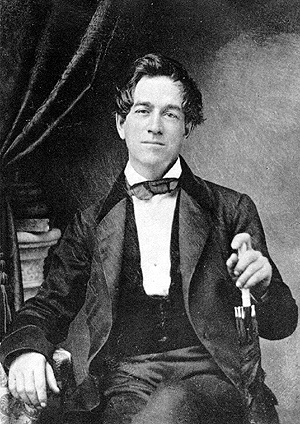
ACHIEVEMENT(S): Colleague of Samuel Morse in telegraphy development. May have thought of “Morse” code
NICKNAME/ALIAS: None
DATE AND PLACE OF BIRTH: September 25, 1807, Morristown, NJ
DATE/PLACE OF DEATH/AGE AT DEATH: January 18, 1859, Morristown, NJ. Aged 51
DISCIPLINE: Telegraphy
FIELD: Communications
LANGUAGE: English
EDUCATION: Common-school in Morristown, NJ
MAJOR WORK: Devised the instruments for the first Morse telegraph
LIFE AND TIMES:
Vail first worked for his father who owned and operated The Speedwell Iron Works. Despite having no formal training, Vail had a natural talent for mechanics, and became an expert mechanic by the time he was 20.
He ran the factory machine shop for a number of years until, at roughly 23, he decided he wanted to be a Presbyterian minister. In 1832, he entered the University of the City of New York, and, after graduating in 1836, proceeded to his theological studies.
In September, 1837, Vail saw American inventor <collaborated with> Samuel Morse* demonstrating his <helped develop> telegraph* at the University and at that moment abandoned all thought of theological studies.
Vail was so excited by the invention, he offered to help Morse improve his instruments, which were still crude, and promote the new machine. In severe financial straits and exhausted from exhibiting his new machine without raising much attention or funds, Morse accepted Vail's offer and the two signed a contract that same month.
For a quarter interest in the business, Vail agreed to build a complete set of instruments and obtain patents for them in the United States and elsewhere. He persuaded his father to help in the financing and Vail, Morse and a third associate, Leonard D. Gale, worked to perfect the instruments at Vail's father's factory. Their assistant mechanic was engine-builder <assistant was> William Baxter*. On January 6, 1838, a successful test was completed through three miles of wire. Vail's father made up the telegraphed message: "a patient waiter is no loser."
The first public demonstration of the telegraph followed within a month at New York City. The message then was "Attention, the Universe, by kingdom’s right wheel." Vail and Morse demonstrated the machine before the Franklin Institute in Philadelphia, and also in Washington, where they appealed to the government to buy the invention for the good of the nation, rather than let it be run by private interests.
Their plea fell on deaf ears, but Congressman F.O.J. Smith, saw the telegraph’s potential, and persuaded Vail and Morse to let him become a partner. Smith was given one quarter of the business, with Vail's share being reduced by two sixteenths. But Smith brought along two important things: vital funds and contacts.
Some time later, Morse went off to Europe to seek patents there, but while he was away, Vail began to lose interest in the project and did little work on it. Instead, he turned his attention to his father's business, and from 1839 to 1843, represented his father's interests in Philadelphia.
But in 1843, Congress approved $30,000 for an experimental telegraph line between Washington and Baltimore. Vail regained his interest and joined Morse as his assistant. After some setbacks, the line was completed, and on May 24, 1844, the first message was transmitted across a long distance. It read: "What hath God wrought!" Vail remained with Morse for four more years, during which he published "the American Electro Magnetic Telegraph", but he began to lose interest again, and returned to his home town of Morristown.
Although it was Vail's mechanical skill that had perfected Morse's instruments, Vail did not prosper from the success of the telegraph. It appears he did not retain his share from his early partnership with Morse, nor did he cultivate business interests. In the early days, no one was manufacturing instruments for the telegraph and Morse and company depended on clockmakers to do the job.
Vail would have been in a prime position to manufacture telegraphic equipment, and undoubtedly would have turned a huge profit.
After his return to Morristown, Vail seems to have lived in retirement. He occupied his later years with compiling genealogical material on his family. He and apparently died poor.
ASSESSMENT: Played no part in the invention of the telegraphic process, but helped turn the idea into a revolutionary medium of communication.
EXTRA CONNECTIONS: Through Morse, he met American physicist <met> Joseph Henry*
Jis work related to that of <work related to> Gauss*, <work related to> Wheatstone*, and Wilhelm Weber*
ONELINER: Henry Vail, who helped Morse with the telegraph
BIBLIOGRAPHY:
ANB
PARENTS: Stephen Vail; Bethiah Young
SIBLINGS: Unknown
SPOUSE: 1) Jane Elizabeth Cummins; 2) Amanda O. Eno
CHILDREN: Three sons by Jane Cummins