Henry, Joseph
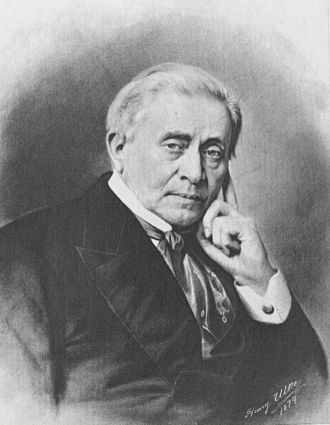
Name: Joseph Henry
Achievements: First Secretary of Smithsonian
Born: December 17, 1797; Albany, NY
Died: May 13, 1878; Washington DC (Aged 80)
Field & Discipline: Science; Physics
Language: English
Father: William Henry
Mother: Ann Alexander
Siblings: Unknown
Spouse: Harriet Alexander
Children: William Alexander; Helen; Mary; Caroline
Education: Albany Academy, Albany, N.Y.
Major Work:
The electromagnetic relay
Life & Times:
From 1819 to 1822, Henry attended the Albany (NY) Academy, studying medicine, then engineering. After graduating, he worked as a tutor and surveyor. In 1826 he returned to Albany Academy as Professor of Mathematics and Physics.
Henry became interested in electromagnetism, the area in which he would do his major scientific research. By 1830, he had improved the electromagnet by winding insulated wire many times around an iron core. He also discovered that the electromagnet could be activated over long distances, a fact that would become relevant in the development of the telegraph.
His most important discoveries at this time were electromagnetic induction and electromagnetic self-induction. His discoveries predated by several weeks identical work carried out by British physicist [simultaneous discovery with] Faraday*, but Faraday was the first to make his observations public.
In 1832, recommended by a friend, Henry was invited by John Maclean, President of New Jersey College (later Princeton), to become professor of natural philosophy and to lecture also in chemistry, geology, mineralogy, and astronomy. Before long, he gained a reputation as a brilliant teacher.
At New Jersey Henry continued to work in electro-magnetics, putting together an electromagnet capable of lifting 3,500 pounds. He also continued work on the telegraph. In a dramatic experiment in 1835, he strung several hundred feet of wire around the campus and sent a current down the wire, having it pass through a small magnet, which, excited, activated a device that rang a bell.
Henry's electromagnet relay was another of his important discoveries, also made in 1835. By adding an intensity magnet to the circuit of his electric telegraph, he was able to either make or break the local circuit of his large-quantity magnet. Henry neglected to make any official announcement of this discovery.
For most of 1837, Henry travelled in Europe, visiting Britain, France and Belgium, where he met important men of science, including the British mathematician [met] Babbage* and physicist [met] Sturgeon*. He discussed his discovery of the electromagnetic relay with physicist [met] Wheatstone*, who used it in his telegraph research. He met and talked at great length with Faraday, who was not noted for his socializing.
Henry became intrigued with the phenomenon of lateral discharge, or the tendency of electricity to deviate from its most direct path. As lightning was considered to behave in this way, Henry's advice was often sought on how to prevent lightning strikes.
He also explored various theories on induction, observed the oscillatory nature of the discharge of a capacitor, and formulated the concept of the transformer.
Other areas he explored at New Jersey included sunspots, molecular cohesion, capillary action through solid substances, geophysics, terrestrial magnetism and auroras.
In 1839, Henry was introduced to, and immediately liked, American telegraph inventor [a pal of] Samuel Morse*. Although Henry's friends had urged him to compete with Morse in getting a workable telegraph on the market, Henry thought Morse should succeed, gave him advice on the electromagnetic relay and willingly told him all he knew about telegraphing.
After Congress passed an act founding the Smithsonian Institution, two members of the board of regents, [co-opted by] Robert Dale Owen* and Henry's old friend, Alexander Dallas Bache, asked Henry to draw up an outline of the aims and objects of the Institution.
Henry's plan called for "an Institution for the increase and diffusion of knowledge among men." When the Smithsonian began looking for a man "possessing weight and character and a high degree of talent" as well as "eminent scientific and general acquirements", Henry was the obvious choice.
He took up the posts of Secretary and Director in 1846, largely gave up his own research, and worked to promote basic experimental research in a variety of disciplines: zoology, botany, archaeology, anthropology, geophysics, and astronomy.
As Secretary of the Smithsonian, Henry was often asked to serve as an advisor to the government. During the Civil War, he was a member of the Permanent Commission of the Navy Department and the Lighthouse Board, a job that brought him into close contact with President [knew] Lincoln*. The two men did not like each other, but eventually developed respect for each other's abilities.
Also fascinated by meteorology, Henry developed a weather-forecasting system based on the meteorological information received by the electric telegraph. His studies and his coordination of research in the field played a role in the founding of the United States Weather Bureau.
Henry was a founding member of the National Academy of Sciences, and was its first president, holding the position for 10 years. He was instrumental in the establishment of the American Association for the Advancement of Science.
In 1877, Henry first showed signs of Bright's Disease, for which there was no cure. Fifteen years after his death in 1878, the unit of inductance, the "henry", was named after him.
Assessment: Reached a position of leadership in American science through contributions to the study of electricity as applied to the electric telegraph.
Oneliner: Joseph Henry, early electro-magnetics expert
Bibliography:
- Coulson, Thomas, Joseph Henry: his Life and Work. Princeton University Press: Princeton, 1950.
Father: William Henry
Mother: Ann Alexander
Siblings: Unknown
Spouse: Harriet Alexander
Children: William Alexander; Helen; Mary; Caroline