calculator
DETAILS: The best friend of the mathematically-inclined (and those who are not), the modern digital calculator is a descendent of a mechanical arithmetic machine, developed by Blaise Pascal* in 1642, which performed computations using hand-powered disks, drums, and gears. Pascal’s machine dealt directly with numbers or digits and work by counting, listing, comparing, and rearranging these digits, and was, therefore, digital. Multiplication and division operations were implemented by performing a series of additions or subtractions.
In the late 1600, Leibniz* created a more advanced a machine, and over the next couple of centuries, inventors continued to produce calculating machines that were smaller in size and less laborious to use.
In the 1800s, Babbage* had the idea of mechanically calculating mathematical tables of logarithmic and trigonometric functions, and even created a calculator that could perform certain computations to eight decimal places.
Mechanical calculators began to disappear in the 1950s with the development of electronic calculators which used integrated circuits like the ones found in computers.
Today’s electronic calculators include hand-held and pocket devices, adding machines and cash registers, and are used in schools, laboratories, offices, stores and banks.
OTHER CONNECTIONS: The founders of Artificial Intelligence at the 1956 Dartmouth Conference: AI founded at 1956 Dartmouth conference “ will concentrate on a problem of devising a way of programming a calculator to form concepts and to form generalizations. This of course is subject to change when the group gets together."[3]
BIBLIOGRAPHY:
"Calculator." Britannica Student Encyclopedia. 2004. Encyclopædia Britannica Online.5 May 2004, search.eb.com/ebi/article?eu=295241.
"Charles Babbage."Britannica Student Encyclopedia. 2004. Encyclopædia Britannica Online. 5 May 2004, search.eb.com/ebi/article?eu=294806.
...
History
Precursors to the electronic calculator
Main article: Mechanical calculator
See also: Human computer
The first known tools used to aid arithmetic calculations were: bones (used to tally items), pebbles, and counting boards, and the abacus, known to have been used by Sumerians and Egyptians before 2000 BC.[6]
Except for the Antikythera mechanism (an "out of the time" astronomical device), development of computing tools arrived near the start of the 17th century: the geometric-military compass (by Galileo), logarithms and Napier bones (by Napier), and the slide rule (by Edmund Gunter).

17th century mechanical calculators
In 1642, the Renaissance saw the invention of the mechanical calculator (by Wilhelm Schickard[7] and several decades later Blaise Pascal[8]), a device that was at times somewhat over-promoted as being able to perform all four arithmetic operations with minimal human intervention.[9] Pascal's calculator could add and subtract two numbers directly and thus, if the tedium could be borne, multiply and divide by repetition. Schickard's machine, constructed several decades earlier, used a clever set of mechanised multiplication tables to ease the process of multiplication and division with the adding machine as a means of completing this operation.
There is a debate about whether Pascal or Shickard should be credited as the known inventor of a calculating machine due to the differences (like the different aims) of both inventions.[10] Schickard and Pascal were followed by Gottfried Leibniz who spent forty years designing a four-operation mechanical calculator, the stepped reckoner, inventing in the process his leibniz wheel, but who couldn't design a fully operational machine.[11] There were also five unsuccessful attempts to design a calculating clock in the 17th century.[12]

The Grant mechanical calculating machine, 1877
The 18th century saw the arrival of some notable improvements, first by Poleni with the first fully functional calculating clock and four-operation machine, but these machines were almost always one of a kind. Luigi Torchi invented the first direct multiplication machine in 1834: this was also the second key-driven machine in the world, following that of James White (1822).[13]
It was not until the 19th century and the Industrial Revolution that real developments began to occur. Although machines capable of performing all four arithmetic functions existed prior to the 19th century, the refinement of manufacturing and fabrication processes during the eve of the industrial revolution made large scale production of more compact and modern units possible.
The Arithmometer, invented in 1820 as a four-operation mechanical calculator, was released to production in 1851 as an adding machine and became the first commercially successful unit; forty years later, by 1890, about 2,500 arithmometers had been sold[14] plus a few hundreds more from two arithmometer clone makers (Burkhardt, Germany, 1878 and Layton, UK, 1883) and Felt and Tarrant, the only other competitor in true commercial production, had sold 100 comptometers.[15]
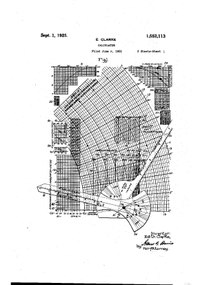
Patent image of the Clarke graph-based calculator, 1921
It wasn't until 1902 that the familiar push-button user interface was developed, with the introduction of the Dalton Adding Machine, developed by James L. Dalton in the United States.
In 1921, Edith Clarke invented the "Clarke calculator", a simple graph-based calculator for solving line equations involving hyperbolic functions. This allowed electrical engineers to simplify calculations for inductance and capacitance in power transmission lines.[16]
The Curta calculator was developed in 1948 and, although costly, became popular for its portability. This purely mechanical hand-held device could do addition, subtraction, multiplication and division. By the early 1970s electronic pocket calculators ended manufacture of mechanical calculators, although the Curta remains a popular collectable item.
Development of electronic calculators
The first mainframe computers, using firstly vacuum tubes and later transistors in the logic circuits, appeared in the 1940s and 1950s. This technology was to provide a stepping stone to the development of electronic calculators.
The Casio Computer Company, in Japan, released the Model 14-A calculator in 1957, which was the world's first all-electric (relatively) compact calculator. It did not use electronic logic but was based on relay technology, and was built into a desk.

Early calculator light-emitting diode (LED) display from the 1970s (USSR)
In October 1961, the world's first all-electronic desktop calculator, the British Bell Punch/Sumlock Comptometer ANITA (A New Inspiration To Arithmetic/Accounting) was announced.[17][18] This machine used vacuum tubes, cold-cathode tubes and Dekatrons in its circuits, with 12 cold-cathode "Nixie" tubes for its display...