Babbage, Charles
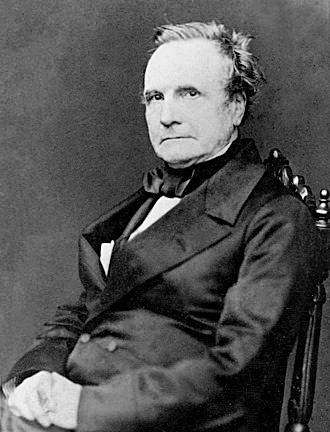
Achievements: The first stored computer program
Born: December 26, 1792; Teignmouth, England.
Died: October 18, 1871; London, England (Aged 88)
Field & Discipline: Mathematics; Computing
Education: Cambridge University, England
Major Work: The difference machine; the analytical engine
Life & Times:
At Cambridge, to stimulate an interest among other students in mathematics, Babbage, [founded club with fellow-student] JWF Herschel*, [founded club with fellow-student] George Peacock* and other undergraduates founded the Cambridge Analytical Society. After graduating in 1814 Babbage and his new wife, Georgiana Whitmore, moved to London where Babbage gave lectures on the history of astronomy at the Royal Institution. Between 1815 and 1820, he wrote a series of original papers on the theory of functions. In 1816, Babbage was elected a fellow of [fellow of] the Royal Society*.
Babbage firmly believed that scientists should apply their discoveries to society in general, so he helped found new societies: The Astronomical Society in 1820; the British Association for the Advancement of Science in 1831; and the Statistical Society in 1834. His views about the social responsibilities of science led him into conflict with conservative scientists like British mathematician [at loggerheads with] Whewell,* who regarded science as a gentleman’s pastime.
In 1826, Babbage found a project that he would work on, without reward, for the rest of his life. On a trip to France, he was told about the new French numerical tables, created by Gaspard Francois de Prony. He was particularly impressed by the logarithms from 1 to 200,000, which de Prony had calculated with the help of 100 mathematicians and clerks. But successful as his tables were and although they were the most accurate of the time, they were still full of errors. Recognizing the enormous value of mathematical tables in navigation, astronomy and commerce, Babbage came to the idea that they would not only be cheaper, but more accurate, if they could be calculated by mechanical means. He set himself to the task, but found the problems enormous.
The logical structure of the machine, the mechanisms for each part of the engines, the mathematical methods for preparing problems for calculation, and programming and microprogramming all had to be worked out. Babbage persuaded the British government to finance a machine (a “difference engine”) that would calculate up to 20 decimal places and incorporate a printer. Entirely new tools with previously unknown tolerances had to be designed; many of these were produced by [commissioned tools from] Whitworth*. Delay was caused by Babbage's constant innovation. During this period Babbage was elected to the Lucasian Chair of Mathematics at Cambridge, but was so busy in London with his computation project, he never carried out the duties.
The project came to nothing. The government decided it had spent too much money and refused to spend more. Abandoning the project, however, did not upset Babbage because he had another project in mind: an analytical engine. In 1801, French inventor [inspired by weaver] Jacquard* had developed a system of punched cards to automate silk-weaving (sprung wire hooks went through the pattern of holes and picked up the required threads), and Babbage saw that cards like these could code the operations of an automatic computing system.
In 1830 Babbage wrote "Reflections of the Decline of Science and some of its Causes" and "On the Economy of Machinery and Manufacture", a major work translated into French, German, Italian, Spanish, Russian and Swedish, and which influenced British philosopher [influenced] John Stuart Mill*, as well as political radicals [influenced] Engels* and [influenced] Karl Marx*.
In 1833, Babbage began work on his analytical engine. Like a computer, the analytical engine was to be divided into two complete parts: the mill, in which the various operations would be done; and the store, in which the numbers would be first placed and to which the results would be returned. The mill consisted of 1,000 columns of geared wheels that carried out four arithmetical functions for up to 1,050 decimal-digit numbers, held in the memory of the store. The operation of the machine was directed by cards programmed for three different kinds of function: the supply of the store with numbers; the transfer of numbers back and forth between the mill and the supply; and the direction of the four basic arithmetical functions of the computer.
After eight years of intense but fruitless effort, Babbage became discouraged. In 1841, he wrote his friend [a pal of] Alexander von Humboldt*: "There is no chance of the machine ever being executed during my own life...." He was right. The machine remained unfinished at the time of Babbage's death, and though his son, Henry, continued to work on it for 30 years between 1880 and 1910, the complexity of its problems were beyond solution. The difference engine was exhibited at the Exhibition of 1862, demonstrated by [invention demonstrated by] Gravitt.
Babbage's other interests included cryptanalysis, probability, geophysics, astronomy, altimetry, ophthalmoscopy, statistical linguistics, meteorology, actuarial science, lighthouse technology, and the use of tree rings as historic climactic records. He developed the first ophthalmoscope.
Babbage also became interested in the workings of the Post Office. Deciding that its main costs came from handling letters, not their transportation, he suggested that the simplest means of charging would be by a flat rate. The idea was later introduced by [inspired] Rowland Hill* as the penny post. Babbage also developed a notation that simplified the making and reading of engineering drawings, as well as helping designers simplify their circuits. His writing on mass production and the principles of "operational research", were used in the manufacture of pins, the printing trade, and the post office.
Extra Connections:
[supported by] Ada Lovelace,* (Byron's daughter), helped him in his work.
Also knew and worked with: [worked with] WG Armstrong*, [knew] Sedgwick*, [a colleague of] Quetelet*, [knew] Ure*, [met] Sorby*, [knew] Galton*.
Met [met] Cavour*.
His work also related to that of [his work related to] Arago
Gleick: the Victorian polymath Charles Babbage writing to Tennyson to take exception to the arithmetic in “Every minute dies a man / Every minute one is born.”
Assessment: His plan for the systematic application of science to industry was ignored.
Oneliner: Charles Babbage, inventor of the first stored computer program
Bibliography:
- Anthony Hyman. Charles Babbage: Pioneer of the Computer. Princeton University Press. Princeton, New Jersey. 1982.
- Computer History Museum (video) http://www.computerhistory.org/babbage/
Language: English
Father: Benjamin Babbage
Mother: Unknown
Siblings: Unknown
Spouse: Georgiana Whitmore
Children: Benjamin Herschel; Charles; Georgiana; Dugald Bromhead; Henry Prevost