Bodley T
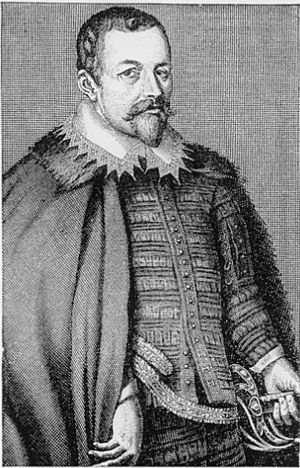
Bodley, Sir Thomas
ACHIEVEMENTS: Founded the Bodleian Library, Oxford
NICKNAME/ALIAS: None
DATE AND PLACE OF BIRTH: March 2, 1545, Exeter, England
DATE/PLACE OF DEATH/AGE AT DEATH: January 28, 1613, London, England. Aged 67
DISCIPLINE: Diplomat, scholar
FIELD: Politics
LANGUAGE: English
PARENTS: John Bodley; Joan Hone
SIBLINGS: Brothers Miles, Laurence, Josias; sisters Prothasy, Alice, Sybill (fourth sister name unknown)
SPOUSE: Ann Ball
CHILDREN: None
EDUCATION: Preparatory schools in England and Geneva; Magdalen College, Oxford
MAJOR WORK: None
LIFE AND TIMES:
When Bodley was about 10, his father, a Protestant, thought it prudent to move to the continent when the Catholic Mary Tudor succeeded Edward VI and became Queen of England in 1553. The family lived at Wesel, and then Frankfurt, Germany, before settling in Geneva, Switzerland (a well-known as a refuge for Protestants) where French Protestant leader Calvin* ruled the city.
When Queen Elizabeth* succeeded Mary in 1558 and England swung back to the Protestant religion, the Bodley family returned and settled in London. In 1562, Elizabeth granted Bodley's father a seven-year monopoly to print the Geneva Bible, produced in Geneva two years earlier. Based on Tyndale*'s translation, it had been shunned by Mary's regime because it included annotations that were strongly Protestant in tone.
In Geneva, Bodley had received a good classical education, studying Hebrew and Greek as well as Latin. Back in England, he was sent to Magdalen College, Oxford, from which he graduated in 1563. A year later, he became a fellow at Merton College, Oxford. He lectured on the Greek language, giving his first lecture free because he was anxious that more academics take an interest in Greek.
The college authorities were so delighted with Bodley's lecture that they paid him regardless, and asked him to continue lecturing. At 22 he got his Master of Arts degree, after which he began to give public lectures in natural philosophy in the university school. He continued studying Hebrew and became recognized as the pre-eminent scholar in that language. He was elected a university proctor in 1569 and acted as deputy university orator.
Languages were Bodley's great interest. In 1576, at 31, he was granted a permit from the Crown to study modern languages abroad. After four years on the continent, he returned with a particularly good command of French, Italian and Spanish. Shortly after his return, he was made a gentleman usher to the queen, though it is not known how he ingratiated himself with the court. In 1584, he entered Parliament as the Member for Plymouth in Devon.
In the 1580s, it became clear to Elizabeth's government that England needed a strong Protestant presence in Europe to counteract the effect of Catholic Spain. In 1585, Bodley was sent to Denmark to gain the support of Danish King Frederick II for French Protestant Huguenots against the Catholic French crown. He then approached German Protestant princes to gain their support for Henry of Navarre, who was the Protestant heir to the French throne.
In 1588, with France in religious turmoil, Bodley went on another diplomatic mission. The Catholic League, under the Duke of Guise and backed by Spain, had turned against French King Henry III for having made concessions to the Huguenots, and forced him to flee Paris. England still had a vested interest in protecting the position of Henry of Navarre, but the exact nature of Bodley's mission is not known, only that it was for the benefit of the Protestant cause.
Upon his return, Bodley was made the Queen's permanent representative at The Hague, the capital of the United Provinces, an extremely important post. Calvinism had taken root in the northern provinces of the Netherlands during the Reformation earlier in the 16th century. In 1579, by the Treaty of Utrecht, the Calvinists formed the United Provinces and established their separation from the Catholic Spanish Netherlands in the south.
The Netherlands became a flash point, where the Protestant humanism of northern Europe clashed with Roman Catholic traditionalism as embodied by Spain. Elizabeth made sure that Bodley's voice in The Hague was a significant one: he was made a member of the Council of State with full voting rights, second in rank only to Prince Maurice of Nassau*.
By 1592, after about three years of service in The Hague, Bodley asked to be relieved, but was only allowed a short holiday, in 1593. He was eventually allowed to retire in 1596.
Bodley by now was tired of politics and intrigue, but was still anxious to make a substantial contribution to the state. He decided to restore the library at Oxford University. The library had been founded at the beginning of the 15th century, but had fallen into disuse with the advent of printing and the expansion of individual college libraries.
During the reign of Edward VI (1547-1533), the remaining books had been removed and the shelves dismantled. The University gratefully took up Bodley's formal offer to renovate the room that Duke Humphrey of Gloucester had endowed in the 15th century. He bought many books out of his own pocket, or with the assistance of his wife, Ann Ball, a wealthy widow he had married in 1587. He also asked among his many friends for donations of books, manuscripts, and funds.
The response was generous, perhaps partly because Bodley promised to include each donor's name on a list of benefactors. The library reopened in November, 1602, and in 1604, was named the Bodleian. In the same year, Bodley was knighted by James I, who visited the library in 1605, the same year the first catalog was brought out. The library soon began to grow beyond its shelves and a new wing was ordered.
Bodley oversaw every detail. In 1610, the Stationers' Company agreed to donate a copy of every book it had published. In 1611, Bodley initiated the library's permanent endowment with a farm in Berkshire and houses in the city of London.
To the displeasure of relatives and friends, Bodley, who died in London in 1613, bequeathed the main part of his estate to the university. He was buried, as he had requested, in the chapel of Merton College. Many eminent scholars attended, including historian Camden*, who, on behalf of Bodley, refused a posthumous MA offered by the authorities.
ASSESSMENT: Founder of the Bodleian Library of Oxford University.
EXTRA CONNECTIONS: In 1602, while seeking books for his library at Oxford, Bodley met Ussher*, a fellow of Trinity College, Dublin, who was in England looking for books for his college.
He corresponded with the Earl of Essex*
He was a friend of Allen*
ONELINER: Thomas Bodley, founder of the Bodleian Library, Oxford
BIBLIOGRAPHY:
DNB
Bodley, Sir Thomas, The Life of Sir Thomas Bodley, written by himself. Privately reprinted for John Lane and His Friends, Christmas, 1894