Calvin, John
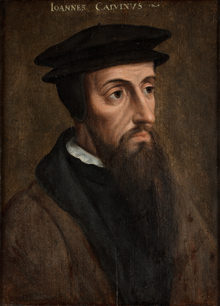
ACHIEVEMENT(S): A founding father of the Reformed Protestant tradition.
NICKNAME/ALIAS: Real name: Jean Cauvin.
DATE/PLACE OF BIRTH: 10th July 1509, in Noyon, France.
DATE/PLACE/AGE AT DEATH: 27th May 1564, in Geneva, Switzerland. Aged 54.
DISCIPLINE: Theologian.
FIELD: Religion.
LANGUAGE: French.
EDUCATION: College des Capettes, Noyon; University of Paris; University of Orleans; University of Bourges.
MAJOR WORK: 'Institutes of the Christian Religion', 1536-60.
LIFE AND TIMES: Calvin studied civil law at the University of Orleans in 1527, before moving to the University of Bourges to study under the Italian jurist, Andreas Alciati. His other interest was reading works of the great religious reformers, like Luther* and, sure of his religious calling, he began to preach privately.
In 1531, he returned to Paris, at a time when the Renaissance Humanist movement, led by Erasmus* and Jacques Lefèvre d'Étaples, was at its height. The Humanists were reasserting the importance of the humanities in higher education, advocating the study of classical texts and the Bible. Calvin studied Greek and Hebrew in preparation for study of the Scriptures and he turned his hand to the classics, publishing a commentary on Seneca's essay 'De Clementia', in 1532. He collaborated in the preparation of a public speech with the Reformist Nicholas Cop, Rector of the University of Paris, but the government opposed him and he was forced to flee to Basel, Switzerland.
Over the next two years Calvin’s beliefs, which were, to an extent, compatible with Catholic ideology, began reverting to Protestant ideals. He started to form his own brand of theology, outlined in his 'Christianae Religionis Institutio', published in 1536. This work thrust him to the forefront of Protestantism and, by the 1540s, it had been adopted as the textbook of Reformed theology.
Calvin's theology, now known as 'Calvinism', echoed the insight of Martin Luther, but he often cited medieval Catholic thinkers, like the theologian and philosopher, Duns Scotus*. Calvin’s ideas took a middle course between an exclusive emphasis on divine providence and a belief in the ideal of human responsibility.
During 1536, he was asked by Guillaume Farel to assist in Geneva’s reformation movement. He drafted his 'Articuli de Regimine Ecclesiae', outlining regulations for admission to the Lord's Supper and a profession of faith from all citizens, both of which were accepted. In May 1538, Farel and Calvin were expelled from the city by a group known as the 'Libertines', who opposed Calvin’s strict moral codes and his refusal to conform the customs of the Church of Geneva with those of Berne. He spent the next three years in Strasbourg, France, as Pastor of a church for French-speaking refugees, taking instruction from Bucer*.
He was invited back to Geneva in September 1541, where the Protestant revolution was weakening, and the town council enacted his 'Ecclesiastical Ordinances,' establishing a theocratic regime along Old Testament lines. In the early 1550s, Calvin's position in Geneva was powerful. Many opposed his leadership but 1555 saw the defeat of his political opponents, the Perrin family. By 1559, he had become a citizen of Geneva, introduced a municipal school system, and founded the Geneva Academy, where the future ministerial leaders were trained.
During this period, the Scottish Protestant reformer, Knox*, spent two years in Geneva and took Calvin's influence back to Britain. Calvin regularly corresponded with the leaders of Protestant Europe in a bid to maintain alliances. With this in mind, he also promoted the writing of hymns intended to unite the people, making the famous Genevan Psalter, composed mostly by Louis Bourgeois, the basis for many later hymns.
Calvin suffered from chronic asthma and, worn out by his responsibilities, he died in 1564 and was buried in an unmarked grave in Geneva.
ASSESSMENT: His interpretation of Christianity influenced Protestantism throughout Europe and North and had a major impact on the formation of the modern world.
EXTRA CONNECTIONS: His Geneva sheltered Bodley*, Estienne*
He was repudiated by the Council of Trent*
His doctrines were challenged by Arminius*
ONELINER: John Calvin, hard-line Protestant reformer
BIBLIOGRAPHY:
Parker, T.H.L., John Calvin: A Biography, London: M. Dent & Sons Ltd., 1975.
See Calvinism
Pantheon rank 234
PARENTS: Gerard Cauvin and Jeanne Le Franc.
SIBLINGS: Charles, Antoine and Francois (died in infancy); two half-sisters,
one named Marie.
SPOUSE: Idelette de Bure.
CHILDREN: One son (1542 - died in infancy); step-daughter, Judith, and step-son.