Manifest Destiny
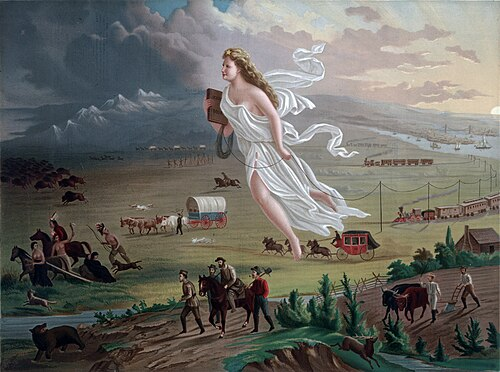
Manifest destiny was the expansionist colonial belief in the 19th-century United States that American settlers were destined to expand westward across North America, and that this belief was both obvious ("manifest") and certain ("destiny"). The belief is rooted in American exceptionalism, romantic nationalism, Anglo-Saxonism, and nascent ideas of white chauvinism,[a]^ implying the inevitable spread of republicanism and the American way.[6]^
It is one of the earliest expressions of American imperialism.[7][8][9]^ According to historian William Earl Weeks, there were three basic tenets behind the concept: The assumption of the unique moral virtue of the United States, the assertion of its mission to redeem the world by the spread of republican government and more generally the "American way of life", and the faith in the nation's divinely ordained destiny to succeed in this mission.[6]^
Manifest destiny remained heavily divisive in politics, causing constant conflict with regard to slavery in these new states and territories.[10]^ It is also associated with the expansion of European settlers onto the territories of Indigenous Americans[11]^ and the annexation of lands to the west of the United States borders at the time on the continent. The concept became one of several major campaign issues during the 1844 presidential election, where the Democratic Party won and the phrase "Manifest Destiny" was coined within a year.[7][12]^
The concept of manifest destiny was used by Democrats to justify the 1846 Oregon boundary dispute and the 1845 annexation of Texas as a slave state, culminating in the 1846 Mexican–American War. In contrast, the large majority of Whigs and prominent Republicans (such as Abraham Lincoln and Ulysses S. Grant) rejected the concept and campaigned against these actions.[13][14][15]^ By 1843, former U.S. president John Quincy Adams, originally a major supporter of the concept underlying manifest destiny, had changed his mind and repudiated expansionism because it meant the expansion of slavery in Texas.[7]^ Ulysses S. Grant served in and condemned the Mexican–American War, declaring it "one of the most unjust ever waged by a stronger against a weaker nation".[14]^
After the American Civil War, the U.S. acquired Alaska in 1867. In the 1890s, Republican president William McKinley annexed Hawaii, the Philippines, Puerto Rico, Guam, and American Samoa. The 1898 Spanish–American War was controversial, and imperialism became a major issue in the 1900 United States presidential election. Historian Daniel Walker Howe summarizes that "American imperialism did not represent an American consensus; it provoked bitter dissent within the national polity".[7][16]^
Context
There was never a set of principles defining manifest destiny; it was always a general idea rather than a specific policy made with a motto. Ill-defined but keenly felt, manifest destiny was an expression of conviction in the morality and value of expansionism that complemented other popular ideas of the era, including American exceptionalism and Romantic nationalism. Andrew Jackson, who spoke of "extending the area of freedom", typified the conflation of America's potential greatness, the nation's budding sense of Romantic self-identity, and its expansion.[17][18]^
Yet Jackson was not the only president to elaborate on the principles underlying manifest destiny.
Owing in part to the lack of a definitive narrative outlining its rationale, proponents offered divergent or seemingly conflicting viewpoints. While many writers focused primarily upon American expansionism, be it into Mexico or across the Pacific, others saw the term as a call to example. Without an agreed-upon interpretation, much less an elaborated political philosophy, these conflicting views of America's destiny were never resolved. This variety of possible meanings was summed up by Ernest Lee Tuveson: "A vast complex of ideas, policies, and actions is comprehended under the phrase 'Manifest Destiny'. They are not, as we should expect, all compatible, nor do they come from any one source."[19]^
...
Debate over manifest destiny
With the Louisiana Purchase in 1803, which doubled the size of the United States, Thomas Jefferson set the stage for the continental expansion of the United States. Many began to see this as the beginning of a new providential mission: If the United States was successful as a "shining city upon a hill", people in other countries would seek to establish their own democratic republics.[48]^
Not all Americans or their political leaders believed that the United States was a divinely favored nation, or thought that it ought to expand. For example, many Whigs opposed territorial expansion based on the Democratic claim that the United States was destined to serve as a virtuous example to the rest of the world, and also had a divine obligation to spread its superordinate political system and a way of life throughout North American continent. Many in the Whig party "were fearful of spreading out too widely", and they "adhered to the concentration of national authority in a limited area".[49]^ In July 1848, Alexander Stephens denounced President Polk's expansionist interpretation of America's future as "mendacious".[50]^
In the mid‑19th century, expansionism, especially southward toward Cuba, also faced opposition from those Americans who were trying to abolish slavery. As more territory was added to the United States in the following decades, "extending the area of freedom" in the minds of Southerners also meant extending the institution of slavery. That is why slavery became one of the central issues in the continental expansion of the United States before the Civil War.[51]^
Before and during the Civil War, both sides claimed that America's destiny was rightfully their own. Abraham Lincoln opposed anti-immigrant nativism, and the imperialism of manifest destiny as both unjust and unreasonable.[52]^ He objected to the Mexican war and believed each of these disordered forms of patriotism threatened the inseparable moral and fraternal bonds of liberty and union that he sought to perpetuate through a patriotic love of country guided by wisdom and critical self-awareness. Lincoln's "Eulogy to Henry Clay", June 6, 1852, provides the most cogent expression of his reflective patriotism.[53]^
Ulysses S. Grant served in the war with Mexico and later wrote:
I was bitterly opposed to the measure [to annex Texas], and to this day regard the war [with Mexico] which resulted as one of the most unjust ever waged by a stronger against a weaker nation. It was an instance of a republic following the bad example of European monarchies, in not considering justice in their desire to acquire additional territory ... The Southern rebellion was largely the outgrowth of the Mexican war. Nations, like individuals, are punished for their transgressions. We got our punishment in the most sanguinary and expensive war of modern times.[54]^
Era of expansion
See also: United States territorial acquisitions table

John Quincy Adams, painted above in 1816 by Charles Robert Leslie, was an early proponent of continentalism. Late in life, he came to regret his role in helping U.S. slavery to expand, and became a leading opponent of the annexation of Texas.
The phrase "manifest destiny" is most associated with the territorial expansion of the United States from 1803 to 1900. However, the Vermont Republic joined the United States in 1791, the territory of American Samoa grew larger in 1904 and 1925, and the U.S. acquired what is now the United States Virgin Islands in 1917 and what was the United Nations Trust Territory of the Pacific Islands in 1947. Of that Trust Territory, the Northern Mariana Islands joined the United States in 1986, while the Federated States of Micronesia, Republic of the Marshall Islands, and Palau became independent states in a Compact of Free Association with the U.S.[55][56]^
Some scholars limit the "manifest destiny" period to solely North American continental expansion from the Louisiana Purchase to the acquisition of Alaska in 1867, sometimes called the "age of manifest destiny".[57]^ During this time, the United States expanded to the Pacific Ocean—"from sea to shining sea"—largely defining the borders of the continental United States as they are today.[58]^ In the 1890s, the United States expanded into Polynesia and Asia with the annexation of the Republic of Hawaii, the Philippines, Guam, and American Samoa.
War of 1812
Further information: War of 1812
One of the goals of the War of 1812 was to threaten to annex the British colony of Lower Canada as a bargaining chip to force the British to abandon support for the various Native American tribes residing there.[59][60]^ The result of this overoptimism was a series of defeats in 1812 in part due to the wide use of poorly trained state militias rather than regular troops. The American victories at the Battle of Lake Erie and the Battle of the Thames in 1813 ended the Indian raids and removed the main reason for threatening annexation. To end the War of 1812, John Quincy Adams, Henry Clay and Albert Gallatin (former treasury secretary and a leading expert on Indians) and the other American diplomats negotiated the Treaty of Ghent in 1814 with Britain. They rejected the British plan to set up an Indian state in U.S. territory south of the Great Lakes. They explained the American policy toward acquisition of Indian lands:
The United States, while intending never to acquire lands from the Indians otherwise than peaceably, and with their free consent, are fully determined, in that manner, progressively, and in proportion as their growing population may require, to reclaim from the state of nature, and to bring into cultivation every portion of the territory contained within their acknowledged boundaries. In thus providing for the support of millions of civilized beings, they will not violate any dictate of justice or of humanity; for they will not only give to the few thousand savages scattered over that territory an ample equivalent for any right they may surrender, but will always leave them the possession of lands more than they can cultivate, and more than adequate to their subsistence, comfort, and enjoyment, by cultivation. If this be a spirit of aggrandizement, the undersigned are prepared to admit, in that sense, its existence; but they must deny that it affords the slightest proof of an intention not to respect the boundaries between them and European nations, or of a desire to encroach upon the territories of Great Britain... They will not suppose that that Government will avow, as the basis of their policy towards the United States a system of arresting their natural growth within their own territories, for the sake of preserving a perpetual desert for savages.[61]^
A shocked Henry Goulburn, one of the British negotiators at Ghent, remarked, after coming to understand the American position on taking the Indians' land:
Till I came here, I had no idea of the fixed determination which there is in the heart of every American to extirpate the Indians and appropriate their territory.[62]^
Continentalism
The 19th-century belief that the United States would eventually encompass all of North America is known as "continentalism".[63][64]^ An early proponent of this idea, John Quincy Adams became a leading figure in U.S. expansion between the Louisiana Purchase in 1803 and the Polk administration in the 1840s. In 1811, Adams wrote to his father:
The whole continent of North America appears to be destined by Divine Providence to be peopled by one nation, speaking one language, professing one general system of religious and political principles, and accustomed to one general tenor of social usages and customs. For the common happiness of them all, for their peace and prosperity, I believe it is indispensable that they should be associated in one federal Union.[65]^
...
===