Martin Luther King
Martin Luther King Jr. - Wikipedia
- Early life and education
- Religious education
- Marriage and family
- Activism and organizational leadership
- Assassination and aftermath
- Legacy
- Veneration
- Ideas, influences, and political stances
- State surveillance and coercion
- Awards and recognition
- Works
- Discography
- See also
- References
- Further reading
- External links
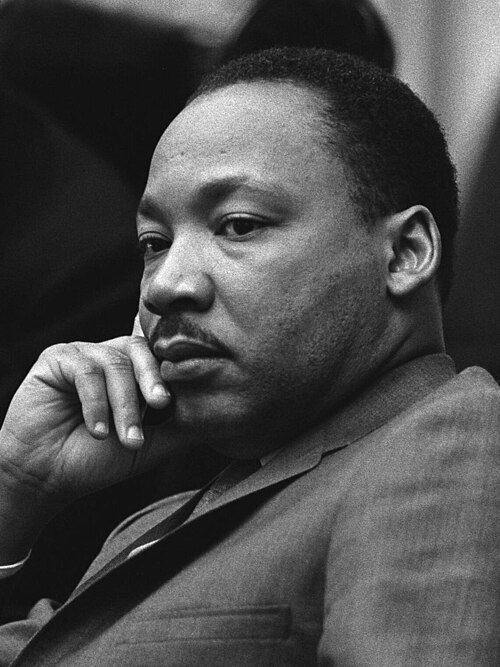
Martin Luther King Jr. (born Michael King Jr.; January 15, 1929 – April 4, 1968) was an American civil rights activist and Baptist minister who was a prominent leader of the civil rights movement from 1955 until his assassination in 1968. He advanced civil rights for people of color in the United States through the use of nonviolent resistance and civil disobedience against Jim Crow laws and other forms of legalized discrimination, which most commonly affected African Americans.
A Black church leader, King participated in and led marches for the right to vote, desegregation, labor rights, and other civil rights.[1] He oversaw the 1955 Montgomery bus boycott and was the first president of the Southern Christian Leadership Conference (SCLC), leading the unsuccessful Albany Movement in Albany, Georgia, and helping organize nonviolent 1963 protests in Birmingham, Alabama. King was one of the leaders of the 1963 March on Washington, where he delivered his "I Have a Dream" speech, and helped organize two of the three Selma to Montgomery marches during the 1965 Selma voting rights movement. There were dramatic standoffs with segregationist authorities, who often responded violently.[2] The civil rights movement achieved pivotal legislative gains in the Civil Rights Act of 1964, the Voting Rights Act of 1965, and the Fair Housing Act of 1968.
King was jailed several times. Federal Bureau of Investigation (FBI) director J. Edgar Hoover considered King a radical and made him an object of COINTELPRO from 1963. FBI agents investigated him for possible communist ties, spied on his personal life, and secretly recorded him. In 1964, the FBI mailed King a threatening anonymous letter, which he interpreted as an attempt to make him commit suicide.[3] King won the 1964 Nobel Peace Prize for combating racial inequality through nonviolent resistance. In his final years, he expanded his focus to include opposition towards poverty and the Vietnam War.
In 1968, King was planning a national occupation of Washington, D.C., to be called the Poor People's Campaign, when he was assassinated on April 4 in Memphis, Tennessee. James Earl Ray was convicted of the assassination, though it remains the subject of conspiracy theories. King's death led to riots in US cities. King was posthumously awarded the Presidential Medal of Freedom in 1977 and Congressional Gold Medal in 2003. Martin Luther King Jr. Day was established as a holiday in cities and states throughout the United States beginning in 1971; the federal holiday was first observed in 1986. The Martin Luther King Jr. Memorial on the National Mall in Washington, D.C., was dedicated in 2011.
Early life and education
Birth
Michael King Jr. was born on January 15, 1929, in Atlanta, the second of three children of Michael King and Alberta King (née Williams).[4][5][6] Alberta's father, Adam Daniel Williams,[7] was a minister in rural Georgia, moved to Atlanta in 1893,[6] and became pastor of the Ebenezer Baptist Church in the following year.[8] Williams married Jennie Celeste Parks.[6] Michael Sr. was born to sharecroppers James Albert and Delia King of Stockbridge, Georgia;[5][6] he was likely of Mende (Sierra Leone) descent.[9][10][11] He enrolled in Morehouse College to study for entry to the ministry.[12] Michael Sr. and Alberta began dating in 1920, and married on November 25, 1926.[13][14] Until Jennie's death in 1941, their home was on the second floor of Alberta's parents' home, where King was born.[15][13][14][16] Michael Jr. had an older sister, Christine King Farris, and a younger brother, Alfred Daniel King.[17]
Shortly after marrying Alberta, King Sr. became assistant pastor of the Ebenezer church.[14] Senior pastor Williams died in the spring of 1931[14] and that fall King Sr. took the role. With support from his wife, he raised attendance from six hundred to several thousand.[6][14][18] In 1934, the church sent King Sr. on a multinational trip; one of the stops being Berlin for the Fifth Congress of the Baptist World Alliance (BWA).[19] He also visited sites in Germany that are associated with the Reformation leader Martin Luther.[19] In reaction to the rise of Nazism, the Congress of the BWA adopted, in August 1934, a resolution saying, "This Congress deplores and condemns as a violation of the law of God the Heavenly Father, all racial animosity, and every form of oppression or unfair discrimination toward the Jews, toward colored people, or toward subject races in any part of the world."[20] After returning home in August 1934, Michael Sr. changed his name to Martin Luther King and his five-year-old son's name to Martin Luther King Jr.[19][21][13][a]
Early childhood
 King's childhood home in Atlanta
At his childhood home, Martin Jr. and his two siblings read aloud the Bible as instructed by their father.[23] After dinners, Martin Jr.'s grandmother Jennie, whom he affectionately referred to as "Mama", told lively stories from the Bible.[23] Martin Jr.'s father regularly used whippings to discipline his children,[24] sometimes having them whip each other.[24] Martin Sr. later remarked, "[Martin Jr.] was the most peculiar child whenever you whipped him. He'd stand there, and the tears would run down, and he'd never cry."[25] Once, when Martin Jr. witnessed his brother A.D. emotionally upset his sister Christine, he took a telephone and knocked A.D. unconscious with it.[24][26] When Martin Jr. and his brother were playing at their home, A.D. slid from a banister and hit Jennie, causing her to fall unresponsive.[27][26] Martin Jr., believing her dead, blamed himself and attempted suicide by jumping from a second-story window,[28][26] but rose from the ground after hearing that she was alive.[28]
Martin Jr. became friends with a white boy whose father owned a business across the street from his home.[29] In September 1935, when the boys were about six years old, they started school.[29][30] King had to attend a school for black children, Yonge Street Elementary School,[29][31] while his playmate went to a separate school for white children only.[29][31] Soon afterwards, the parents of the white boy stopped allowing King to play with their son, stating to him, "we are white, and you are colored".[29][32] When King relayed this to his parents, they talked with him about the history of slavery and racism in America,[29][33] which King would later say made him "determined to hate every white person".[29] His parents instructed him that it was his Christian duty to love everyone.[33]
Martin Jr. witnessed his father stand up against segregation and discrimination.[34] Once, when stopped by a police officer who referred to Martin Sr. as "boy", Martin Sr. responded sharply that Martin Jr. was a boy but he was a man.[34] When Martin Jr's father took him into a shoe store in downtown Atlanta, the clerk told them they needed to sit in the back.[35] Martin Sr. refused, asserting "We'll either buy shoes sitting here or we won't buy any shoes at all", before leaving the store with Martin Jr.[36] He told Martin Jr. afterward, "I don't care how long I have to live with this system, I will never accept it."[36] In 1936, Martin Sr. led hundreds of African Americans in a civil rights march to the city hall in Atlanta to protest voting rights discrimination.[24] Martin Jr. later remarked that Martin Sr. was "a real father" to him.[37]
Martin Jr. memorized hymns and Bible verses by the time he was five years old.[28] Beginning at six years old, he attended church events with his mother and sang hymns while she played piano.[28] His favorite hymn was "I Want to Be More and More Like Jesus".[28] King later became a member of the junior choir in his church.[38] He enjoyed opera, and played the piano.[39] King garnered a large vocabulary from reading dictionaries.[26] He got into physical altercations with boys in his neighborhood, but oftentimes used his knowledge of words to stop or avoid fights.[26][39] King showed a lack of interest in grammar and spelling, a trait that persisted throughout his life.[39] In 1939, King sang as a member of his church choir dressed as a slave for the all-white audience at the Atlanta premiere of the film Gone with the Wind.[40][41] In September 1940, at the age of 11, King was enrolled at the Atlanta University Laboratory School for the seventh grade.[42][43] While there, King took violin and piano lessons and showed keen interest in history and English classes.[42]
On May 18, 1941, when King had sneaked away from studying at home to watch a parade, he was informed that something had happened to his maternal grandmother.[37] After returning home, he learned she had a heart attack and died while being transported to a hospital.[16] He took her death very hard and believed that his deception in going to see the parade may have been responsible for God taking her.[16] King again jumped out of a second-story window at his home but again survived.[16][25][26] His father instructed him that Martin Jr. should not blame himself and that she had been called home to God as part of God's plan.[16][44] Martin Jr. struggled with this.[16] Shortly thereafter, Martin Sr. decided to move the family to a two-story brick home on a hill overlooking downtown Atlanta.[16]
Adolescence
[ ](https://en.wikipedia.org/wiki/File:Booker_T._Washington_High_School_in_Atlanta.jpg)The high school that King attended was named after African-American educator Booker T. Washington.
As an adolescent, he initially felt resentment against whites due to the "racial humiliation" that he, his family, and his neighbors often had to endure.[45] In 1942, when King was 13, he became the youngest assistant manager of a newspaper delivery station for the Atlanta Journal.[46] In the same year, King skipped the ninth grade and enrolled in Booker T. Washington High School, where he maintained a B-plus average.[44][47] The high school was the only one in the city for African-American students.[14]
...
On April 13, 1944, in his junior year, King gave his first public speech during an oratorical contest.[59][55][60][61] In his speech he stated, "black America still wears chains. The finest negro is at the mercy of the meanest white man."[62][59] King was selected as the winner of the contest.[59][55] On the ride home to Atlanta by bus, he and his teacher were ordered by the driver to stand so that white passengers could sit.[55][63] The driver of the bus called King a "black son-of-a-bitch".[55] King initially refused but complied after his teacher told him that he would be breaking the law if he did not.[63] As all the seats were occupied, he and his teacher were forced to stand the rest of the way to Atlanta.[55] Later King wrote of the incident: "That night will never leave my memory. It was the angriest I have ever been in my life."[63]
Morehouse College
During King's junior year in high school, Morehouse College—an all-male historically black college that King's father and maternal grandfather had attended[64][65]—began accepting high school juniors who passed the entrance examination.[55][66][63] As World War II was underway, many black college students had been enlisted,[55][66] so the university aimed to increase their enrollment by allowing juniors to apply.[55][66][63] In 1944, aged 15, King passed the examination and was enrolled at the university that autumn.[67]
In the summer before King started at Morehouse, he boarded a train with his friend—Emmett "Weasel" Proctor—and a group of other Morehouse College students to work in Simsbury, Connecticut, at the tobacco farm of Cullman Brothers Tobacco.[68][69] This was King's first trip into the integrated north.[70][71] In a June 1944 letter to his father, King wrote about the differences that struck him: "On our way here we saw some things I had never anticipated to see. After we passed Washington there was no discrimination at all. The white people here are very nice. We go to any place we want to and sit anywhere we want to."[70]
The farm had partnered with Morehouse College to allot their wages towards the university's tuition, housing, and fees.[68][69] On weekdays King and the other students worked in the fields, picking tobacco from 7:00 am to at least 5:00 pm, enduring temperatures above 100 °F, to earn roughly USD$4 per day.[69][70] On Friday evenings, the students visited downtown Simsbury to get milkshakes and watch movies, and on Saturdays they would travel to Hartford, Connecticut, to see theatre performances, shop, and eat in restaurants.[69][71] On Sundays, they attended church services in Hartford at a church filled with white congregants.[69] King wrote to his parents about the lack of segregation, relaying how he was amazed they could go to "one of the finest restaurants in Hartford" and that "Negroes and whites go to the same church".[69][72][70]...
Marriage and family
[ ](https://en.wikipedia.org/wiki/File:Martin_Luther_King_Jr._is_welcomed_with_a_kiss_from_his_wife,_Coretta_Scott_King,_after_leaving_court_in_Montgomery,_AL,_on_March_22,_1956.jpg)King is welcomed with a kiss from his wife, Coretta Scott King, after leaving court in Montgomery, AL, on March 22, 1956[
 ](https://en.wikipedia.org/wiki/File:Martin_Luther,_Coretta_Scott_and_Yolanda_Denise_King,_1956.png)King with his wife, Coretta Scott King, and daughter, Yolanda Denise King, in 1956
While studying at Boston University, King asked a friend from Atlanta named Mary Powell, a student at the New England Conservatory of Music, if she knew any nice Southern girls. Powell spoke to fellow student Coretta Scott; Scott was not interested in dating preachers but eventually agreed to allow King to telephone her based on Powell's description and vouching. On their first call, King told Scott, "I am like Napoleon at Waterloo before your charms," to which she replied: "You haven't even met me."[citation ^needed]
King married Scott on June 18, 1953, on the lawn of her parents' house, in Heiberger, Alabama.[94] They had four children: Yolanda King (1955–2007), Martin Luther King III (b. 1957), Dexter Scott King (1961–2024), and Bernice King (b. 1963).[95] King limited Coretta's role in the civil rights movement, expecting her to be a housewife and mother.[96]
Activism and organizational leadership
Mary's Cafe Sit-In, 1950
On Sunday, June 11, 1950, King, classmate at Crozer Seminary and housemate Walter McCall, and their dates Doris Wilson and Pearl Smith attended church services in Merchantville. Afterwards they stopped at tavern Mary's Cafe in Maple Shade for beers. The foursome were left waiting without anyone approaching them for service, not unexpectedly. A friend's father and King and McCall's landlord Jesthroe Hunt had warned them Black people were not welcome at Mary's. King replied to the effect of maybe they needed to go, so they could start to go anywhere they wanted.[97] The seminarians had opted for Mary's Cafe with full knowledge of its reputation.[98] After waiting without service, McCall approached the bar.
McCall asked bartender and Mary's Cafe owner Ernest Nichols for packaged goods (beer for takeaway). Nichols refused, explaining he could not sell packaged goods on Sundays or any day after 10pm, by law. McCall then requested 4 glasses of beer to which Nichols answered "no beer, Mr! Today is Sunday”.[99] Nichols would claim they sought him to violate New Jersey's blue law (a restriction common in South Jersey and Pennsylvania as a remnant of the influence of their Quakers roots).[99] McCall requested ginger ales as non-alcoholic beverages were not subject to the blue law. Nichols refused the group even ginger ales and reportedly stated "the best thing would be for you to leave".[100] King and company met refusal with refusal, and remained in their seats as was their right per New Jersey's 1945 anti-discrimination law, which guaranteed non-discrimination by race in public accommodations. Nichols stomped out and returned with a gun standing outside firing into the air reportedly shouting "I'd kill for less".[100] Fearing for their lives, the four activists ran from the tavern. The group went to the Maple Shade Police Department where officers refused to file their complaint. King and McCall contacted Ulysses Simpson Wiggins then President of the Camden County Branch NAACP, who helped them successfully file a police report. The New York Times confirms "The complaint was against Ernest Nichols, a white tavern owner in Maple Shade, N.J., and said that he had refused to serve the black students and their dates in June 1950, and had threatened them by firing a gun in the air. The complaint was signed by the two students. One of the signatures, in a loopy, slanted cursive, reads 'M. L. King Jr.'" ^[101]
Nichols was charged with disorderly conduct and violation of the anti-discrimination law. He was found guilty and fined $50, however the racial discrimination count was dismissed. In a statement submitted "in the spirit of assisting the Prosecutor"[99] Nichol's attorney noted:
Mr. Nichols claims that this act was not intended as a threat to his colored patrons. The colored patrons, on the other hand, while they admit that the gun was not pointed at them or any of them, seemed to think that it was a threat. Mr. Nichols on the other hand states that he has been held up before and he wanted to alert his watchdog who was somewhere outside on the tavern grounds.
— Statement on Behalf of Ernest Nichols, State of New Jersey vs. Ernest Nichols, by W. Thomas McGann[99]
King cited the incident saying it was “a formative step” in his “commitment to a more just society.”[100] The Mary's Cafe sit-in demonstrated the power of non-violent civil disobedience. Nichols' reaction in retrieving a weapon and discharging it to scare the group, or summon his guard dog, to young people's refusal to leave unserved, showed King the potency of such tactics. This sit-in is believed to be the first deployment of the non-violence and civil disobedience tactics which would distinguish King's activism and legacy.
The Mary's Cafe sit-in occurred six months prior to Mordecai Johnson's Lecture on Gandi at the First Unitarian Church of Philadelphia on November 19, 1950 where King would be formally exposed to these tactics. At that lecture and in discussions with Dr. Johnson at the Fellowship House, Dr. King would be inspired and galvanized by how Mahatma Gandhi integrated Henry David Thoreau's theory of Nonviolent resistance and civil disobedience tactics.[102] Patrick Duff, a South Jersey resident, discovered the police report detailing the events at Mary's after searching the archive at The Martin Luther King, Jr. Research and Education Institute.[101]
Montgomery bus boycott, 1955
Main articles: Montgomery bus boycott and Jim Crow laws § Public arena
The Dexter Avenue Baptist Church was influential in the Montgomery African-American community. As the church's pastor, King became known for his oratorical preaching in Montgomery and surrounding region.[103]
In March 1955, Claudette Colvin—a black schoolgirl in Montgomery—refused to give up her bus seat to a white man in violation of Jim Crow laws, local laws in the Southern US that enforced racial segregation.[104] On December 1, 1955, Rosa Parks was arrested for refusing to give up her seat on a city bus.[105] These incidents led to the Montgomery bus boycott, which was urged and planned by Edgar Nixon and led by King.[106] The other ministers asked him to take a leadership role because his relative newness to community leadership made it easier for him to speak out. King was hesitant but decided to do so if no one else wanted it.[107]
The boycott lasted for 385 days,[108] and the situation became so tense that King's house was bombed.[109] King was arrested for traveling 30 mph in a 25 mph zone[110] and jailed, which drew the attention of national media, and increased King's public stature. The controversy ended when the US District Court issued a ruling in Browder v. Gayle that prohibited racial segregation on Montgomery public buses.[111][1][107]
 King first rose to prominence in the civil rights movement while minister of Dexter Avenue Baptist Church in Montgomery, Alabama.
King's role in the bus boycott transformed him into a national figure and the best-known spokesman of the civil rights movement.[112]
Southern Christian Leadership Conference
In 1957, King, along with Christian ministers Ralph Abernathy, Fred Shuttlesworth, and Joseph Lowery, as well as Bayard Rustin and other activists founded the Southern Christian Leadership Conference (SCLC). The group was created to harness the moral authority and organizing power of black churches to conduct nonviolent protests in the service of civil rights reform. The group was inspired by the crusades of evangelist Billy Graham, who befriended King,[113] as well as the national organizing of the group In Friendship, founded by King allies Stanley Levison and Ella Baker.[114] King led the SCLC until his death.[115] The SCLC's 1957 Prayer Pilgrimage for Freedom was the first time King addressed a national audience.[116]
[ ](https://en.wikipedia.org/wiki/File:Martin_Luther_King,_Dining,_November_5,_1962_%28cropped%29.jpg)King in November 1962
Harry Wachtel joined King's legal advisor Clarence B. Jones in defending four ministers of the SCLC in the libel case Abernathy et al. v. Sullivan; the case was litigated about the newspaper advertisement "Heed Their Rising Voices". Wachtel founded a tax-exempt fund to cover the suit's expenses and assist the civil rights movement through more effective fundraising. King served as honorary president of this organization, named the "Gandhi Society for Human Rights". In 1962, King and the Gandhi Society produced a document that called on President Kennedy to issue an executive order to deliver a blow to segregation as a kind of Second Emancipation Proclamation. Kennedy did not execute the order.[117] The FBI, under written directive from Attorney General Robert F. Kennedy, began tapping King's telephone line in the fall of 1963.[118] Kennedy was concerned that public allegations of communists in the SCLC would derail the administration's civil rights initiatives. He warned King to discontinue these associations and felt compelled to issue the directive that authorized the FBI to wiretap King and other SCLC leaders.[119] FBI Director J. Edgar Hoover feared the civil rights movement and investigated the allegations of communist infiltration. When no evidence emerged to support this, the FBI used the incidental details caught on tape over the next five years, as part of its COINTELPRO program, in attempts to force King out of his leadership position.[3]
King believed that organized, nonviolent protest against the system of southern segregation known as Jim Crow laws would lead to extensive media coverage of the struggle for black equality. Journalistic accounts and televised footage of the daily indignities suffered by southern blacks, and of segregationist violence and harassment, produced a wave of sympathetic public opinion that convinced most Americans that the civil rights movement was the most important political issue in the early 1960s.[120][121]
King organized and led marches for blacks' right to vote, desegregation, labor rights, and other basic civil rights.[1] Most of these rights were successfully enacted into law with the Civil Rights Act of 1964 and the 1965 Voting Rights Act.[122][123] The SCLC used tactics of nonviolent protest with success, by strategically choosing the methods and places in which protests were carried out. There were often dramatic stand-offs with segregationist authorities, who sometimes turned violent.[2]
Survived knife attack, 1958
On September 20, 1958, King was signing copies of his book Stride Toward Freedom in Blumstein's department store in Harlem[124] when Izola Curry—a mentally ill black woman who thought King was conspiring against her with communists—stabbed him in the chest with a letter opener.[125] King underwent surgery by Aubre de Lambert Maynard, Emil Naclerio and John W. V. Cordice; he remained hospitalized for weeks. Curry was later found mentally incompetent to stand trial.[126][127] Accepting his doctor's advice, King, along with Coretta and Alabama State College history professor Lawrence D. Reddick, traveled to Europe, India and the Middle East from February to March 1959 to recuperate. Upon returning to Montgomery, King agreed with the SCLC board to fire executive director John Lee Tilley, but hired co-founder Bayard Rustin to manage press relations.
Atlanta sit-ins, prison sentence, and the 1960 elections
 King led the Southern Christian Leadership Conference and later became co-pastor with his father at Ebenezer Baptist Church in Atlanta (pulpit and sanctuary pictured).
In December 1959, King announced his return to Atlanta at the request of the SCLC.[128] In Atlanta, King served until his death as co-pastor with his father at the Ebenezer Baptist Church. Georgia governor Ernest Vandiver expressed open hostility towards King's return and vowed to keep King under surveillance.[129] On May 4, 1960, King drove writer Lillian Smith to Emory University when police stopped them. King was cited for "driving without a license" because he had not yet been issued a Georgia license. King's Alabama license was still valid, and Georgia law did not mandate any time limit for issuing a local license.[130] King paid a fine but was unaware his lawyer agreed to a plea deal that included probation.
Meanwhile, the Atlanta Student Movement had been acting to desegregate businesses and public spaces, organizing the Atlanta sit-ins from March 1960 onwards. In August the movement asked King to participate in a mass October sit-in, timed to highlight how 1960's presidential election campaigns had ignored civil rights. The coordinated day of action took place on October 19. King participated in a sit-in at the restaurant inside Rich's, Atlanta's largest department store, and was among the many arrested. The authorities released everyone over the next few days, except King. Invoking his probationary plea deal, Judge J. Oscar Mitchell sentenced King on October 25 to four months of hard labor. Before dawn the next day, King was transported to Georgia State Prison.[131]
The arrest and harsh sentence drew nationwide attention. Many feared for King's safety, as he started a sentence with people convicted of violent crimes, many white and hostile to his activism.[132] Presidential candidates were asked to weigh in, at a time when parties were courting the support of Southern Whites and their political leadership including Governor Vandiver. Nixon, with whom King had a closer relationship before, declined to make a statement despite a visit from Jackie Robinson requesting his intervention. Nixon's opponent John F. Kennedy called the governor, enlisted his brother Robert to exert more pressure on state authorities, and, at the request of Sargent Shriver, called King's wife to offer his help. The pressure from Kennedy and others proved effective, and King was released two days later. King's father decided to openly endorse Kennedy's candidacy for the November 8 election which he narrowly won.[133]
After the October 19 sit-ins and following unrest, a 30-day truce was declared in Atlanta for desegregation negotiations. However, negotiations failed and sit-ins and boycotts resumed for several months. On March 7, 1961, a group of Black elders including King notified student leaders that a deal had been reached: the city's lunch counters would desegregate in fall 1961, in conjunction with the court-mandated desegregation of schools.[134][135] Many students were disappointed at the compromise. In a meeting on March 10 at Warren Memorial Methodist Church, the audience was hostile and frustrated. King gave an impassioned speech calling participants to resist the "cancerous disease of disunity", helping to calm tensions.[136] Rustin and King organized a civil rights march near the 1960 Democratic National Convention in Los Angeles. Representative Adam Clayton Powell Jr. threatened to leak rumors of a false affair between Rustin and King to the press. King canceled the march and Rustin resigned from his position with the SCLC. ^[137]
Albany Movement, 1961
Main article: Albany Movement
The Albany Movement was a desegregation coalition formed in Albany, Georgia, in November 1961. In December, King and the SCLC became involved. The movement mobilized thousands of citizens for a nonviolent attack on segregation in the city and attracted nationwide attention. When King first visited on December 15, 1961, he "had planned to stay a day or so and return home after giving counsel."[138] The following day he was swept up in a mass arrest of peaceful demonstrators, and he declined bail until the city made concessions. According to King, "that agreement was dishonored and violated by the city" after he left.[138]
...
Birmingham campaign, 1963
Main article: Birmingham campaign
 King was arrested in 1963 for protesting the treatment of black people in Birmingham.[144][
 ](https://en.wikipedia.org/wiki/File:Photograph_of_White_House_Meeting_with_Civil_Rights_Leaders._June_22,_1963_-NARA_-194190_%28no_border%29.tif)Vice President Lyndon B. Johnson and Attorney General Robert F. Kennedy with King, Benjamin Mays, and other civil rights leaders, June 22, 1963.
In April 1963, the SCLC began a campaign against racial segregation and economic injustice in Birmingham, Alabama. The campaign used nonviolent but intentionally confrontational tactics, developed in part by Wyatt Tee Walker. Black people in Birmingham, organizing with the SCLC, occupied public spaces with marches and sit-ins, openly violating laws that they considered unjust.
King's intent was to provoke mass arrests and "create a situation so crisis-packed that it will inevitably open the door to negotiation."[145] The campaign's early volunteers did not succeed in shutting down the city, or in drawing media attention to the police's actions. Over the concerns of an uncertain King, SCLC strategist James Bevel changed the course of the campaign by recruiting children and young adults to join the demonstrations.[146] Newsweek called this strategy a Children's Crusade.[147][148]
The Birmingham Police Department, led by [Eugene "Bull" Connor](https://en.wikipedia.org/wiki/Eugene_%22Bull%22_Connor "Eugene "Bull" Connor"), used high-pressure water jets and police dogs against protesters, including children.
Footage of the police response was broadcast on national television, shocking many white Americans and consolidating black Americans behind the movement.[149] Not all demonstrators were peaceful, despite the avowed intentions of the SCLC. In some cases, bystanders attacked the police, who responded with force. King and the SCLC were criticized for putting children in harm's way. But the campaign was a success: Connor lost his job, the "Jim Crow" signs came down, and public places became more open to blacks. King's reputation improved immensely.[147]
King was arrested and jailed early in the campaign—his 13th arrest[150] out of 29.[151] From his cell, he composed the now-famous "Letter from Birmingham Jail" that responds to calls to pursue legal channels for social change. The letter has been described as "one of the most important historical documents penned by a modern political prisoner".[152]
King argues that the crisis of racism is too urgent, and the current system too entrenched: "We know through painful experience that freedom is never voluntarily given by the oppressor; it must be demanded by the oppressed."[153] He points out that the Boston Tea Party, a celebrated act of rebellion in the American colonies, was illegal civil disobedience, and that, conversely, "everything Adolf Hitler did in Germany was 'legal'."[153] Walter Reuther, president of the United Auto Workers, arranged for $160,000 to bail out King and his fellow protestors.[154]
"I have almost reached the regrettable conclusion that the Negro's great stumbling block in his stride toward freedom is not the White Citizen's Councilor or the Ku Klux Klanner, but the white moderate, who is more devoted to "order" than to justice; who prefers a negative peace which is the absence of tension to a positive peace which is the presence of justice; who constantly says: "I agree with you in the goal you seek, but I cannot agree with your methods of direct action"; who paternalistically believes he can set the timetable for another man's freedom; who lives by a mythical concept of time and who constantly advises the Negro to wait for a "more convenient season."
— Martin Luther King Jr.[153]
March on Washington, 1963
Main article: March on Washington
[ ](https://en.wikipedia.org/wiki/File:Civil_Rights_March_on_Washington,_D.C.%28Leaders_of_the_march_posing_in_front_of_the_statue_of_Abraham_Lincoln...-_NARA_-_542063_%28cropped%29.jpg)Leaders of the March on Washington posing in front of the Lincoln Memorial
 The March on Washington for Jobs and Freedom (1963).
King, representing the SCLC, was among the leaders of the "Big Six" civil rights organizations who were instrumental in the organization of the March on Washington for Jobs and Freedom, which took place on August 28, 1963. The other leaders and organizations comprising the Big Six were Roy Wilkins from the National Association for the Advancement of Colored People; Whitney Young, National Urban League; A. Philip Randolph, Brotherhood of Sleeping Car Porters; John Lewis, SNCC; and James L. Farmer Jr., Congress of Racial Equality.[155]
Bayard Rustin's open homosexuality, support of socialism, and former ties to the Communist Party USA caused many white and African-American leaders to demand King distance himself,[156] which King agreed to do.[157] However, he did collaborate in the 1963 March on Washington, for which Rustin was the primary organizer.[158][159]
For King, this role was another which courted controversy, since he was a key figure who acceded to the wishes of President Kennedy in changing the focus of the march.[160][161] Kennedy initially opposed the march outright, because he was concerned it would negatively impact the drive for passage of civil rights legislation. However, the organizers were firm the march would proceed.[162] With the march going forward, the Kennedys decided it was important to ensure its success. President Kennedy was concerned the turnout would be less than 100,000 and enlisted the aid of additional church leaders and Walter Reuther, president of the United Automobile Workers, to help mobilize demonstrators.[163]
The March, a 1964 documentary film produced by the United States Information Agency.
King's speech has been redacted from this video because of the copyright held by King's estate.
The march originally was planned to dramatize the desperate condition of blacks in the southern US and place organizers' concerns and grievances squarely before the seat of power in the capital. Organizers intended to denounce the federal government for its failure to safeguard the civil rights and physical safety of civil rights workers and blacks. The group acquiesced to presidential pressure, and the event ultimately took on a less strident tone.[164] As a result, some civil rights activists felt it presented an inaccurate, sanitized pageant of racial harmony; Malcolm X called it the "Farce on Washington", and the Nation of Islam forbade its members from attending.[164][165]
[ ](https://en.wikipedia.org/wiki/File:Martin_Luther_King_Jr_National_Historic_Site_%2836233249121%29.jpg)King gave his most famous speech, "I Have a Dream", before the Lincoln Memorial during the 1963 March on Washington for Jobs and Freedom.
Duration: 30 seconds.0:30
30-second sample from "I Have a Dream" speech by Martin Luther King Jr. at the March on Washington for Jobs and Freedom on August 28, 1963
The march made specific demands: an end to racial segregation in public schools; meaningful civil rights legislation, including a law prohibiting racial discrimination in employment; protection of civil rights workers from police brutality; a $2 minimum wage for all workers (equivalent to $21 in 2025); and self-government for Washington, D.C., then governed by congressional committee.[166][167][168] Despite tensions, the march was a resounding success.[169] More than a quarter of a million people of diverse ethnicities attended, sprawling from the steps of the Lincoln Memorial onto the National Mall. At the time, it was the largest gathering of protesters in Washington, D.C.'s history.[169]
King delivered a 17-minute speech, later known as "I Have a Dream". In the speech's most famous passage – in which he departed from his prepared text, possibly at the prompting of Mahalia Jackson, who shouted, "Tell them about the dream!"[170][171] – King said:[172]
I say to you today, my friends, so even though we face the difficulties of today and tomorrow, I still have a dream. It is a dream deeply rooted in the American dream.
I have a dream that one day this nation will rise up and live out the true meaning of its creed: "We hold these truths to be self-evident: that all men are created equal."
I have a dream that one day on the red hills of Georgia the sons of former slaves and the sons of former slave owners will be able to sit down together at the table of brotherhood.
I have a dream that one day even the state of Mississippi, a state sweltering with the heat of injustice, sweltering with the heat of oppression, will be transformed into an oasis of freedom and justice.
I have a dream that my four little children will one day live in a nation where they will not be judged by the color of their skin but by the content of their character.
I have a dream today.
I have a dream that one day, down in Alabama, with its vicious racists, with its governor having his lips dripping with the words of interposition and nullification; one day right there in Alabama, little black boys and black girls will be able to join hands with little white boys and white girls as sisters and brothers.
I have a dream today.
"I Have a Dream" came to be regarded as one of the finest speeches in the history of oratory.[173] The March, and especially King's speech, helped put civil rights at the top of the agenda of reformers and facilitated passage of the Civil Rights Act of 1964.[174][175]
New York City, 1964
 King at a press conference in March 1964
On February 6, 1964, King delivered the inaugural speech[176] of a lecture series initiated at the New School called "The American Race Crisis". In his remarks, King referred to a conversation he had recently had with Jawaharlal Nehru in which he compared the sad condition of many African Americans to that of India's untouchables.[177] In his March 18, 1964, interview with Robert Penn Warren, King compared his activism to his father's, citing his training in non-violence as a key difference. He also discusses the next phase of the civil rights movement and integration.[178]...
...
Selma voting rights movement and "Bloody Sunday", 1965
Main article: Selma to Montgomery marches
 The civil rights march from Selma to Montgomery, Alabama, in 1965.
In December 1964, King and the SCLC joined forces with the Student Nonviolent Coordinating Committee (SNCC) in Selma, Alabama, where the SNCC had been working on voter registration for several months.[188] A local judge issued an injunction that barred any gathering of three or more people affiliated with the SNCC, SCLC, DCVL, or any of 41 named civil rights leaders. This injunction temporarily halted civil rights activity until King defied it by speaking at Brown Chapel on January 2, 1965.[189] During the 1965 march to Montgomery, Alabama, violence by state police and others against the peaceful marchers resulted in much publicity, which made racism in Alabama visible nationwide.
Acting on James Bevel's call for a march from Selma to Montgomery, Bevel and other SCLC members, in partial collaboration with SNCC, attempted to organize a march to the state's capital. The first attempt to march on March 7, 1965, at which King was not present, was aborted because of mob and police violence against the demonstrators. This day has become known as Bloody Sunday and was a turning point in the effort to gain public support for the civil rights movement. It was the clearest demonstration up to that time of the dramatic potential of King and Bevel's nonviolence strategy.[51]
On March 5, King met with officials in the Johnson Administration to request an injunction against any prosecution of the demonstrators. He did not attend the march due to church duties, but later wrote, "If I had any idea that the state troopers would use the kind of brutality they did, I would have felt compelled to give up my church duties altogether to lead the line."[190] Footage of police brutality against the protesters was broadcast extensively and aroused public outrage.[191]
King next attempted to organize a march for March 9. The SCLC petitioned for an injunction in federal court against Alabama; this was denied and the judge issued an order blocking the march until after a hearing. Nonetheless, King led marchers on March 9 to the Edmund Pettus Bridge in Selma, then held a prayer session before turning the marchers around and asking them to disperse so as not to violate the court order. The unexpected ending of this second march aroused the surprise and anger of many within the local movement.[192] The march finally went ahead fully on March 25, 1965.[193][194] At the conclusion of the march on the steps of the state capitol, King delivered a speech that became known as "How Long, Not Long". King stated that equal rights for African Americans could not be far away, "because the arc of the moral universe is long, but it bends toward justice" and "you shall reap what you sow".[b][195][196][197]
Chicago open housing movement, 1966
Main article: Chicago Freedom Movement
[ ](https://en.wikipedia.org/wiki/File:Lyndon_Johnson_signing_Civil_Rights_Act,_July_2,_1964.jpg)King standing behind President Johnson as he signs the Civil Rights Act of 1964.
In 1966, after several successes in the south, King, Bevel, and others in the civil rights organizations took the movement to the North. King and Ralph Abernathy, both from the middle class, moved into a building at 1550 S. Hamlin Avenue, in the slums of North Lawndale[198] on Chicago's West Side, as an educational experience and to demonstrate their support and empathy for the poor.[199]
St. Augustine, Florida, 1964
Main article: St. Augustine movement
...Opposition to the Vietnam War
See also: Opposition to United States involvement in the Vietnam War
The black revolution is much more than a struggle for the rights of Negroes. It is forcing America to face all its interrelated flaws—racism, poverty, militarism, and materialism. It is exposing evils that are rooted deeply in the whole structure of our society. It reveals systemic rather than superficial flaws and suggests that radical reconstruction of society itself is the real issue to be faced.
— Martin Luther King Jr.[211]
We must recognize that we can't solve our problem now until there is a radical redistribution of economic and political power... this means a revolution of values and other things. We must see now that the evils of racism, economic exploitation, and militarism are all tied together… you can't really get rid of one without getting rid of the others… the whole structure of American life must be changed. America is a hypocritical nation and [we] must put [our] own house in order.
— Martin Luther King Jr.[212]
King was long opposed to American involvement in the Vietnam War,[213] but at first avoided the topic in speeches to avoid interference with civil rights goals that criticism of President Johnson's policies might have created.[213] At the urging of SCLC's former Director of Direct Action and now the head of the Spring Mobilization Committee to End the War in Vietnam, James Bevel, and inspired by the outspokenness of Muhammad Ali,[214] King eventually agreed to publicly oppose the war, as opposition was growing among the public.[213]
During an April 1967 appearance at the New York City Riverside Church, King delivered a speech titled "Beyond Vietnam: A Time to Break Silence".[215] He spoke against America's role in the war, arguing the US was in Vietnam "to occupy it as an American colony"[216] and calling the US government "the greatest purveyor of violence in the world today".[217] He connected the war with economic injustice, arguing that the country needed serious moral change:
A true revolution of values will soon look uneasily on the glaring contrast of poverty and wealth. With righteous indignation, it will look across the seas and see individual capitalists of the West investing huge sums of money in Asia, Africa and South America, only to take the profits out with no concern for the social betterment of the countries, and say: "This is not just."[218]
King opposed the war because it took resources away from social welfare at home: "A nation that continues year after year to spend more money on military defense than on programs of social uplift is approaching spiritual death."[218] He stated that North Vietnam "did not begin to send in any large number of supplies or men until American forces had arrived in the tens of thousands",[219] and accused the U.S. of having killed a million Vietnamese, "mostly children".[220] King also criticized American opposition to North Vietnam's land reforms.[221]
King's opposition cost him significant support among white allies including Johnson, Billy Graham, union leaders, and powerful publishers.[222][223][224] "The press is being stacked against me", King said,[225] complaining of what he described as a double standard that applauded his nonviolence at home, but deplored it when applied "toward little brown Vietnamese children".[226] Life magazine called the speech "demagogic slander that sounded like a script for Radio Hanoi",[218] and The Washington Post declared that King had "diminished his usefulness to his cause, his country, his people."[226][227]
 King speaking to an anti-Vietnam war rally at the University of Minnesota in St. Paul on April 27, 1967.
The "Beyond Vietnam" speech reflected King's evolving political advocacy in his later years, which paralleled the teachings of the progressive Highlander Research and Education Center, with which he was affiliated.[228][229] King began to speak of the need for fundamental changes in the American political and economic situation, and more frequently expressed his opposition to the war and his desire to see a redistribution of resources to correct injustice.[230][231] He guarded his language in public to avoid being linked to communism, but in private sometimes spoke of his support for democratic socialism.[232][233]
King stated in "Beyond Vietnam" that "true compassion is more than flinging a coin to a beggar ... it comes to see that an edifice which produces beggars needs restructuring."[234] King quoted a US official who said that from Vietnam to Latin America, the country was "on the wrong side of a world revolution."[234] King condemned America's "alliance with the landed gentry of Latin America", and said the US should support "the shirtless and barefoot people" in the Third World rather than suppressing their attempts at revolution.[234]
King's stance on Vietnam encouraged Allard K. Lowenstein, William Sloane Coffin and Norman Thomas, with the support of anti-war Democrats, to attempt to persuade King to run against President Johnson in the 1968 presidential election. King contemplated but decided against this as he felt uneasy with politics and considered himself better suited to activism.[235]
On April 15, 1967, King spoke at an anti-war march from Manhattan's Central Park to the UN. The march was organized by the Spring Mobilization Committee to End the War in Vietnam under chairman James Bevel. At the UN King brought up issues of civil rights and the draft:
I have not urged a mechanical fusion of the civil rights and peace movements. There are people who have come to see the moral imperative of equality, but who cannot yet see the moral imperative of world brotherhood. I would like to see the fervor of the civil-rights movement imbued into the peace movement to instill it with greater strength. And I believe everyone has a duty to be in both the civil-rights and peace movements. But for those who presently choose but one, I would hope they will finally come to see the moral roots common to both.[236]
Seeing an opportunity to unite civil rights and anti-war activists,[214] Bevel convinced King to become even more active in the anti-war effort.[214] Despite his growing public opposition to the war, King was not fond of the hippie culture developed from the anti-war movement.[237] In his 1967 Massey Lecture, King stated:
The importance of the hippies is not in their unconventional behavior, but in the fact that hundreds of thousands of young people, in turning to a flight from reality, are expressing a profoundly discrediting view on the society they emerge from.[237]
On January 13, 1968, King called for a large march on Washington against "one of history's most cruel and senseless wars":[238][239]
We need to make clear in this political year, to congressmen on both sides of the aisle and to the president of the United States, that we will no longer tolerate, we will no longer vote for men who continue to see the killings of Vietnamese and Americans as the best way of advancing the goals of freedom and self-determination in Southeast Asia.[238][239]
Correspondence with Thích Nhất Hạnh
Thích Nhất Hạnh was an influential Vietnamese Buddhist who wrote a letter to King in 1965 entitled: "In Search of the Enemy of Man". It was during his 1966 stay in the US that Nhất Hạnh met with King and urged him to publicly denounce the war.[240] On 4 April 1967, King gave a speech in New York City, his first to publicly question U.S. involvement in Vietnam.[241] Later that year, King nominated Nhất Hạnh for the Nobel Peace Prize. In his nomination, King said, "I do not personally know of anyone more worthy of [this prize] than this gentle monk from Vietnam. His ideas for peace, if applied, would build a monument to ecumenism, to world brotherhood, to humanity".[242]
Poor People's Campaign, 1968
Main article: Poor People's Campaign
[ ](https://en.wikipedia.org/wiki/File:Resurrection_City_Washington_D.C._1968.jpg)A shantytown established in Washington, D.C. to protest economic conditions as a part of the Poor People's Campaign.
In 1968, King and the SCLC organized the "Poor People's Campaign" to address economic justice. King traveled the country to assemble "a multiracial army of the poor" that would march on Washington to engage in nonviolent civil disobedience at the Capitol until Congress created an "economic bill of rights".[243][244] ...
Global policy
King was one of the signatories of the agreement to convene a convention for drafting a world constitution.[250][251] As a result, in 1968 a World Constituent Assembly convened to draft and adopt the Constitution for the Federation of Earth.[252]
Assassination and aftermath
Main article: Assassination of Martin Luther King Jr.
[ ](https://en.wikipedia.org/wiki/File:Lorraine_Motel,_Memphis,_TN,_US.jpg)The Lorraine Motel, where King was assassinated, is now the site of the National Civil Rights Museum.
Duration: 30 seconds.0:30
Final 30 seconds of "I've Been to the Mountaintop" speech by Martin Luther King Jr.
On March 29, 1968, King went to Memphis, Tennessee, in support of the black sanitation workers, who were represented by American Federation of State, County and Municipal Employees (AFSCME) Local 1733. The workers had been on strike since March 12 for higher wages and better treatment. In one incident, black street repairmen received pay for two hours when they were sent home because of bad weather, but white employees were paid for the full day.[253][254][255]
On April 3, King addressed a rally and delivered his "I've Been to the Mountaintop" address at Mason Temple. King's flight to Memphis had been delayed by a bomb threat against his plane.[256] In reference to the bomb threat, King said:
And then I got to Memphis. And some began to say the threats, or talk about the threats that were out. What would happen to me from some of our sick white brothers? Well, I don't know what will happen now. We've got some difficult days ahead. But it doesn't matter with me now. Because I've been to the mountaintop. And I don't mind. Like anybody, I would like to live a long life. Longevity has its place. But I'm not concerned about that now. I just want to do God's will. And He's allowed me to go up to the mountain. And I've looked over. And I've seen the promised land. I may not get there with you. But I want you to know tonight, that we, as a people, will get to the promised land. So I'm happy, tonight. I'm not worried about anything. I'm not fearing any man. Mine eyes have seen the glory of the coming of the Lord.[257]
King was booked in Room 306 at the Lorraine Motel in Memphis. Ralph Abernathy, who was present at the assassination, testified to the United States House Select Committee on Assassinations that King and his entourage stayed at Room 306 so often that it was known as the "King-Abernathy suite".[258] According to Jesse Jackson, who was present, King's last words were spoken to musician Ben Branch, who was scheduled to perform that night at an event King was attending: "Ben, make sure you play 'Take My Hand, Precious Lord' in the meeting tonight. Play it real pretty."[259]
King was fatally shot by James Earl Ray at 6:01 p.m., Thursday, April 4, 1968, as he stood on the motel's second-floor balcony. The bullet entered through his right cheek, smashing his jaw, then traveled down his spinal cord before lodging in his shoulder.[260][261] Abernathy heard the shot from inside the motel room and ran to the balcony to find King on the floor.[262]
After emergency surgery, King died at St. Joseph's Hospital at 7:05 p.m.[263] According to biographer Taylor Branch, King's autopsy revealed that though only 39 years old, he "had the heart of a 60 year old", which Branch attributed to stress.[264] King was initially interred in South View Cemetery in South Atlanta, but in 1977, his remains were transferred to a tomb on the site of the Martin Luther King Jr. National Historical Park.[265]
Aftermath
Further information: King assassination riots
The assassination led to race riots in Washington, D.C., Chicago, Baltimore, Louisville, Kansas City, and dozens of other cities.[266][267][268] Presidential candidate Robert F. Kennedy was on his way to Indianapolis for a campaign rally when he was informed of King's death. He gave a short, improvised speech to the gathering of supporters informing them of the tragedy and urging them to continue King's ideal of nonviolence.[269] The following day, he delivered a prepared response in Cleveland.[270] James Farmer Jr. and other civil rights leaders also called for non-violent action, while the more militant Stokely Carmichael called for a more forceful response.[271] The city of Memphis quickly settled the strike on terms favorable to the sanitation workers.[272]
The plan to set up a shantytown in Washington, D.C., was carried out soon after the April 4 assassination. Criticism of King's plan was subdued in the wake of his death, and the SCLC received an unprecedented wave of donations to carry it out. The campaign officially began in Memphis, on May 2, at the hotel where King was murdered.[273] Thousands of demonstrators arrived on the National Mall and stayed for six weeks, establishing a camp they called "Resurrection City".[274]
President Johnson tried to quell the riots by making telephone calls to civil rights leaders, mayors and governors and told politicians that they should warn the police against the unwarranted use of force.[268] "I'm not getting through," Johnson told his aides. "They're all holing up like generals in a dugout getting ready to watch a war."[268] Johnson declared April 7 a national day of mourning for King.[275] Vice President Hubert Humphrey attended King's funeral on behalf of the President, as there were fears that Johnson's presence might incite protests and perhaps violence.[276] At his widow's request, King's last sermon at Ebenezer Baptist Church, given on February 4, 1968, was played at the funeral,
I'd like somebody to mention that day that Martin Luther King Jr. tried to give his life serving others. I'd like for somebody to say that day that Martin Luther King Jr. tried to love somebody. I want you to say that day that I tried to be right on the war question. I want you to be able to say that day that I did try to feed the hungry. I want you to be able to say that day that I did try in my life to clothe those who were naked. I want you to say on that day that I did try in my life to visit those who were in prison. And I want you to say that I tried to love and serve humanity. Yes, if you want to say that I was a drum major. Say that I was a drum major for justice. Say that I was a drum major for peace. I was a drum major for righteousness. And all of the other shallow things will not matter. I won't have any money to leave behind. I won't have the fine and luxurious things of life to leave behind. But I just want to leave a committed life behind.[277][271][278]
His friend Mahalia Jackson sang his favorite hymn, "Take My Hand, Precious Lord", at the funeral.[279] The assassination helped to spur the enactment of the Civil Rights Act of 1968.[268] Two months after King's death, James Earl Ray—on the loose from a previous prison escape—was captured at London Heathrow Airport while trying to reach white-ruled Rhodesia on a false Canadian passport. He was using the alias Ramon George Sneyd.[280]
Ray was quickly extradited to Tennessee and charged with King's murder. He confessed on March 10, 1969, though he recanted this confession three days later.[281] On the advice of his attorney Percy Foreman, Ray pleaded guilty to avoid the possibility of the death penalty. He was sentenced to a 99-year prison term.[281][282] Ray later claimed a man he met in Montreal, Quebec, with the alias "Raoul" was involved and that the assassination was the result of a conspiracy.[283][284] He spent the remainder of his life attempting, unsuccessfully, to withdraw his guilty plea and secure the trial he never had.[282] Ray died in 1998 at age 70.[285]
Allegations of conspiracy
Main article: Martin Luther King Jr. assassination conspiracy theories.
 The sarcophagus for Martin Luther King Jr. and Coretta Scott King is within the Martin Luther King Jr. National Historical Park in Atlanta, Georgia.
Ray's lawyers maintained he was a scapegoat similar to the way that John F. Kennedy's assassin Lee Harvey Oswald is seen by conspiracy theorists.[286] Supporters of this assertion said that Ray's confession was given under pressure and that he had been threatened with the death penalty.[282][287] They admitted that Ray was a thief and burglar, but claimed that he had no record of committing violent crimes with a weapon.[284]
However, prison records in different U.S. cities have shown that he was incarcerated on numerous occasions for armed robbery.[288] In a 2008 interview with CNN, Jerry Ray, the younger brother of James Earl Ray, claimed that James was smart and was sometimes able to get away with armed robbery. "I never been with nobody as bold as he is," Jerry said. "He just walked in and put that gun on somebody, it was just like it's an everyday thing."[288]
Those suspecting a conspiracy point to the two successive ballistics tests which proved that a rifle similar to Ray's Remington Gamemaster had been the murder weapon. Those tests did not implicate Ray's specific rifle.[282][289] Witnesses near King said that the shot came from another location, from behind thick shrubbery near the boarding house—which had been cut away in the days following the assassination—and not from the boarding house window.[290] However, Ray's fingerprints were found on various objects in the bathroom where it was determined the gunfire came from.[288] An examination of the rifle containing Ray's fingerprints determined that at least one shot was fired from the firearm at the time of the assassination.[288]
In 1997, King's son Dexter Scott King met with Ray, and publicly supported Ray's efforts to obtain a new trial.[291] Two years later, King's widow Coretta Scott King and the couple's children, represented by William F. Pepper,[292] won a wrongful death claim against Loyd Jowers and "other unknown co-conspirators". Jowers claimed to have received $100,000 to arrange King's assassination. The jury found Jowers to be complicit in a conspiracy and that government agencies were party to the assassination.[293][294] ...
Legacy
See also: Memorials to Martin Luther King Jr. and List of streets named after Martin Luther King Jr.
 Martin Luther King Jr. statue over the west entrance of Westminster Abbey, installed in 1998[
 ](https://en.wikipedia.org/wiki/File:Martin_Luther_King_Jr_Blvd,_Chapel_Hill.jpg)Martin Luther King Jr Blvd, in Chapel Hill, North Carolina
South Africa
See also: Black Consciousness Movement
King's legacy includes influences on the Black Consciousness Movement and civil rights movement in South Africa.[305][306] King's work was cited by, and served as, an inspiration for South African leader Albert Luthuli, who fought for racial justice in his country during apartheid and was later awarded the Nobel Peace Prize.[307]
United Kingdom
See also: Northern Ireland civil rights movement
John Hume, the former leader of the Social Democratic and Labour Party, cited King's legacy as quintessential to the Northern Ireland civil rights movement and the signing of the Good Friday Agreement, calling him "one of my great heroes of the century".[308][309][310] ...
Main article: Martin Luther King Jr. Day
Beginning in 1971, cities and states established annual holidays to honor King.[329] On November 2, 1983, President Ronald Reagan signed a bill creating a federal holiday to honor King. Observed for the first time on January 20, 1986, it is called Martin Luther King Jr. Day. Following President George H. W. Bush's 1992 proclamation, the holiday is observed on the third Monday of January each year, near the time of King's birthday.[330][331] On January 17, 2000, for the first time, Martin Luther King Jr. Day was officially observed in all fifty U.S. states.[332] Arizona (1992), New Hampshire (1999) and Utah (2000) were the last states to recognize the holiday. Utah previously celebrated the holiday under the name Human Rights Day.[333].
Television
Actress Nichelle Nichols planned to leave the science-fiction television series Star Trek in 1967 after its first season.[410] She changed her mind after talking to King,[411] who was a fan of the show. King explained that her character signified a future of greater racial cooperation.[412] King told Nichols, "You are our image of where we're going, you're 300 years from now, and that means that's where we are and it takes place now. Keep doing what you're doing, you are our inspiration."[413] As Nichols recounted:
Star Trek was one of the only shows that [King] and his wife Coretta would allow their little children to watch. And I thanked him and I told him I was leaving the show. All the smile came off his face. And he said, 'Don't you understand for the first time we're seen as we should be seen. You don't have a black role. You have an equal role.'[410]
The series' creator, Gene Roddenberry, was deeply moved upon learning of King's support.[414]
Sandbox: TheBrain