Luther
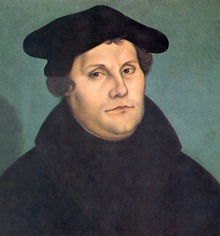
Achievements: Founder of Protestantism
Born: November 10, 1483; Eisleben, Saxony, Germany
Died: February 18, 1546; Eisleben, Saxony, Germany (Aged 63)
Field & Discipline: Religion; Reformer
Language: German
Father:: Father: Hans Luther
Mother: Margarete Lindemann
Siblings: 1 brother: Jacob; 3 sisters
Spouse: Katherina von Bora
Children: 5 survived childhood
Education: Schools in Manfield, Magdeburg, Eisenach; University of Erfurt; University of Wittenberg
Major Work:
"Ninety-five Theses" (1517)
"Sermon on Good Works" (1520)
Life & Times:
In 1505 Luther joined the closed order of St Augustine at Erfurt. He was ordained in April 1507 and spent the following five years in religious studies.
In 1510 he was sent to Rome to appeal on behalf of the Augustinians who wanted stricter discipline within the order. Luther was taken aback by the lack of spirituality he found in Rome and the worldliness of the clergy.
In 1512 he received his theological doctorate and soon afterwards was appointed professor in biblical theology at the new Wittenberg University. He became a prior within his monastic order and in 1515 was appointed district vicar over a number of other monasteries. Luther was undergoing enter a period of spiritual conflict at this time, and the resolution of his uncertainties came about through the formation of his core belief in justification by faith.
He had been oppressed by the idea that through original sin mankind was eternally damned, and that the individual’s attempt to win salvation through good deeds and penitential acts was pointless. He came to believe that if an individual had a true faith in God they would receive God's divine grace. Luther's statement that "the just man shall live by faith alone" meant that guilt could be replaced by obedience to God's will.
At Wittenberg, Luther became a spokesman for Christian humanism, which encouraged direct study of the biblical text in Greek and Latin, in contrast to the old way of interpreting the Bible through the commentaries of the early Church patriarchs. At his local church, he interpreted the Bible for the ordinary people and related its teaching to their everyday lives in a practical way.
In 1517 his disapproval of indulgences came to a head. Indulgences were sold by the Roman Catholic church through designated agents. They were part of the penitential sacrament and while true penitence was the prime requirement for absolution, the purchase of an indulgence expiated part of the sin. Abuses were commonplace, and the Vatican, as the source of authority for the granting of indulgences, was heavily implicated.
Luther often preached against indulgences, not least because the patron of Wittenberg, [protected by] Frederick III the Wise* of Saxony had bought for the castle church a large collection of holy relics to which indulgences were attached. Luther was further enraged by the abuses committed by a Dominican who was a licensed salesman of indulgences.
In 1517, Luther drew up his famous "Ninety-five Theses" which called for an investigation into the practice. He is said to have fixed them to the door of the castle church on 31 October November, the day before the church's holy relics were traditionally exposed to mark the festival of All Saints. The theses also included much of Luther's thinking about justification by faith.
He sent copies to the archbishop of Mainz and to his bishop. More crucially, copies were printed and circulated outside Germany. The Vatican at first reacted quite mildly and ordered that Luther be reprimanded by his order, but the Dominicans were out for blood and pushed for an indictment of heresy against Luther.
The debate then widened to include the question of the pope's authority within Germany. Universities took sides, with the theological faculty at Wittenberg firmly supporting Luther. It became clear that support for Luther extended well beyond that of his young humanist disciples, [collaborated with] Melanchthon* and [collaborated with] Bucer*. The famous artist, [present received from] Durer* sent a set of prints of woodcuts to Luther in gratitude for his courage in exposing what had long been a subject of concern, and his views were welcomed across Germany and in Switzerland.
Luther was invited to meet the Pope's representative in Augsburg but he fled from the city after rumours that he was to be taken in chains to Rome. In 1519 he took part in a debate at Leipzig which widened his rift with Rome. The following year he published his "Sermon on Good Works" which emphasised justification by faith alone. The Vatican reacted by burning his writings in Rome and issuing a papal bull prohibiting 41 articles of his teaching.
Luther issued more tracts, one of which was addressed to the rulers of Germany, calling for them to demonstrate their support of the German people against Rome ("Address to the Christian Nobility of the German Nation"). In December 1520 he placed the papal bull condemning his works on a bonfire lit by students at Wittenberg. He was formally excommunicated by the Pope in January 1521 and summoned to attend the Imperial Diet (government meeting) at Worms.
In April, under the protection of Frederick, Luther made a triumphal arrival at Worms escorted by German knights and cheered by crowds in the streets. He defied the
Diet's order to recant on the grounds of conscience, and although scholars have since doubted the story that Luther ended his speech with the defiant "Here I stand. I can do no other."
This image which resounded through Europe. Popular support saved him from immediate arrest but the Diet passed the Edict of Worms which declared Luther to an outlaw and his writings forbidden. Bound now by German law, not just the Pope's authority, Frederick could not support Luther, who was whisked off to Wartburg castle near Eisenach dressed as a knight, a disguise in which [painted by] Cranach* painted a portrait of him. Cranach was a friend of Luther's, and used his art to become one of the foremost propagandists for Lutheranism.
It was at Wartburg that Luther began his translation of the New Testament from Greek into German, further democratizing religion by providing access to biblical texts for those who did not know Greek or Latin. When radical reformers got out of hand at Wittenberg (one of them administered communion while dressed as a layman and announced his plan to marry a sixteen-year-old girl), Luther returned to the university.
Defying the papal excommunication, he wore a monk's habit and gave sermons.
He addressed all the questions of reform of the church and the clergy which were being debated: celibacy, ritual, religious images, private masses. He was now fighting both Roman Catholics and extreme reformers.
The following year, Luther disappointed some of his disciples and defied the Vatican yet again when he married a former nun. The civil authorities were finding it impossible to enforce the Diet of Worms and in 1526 it was suspended. Three years later this suspension was revoked, together with the permission for German princes to follow their religious consciences. As a result the princes issued a protest, from which the name Protestant came into being.
In the same year, one of them, Philip of Hesse, attempted to resolve the differences of doctrine which existed between Luther and the Swiss reformer [work related to] Zwingli* by calling a conference at Marburg. Neither man could give way and the attempt failed.
From around 1530 Luther tended to leave statements on doctrine to Melanchthon who produced the Augsburg Confession, the first declaration of the Protestant faith.
Luther devoted much of his time to evangelical education in which he was assisted by loyal colleagues at Wittenberg, including [a follower was] Cruciger*. Although he was less concerned with the organisation of the reformed church, Luther wrote two catechisms, provided orders of worship on which the Protestant liturgy was based and also wrote hymns, the most famous being "A Mighty Fortress is Our God".
In 1537 he suffered a serious illness after which he became a chronic invalid. The work of reformation was now being carried out in a more systematic way by others such as [work related to] Calvin*, and as a result of the success of Lutheranism, the Roman Catholic church began preparations for the [caused] Council of Trent*, at which their own reform was begun.
In his last years Luther had the satisfaction of seeing his reformed church flourishing under the protection of Protestant rulers all over Germany and Europe and during the next century, Lutheranism was reformed and reorganized by men such as [a follower was] Andreae*.
Extra Connections:
Knew botanist [a colleague was] Cordus* at Wittenberg.
Influenced naturalist [influenced] Johann Forster*.
[a follower was] Gunzburg* was a follower.
[a follower was] Osiander* was a follower
Was a follower of the ideas of [was a follower of] William of Ockham*
Was an admirer of [a fan of] Valla*
Opposed publication of the theories of [opposed publication of] Copernicus*
Work related to [work related to] Charles V* and [work related to] Archbishop Hamilton*
He was visited by [visited by] Tyndale*
Assessment: Luther is famed as the undisputed founder of the Protestant religion and the Reformation in Europe.
Oneliner: Martin Luther, who founded Protestantism
Bibliography:
- Brecht, Martin, trans. Schaaf, James L, Martin Luther, Vol I, Fortress Press, Minneapolis, 1985.
- Brecht, Martin, trans. Schaaf, James L, Martin Luther, Vol II, Fortress press, Minneapolis, 1990.
- Haile, H.G., Luther, Doubleday & Co. Inc., New York, 1980.