Geiger
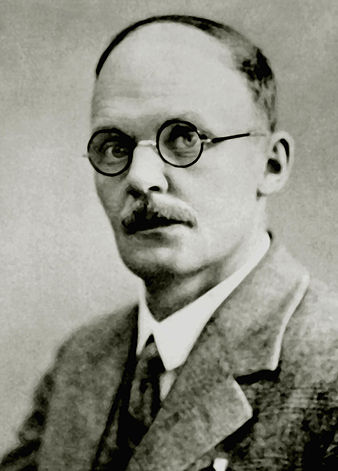 [
ACHIEVEMENT(S): Geiger(-Mueller) counter for measuring radioactivity
NICKNAME/ALIAS: Geiger, Hans
DATE AND PLACE OF BIRTH: September 30, 1882, Neustadt-an-der-Haardt (now Neustadt an-der-Weinstrasse), Rhineland-Palatinate, Germany
DATE/PLACE OF DEATH/AGE AT DEATH: September 24, 1945, Potsdam, Germany. Aged 62
DISCIPLINE: Nuclear physicist
FIELD: Physics
LANGUAGE: German, English
EDUCATION: Erlangen Gymnasium; University of Munich, Germany; University of Erlangen, Germany
MAJOR WORK: "An Electrical Method of Counting the Number of Alpha Particles"; "The Charge and Nature of the Alpha Particle"
LIFE AND TIMES:
In 1906 Geiger accepted the post of assistant to Arthur Schuster, an expert on gas ionization and head of the physics department at the University of Manchester. The next year, British physicist Rutherford* became head of the department.
Under Rutherford, Geiger began studying alpha particles, finding that two alpha particles appeared to be released when uranium disintegrated.
Since alpha particles can penetrate thin walls of solids, Rutherford and Geiger presumed they could also move through atoms, and in 1907, with an apparatus Geiger designed, they shot streams of alpha particles through gold foil and onto a screen, where they were observed as "scintillations", or tiny flashes of light. Counting the thousands of scintillations produced per minute was a laborious manual job, which prompted Geiger to invent an automatic measuring device to count the particles.
Geiger's early version of his counter was a highly sensitive electrical device, consisting of a metal tube containing a gas at low pressure and thin wire in the center of the tube. The wire and tube were under a high voltage, and each alpha particle arriving through a window at one end of the tube caused the gas to ionize, producing a momentary flow of current. The resulting electric signals, in effect, counted the number of alpha particles entering the tube.
With the counter, Geiger was able to show that approximately 340 bn. alpha particles were emitted per second by a gram of radium, and that each alpha was in fact a doubly charged nuclear particle, identical to the nucleus of helium atoms traveling at high velocity. Geiger and Rutherford also established the basic unit of electrical charge when it was involved in electrical activity, which was equivalent to that carried by a single hydrogen atom.
While bombarding the gold foil with the alpha particles, Geiger and Rutherford noted that the majority of the particles went straight through, but that a few particles were unexpectedly deflected or scattered upon contact with the atoms in the gold, indicating that they had come into contact with an extremely powerful electrical field.
Geiger continued to investigate this phenomenon by studying the interaction of alpha particles from radium with metal reflectors. He found that of the few particles that were deflected at wide angles, the amount of deflection depended on the metal n the reflector was, and that the amount of deflection decreased with lower atomic weight.
To demonstrate that the deflection was not caused merely by some surface effect, Geiger and his associates also used metal reflectors of different thicknesses. In 1909, they published an article, "On a Diffuse Reflection of the Alpha-Particles", for the "Proceedings of the Royal Society".
Geiger's work with Rutherford and another young physicist, Ernest Marsden, brought Rutherford finally to the conclusion, in 1911, that the atoms contained a positively charged core or nucleus which repelled the alpha particles, the observed deflection of the alpha particles being due to the positively charged particle being repelled by the positively charged nuclei in the metal.
Based on this conclusion, Rutherford constructed his model for the atom, hypothesizing that it consisted of a central, positively charged nucleus surrounded by electron shells.
Under Rutherford, Geiger also studied the relationship between the range of an alpha particle and its velocity; the various disintegration products of uranium; and, with John Nuttall, the relationship between the range of an alpha particle and the radioactive constant.
This research resulted in the Geiger-Nuttall law (1912), which states that radioactive atoms with short half-lives emit alpha particles at high speed.
In 1912, Geiger accepted the post as director of the new Laboratory for Radioactivity at the German National Institute for Science and Technology in Berlin. Here, he began the first of many refinements to his radiation counter, enabling it to detect beta particles and other kinds of radiation as well as alpha particles.
The First World War put a temporary end to Geiger's work and he became an officer in the German artillery. Seven years after the War, in Kiel, Germany, Geiger and fellow-physicist Walther Mueller improved the sensitivity, performance, and durability of Geiger's 1908 particle counter , and in 1928, the pair produced the modern form of the instrument, now known as the Geiger-Mueller counter.
Consisting of a small metal container with an electrically insulated wire at its center to which a potential of about 1,000 volts is applied, the counter can detect not only alpha particles but also beta particles (electrons) and ionizing electromagnetic photons by locating speeding particles within approximately one centimeter in space and to within a hundred-millionth of a second in time.
The device was designed to be compact, portable and functional, and the signal was able to be amplified so as to trigger a mechanical register -- the familiar audible clicks, which can be recorded automatically.
In 1929, Geiger took the posts of professor of physics and director of research at the physics institute at the University of Tubingen, Germany, where he worked on increasing the Geiger counter's speed and sensitivity. In 1931, as a result of this work, he discovered simultaneous bursts of radiation called cosmic-ray showers, and concentrated on studying them for the rest of his career.
In 1936, he was appointed to the chair of physics at the Technische Hochschule in Berlin. In 1936, 75 of Germany's most notable physicists put their names to the Heisenberg*-Wien-Geiger Memorandum, lamenting the state of physics in Germany, and objecting to Nazi newspaper attacks on theoretical physics.
In June, 1945, his home in Babelsburg was occupied by Allied forces, and Geiger was forced to flee and seek refuge in Potsdam, where he died three months later.
ASSESSMENT: Best known for inventing a device used for counting atomic particles, the Geiger-Mueller counter.
EXTRA CONNECTIONS: He was the brother of meteorologist and climatologist Rudolf Geiger.
ONELINER: Hans Geiger, co-inventor of the particle counter
BIBLIOGRAPHY:
EB, DSB
McDonald, Avril, "Hans Geiger" , in Notable Twentieth Century Scientists , ed. Emily J. McMurray, New York & London: Gale Research, 1995
Wikipedia
Later years
Beginning in 1939, following the discovery of nuclear fission, Geiger became a member of the Uranium Club, the German investigation of nuclear weapons during World War II. The group splintered in 1942 after its members came to believe that nuclear weapons would not play a significant role in ending the war.[10]
Although Geiger signed a petition against the Nazi government's interference with universities, he provided no support to colleague Hans Bethe (winner of the 1967 Nobel Prize in Physics) when he was fired for being Jewish.[14][15]
Geiger endured the Battle of Berlin and subsequent Soviet occupation in April/May 1945. In June 1945, Geiger's house in Potsdam was confiscated and sealed off by the Russians. He was forced to move into emergency accommodation, where he died of severe, debilitating rheumatism, hunger and general exhaustion on 24 September 1945 at the age of 62.
PARENTS: Wilhelm Ludwig Geiger; Mother's name unknown
SIBLINGS: Rudolf; three sisters
SPOUSE: Elisabeth Heffter
CHILDREN: Three sons