Rutherford, E
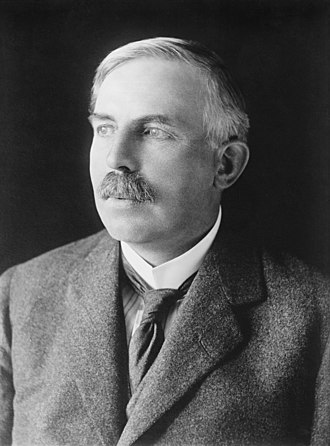
Nickname/Alias: Baron Rutherford of Nelson
Achievements: Discovered that radioactivity was produced by the disintegration of atoms, and that alpha particles consisted of helium nuclei
Born: August 30, 1871; near Spring Grove, New Zealand
Died: October 19, 1937; Cambridge, England (Aged 66)
Field & Discipline: Physics; Nuclear physicist
Language: English
Education: Nelson College, Nelson, New Zealand; Canterbury College, Christchurch, New Zealand
Life & Times:
Rutherford became the first research student to work under English physicist [first research student of] J.J. Thomson* at the Cavendish Laboratory. In early 1896 Thomson asked Rutherford to help him study the effects of [studied X-rays of] Roentgen*’s X-rays on the discharge of electricity in gases. Rutherford demonstrated that X-rays broke gas molecules into electrically charged particles, or ions, of positive and negative electricity, which recombined to form neutral molecules. Working alone, Rutherford then developed a technique for measuring the velocity and rate of recombination of these positive and negative ions.
In 1897 Rutherford took up the study of radioactivity, discovered in 1896 by French physicist [work related to] Becquerel*. Rutherford first studied the radioactive emissions of uranium, systematically wrapping uranium in successive layers of aluminum foil to observe the emissions' penetrating ability. He concluded that uranium emitted two distinct types of radiation, which he named "alpha rays" -- highly powerful in producing ionization, but easily absorbed -- and "beta rays" -- producing less radiation but having more penetrating ability.
In 1900, he also observed what was described by French physicist Paul Villard as "gamma" radiation, the most penetrating type of all.
In 1898, Rutherford accepted a professorship in physics at McGill University in Montreal, Canada, considered to have the best-equipped laboratory in the world. Here he turned from uranium to thorium -- another radioactive element -- which he found produced an intensely radioactive gas, a new radioactive substance that he called "emanation.” This was a decay product of thorium, and Rutherford also observed that the radioactivity of "emanation" gradually decreased geometrically with time, an occurrence now known as the half-life of a radioactive substance -- the measurement of the time it takes for half of a substance to decay.
In 1900 Rutherford and his associate [collaborated with] Soddy* isolated the active part of radioactive thorium, which they named thorium-X, from the apparently-inert parent thorium. They charted how thorium-X gradually lost its radioactivity, while the original thorium regained its activity, illustrating that thorium-X had its own distinctive half-life, much shorter than the half-life of thorium. From this research, Rutherford and Soddy in 1903 were able to put together the modern understanding of radioactivity.
Rutherford's explanation of radioactivity at the atomic level caused a sensation in scientific circles: the idea that atoms could change their identity was revolutionary. This work would earn Rutherford the 1908 Nobel Prize in chemistry. Rutherford was now sought by such gifted associates as Otto Hahn, a German physicist who would demonstrate the fissioning of uranium in 1939.
Rutherford now began to investigate the nature of alpha rays. He was sure they consisted of positively charged particles and specifically either hydrogen or helium ions. Deflection of the rays in electric and magnetic fields proved they were positive particles. In 1904, with Bertram Boltwood, Rutherford worked out the series of transformations that radioactive elements go through and suggested that those with extremely long half-lives might provide a source of energy for sustaining the heat of the Earth's interior. This would offer a means for estimating the age of the Earth.
In 1906, he accepted the chair of professor of physics at Manchester University in England, where he built up a renowned laboratory and a group of talented associates including [worked with] Geiger*, and physicist [worked with] Bohr*. Using their own invention, an apparatus using ionization chambers and scintillation screens, Rutherford and Geiger came up with a method for counting alpha particles precisely. The process entailed firing alpha particles into a nearly evacuated tube with a strong electric field. The resulting ionizing effect in the gas could be detected not only by an electrometer (a device that measured electric charge in a gas), but visually (as the alpha particles struck a zinc sulfide screen, they caused an identifiable flash, or "scintillation").
Counting the particles with the use of the electric radiation "Geiger" counter, they divided the total charge produced by the number of particles counted, and arrived at the conclusion that each particle had two positive charges. The final proof that alpha particles were helium ions came also in 1908, when Rutherford trapped alpha particles in a glass tube and, by sparking the gas that was produced, showed from its spectrum that it was helium.
Rutherford's next major discovery came in 1909. Using a scintillation counter that could be moved around the foil, which was struck by a beam of alpha particles from a radon source, it was observed that when alpha particles were fired at gold foil, a significant number were deflected through angles of more than 90 degrees, and some particles were deflected backwards. Foil made from metals with a large atomic number (such as lead) reflected back even more particles. This convinced Rutherford that the explanation must lie in the nature of the metal atoms in the foil. He deduced that each contained a positively charged nucleus surrounded by electrons: only that kind of nucleus could repulse the positively charged alpha particles that happened to strike them and produce such enormous deflections.
It was not until more than a year later that Rutherford felt he had enough evidence to postulate the modern concept of the atom, which he announced early in 1911. He had come to the conclusion that the intense electric field needed to cause such a large particle deflection could occur only if all the positive charge in the atom --and therefore almost all the mass -- were concentrated on a tiny central nucleus, some 10,000 times smaller in diameter than that of the entire atom. The positive charge on the nucleus would therefore be balanced by an equal charge on all the electrons orbiting the nucleus.
During the First World War, Rutherford, serving in the British Navy's Board of Invention and Research, worked on methods of detecting German U-boats (submarines) by underwater acoustics. His results were used later in [work related to] Langevin’s* development of [work related to] sonar*. During the War, Rutherford's also continued to work at Manchester. In 1914, he found that positive rays consist of hydrogen nuclei. He and Edward Andrade, by diffracting them with a crystal, showed that gamma rays were electromagnetic waves. Measuring the wavelengths of the rays, they found that they lay beyond X-rays in the electromagnetic spectrum. Earlier, in 1900, Bequerel had identified beta rays with cathode rays, which were shown to be electrons. And so the nature of radioactivity was now fully revealed.
Rutherford returned to full research in 1919, when he made his last great discovery. Pursuing earlier work in which scintillations were noticed in hydrogen bombarded by alpha particles well beyond their range in the gas, Rutherford first concluded that the scintillations were being caused by hydrogen nuclei. However, he later observed the same effect when alpha particles were fired into nitrogen. After a long series of experiments, Rutherford concluded that the alpha particles had caused the nitrogen nuclei to disintegrate, forming hydrogen and oxygen nuclei -- the first artificial transformation of one element to another.
Rutherford found similar results with other elements and announced that the nucleus of any atom must be composed of hydrogen nuclei . At his suggestion, the name "proton" was given to the hydrogen nucleus in 1920. Also in 1920, Rutherford speculated that uncharged particles, which were later called neutrons, must also exist in the nucleus.
In 1919, Rutherford succeeded Thomson as director of the Cavendish Laboratory at Cambridge. Under Rutherford's direction, English physicist Patrick Blackett in 1925 used the [made use of] cloud chamber* apparatus, developed by Scottish physicist [used equipment of] C.T.R. Wilson*, to record the tracks of disintegrated nuclei. Blackett showed that the bombardment of alpha particles combined with the nucleus before disintegration, and did not break the nucleus apart like a bullet. He also showed that bombardment with alpha particles had its limits, finding that large nuclei repelled them without disintegrating.
As a result, Rutherford directed physicists John D. Cockcroft and Ernest Walton in 1932 to construct the world's first particle accelerator, and thereby demonstrate the transmutation of elements by artificial means. Throughout the 30s, Rutherford maintained close contact with leading world scientists, in particular, physicists Bohr, [corresponded with] Planck*, [corresponded with] Einstein* and [corresponded with] Fermi*. After his death in 1937, Rutherford was buried in Westminster Abbey, London.
Extra Connections:
His work related to that of [work related to] Marie Curie* and [work related to] Ramsay*
He knew [knew] Balfour*.
He influenced [influenced] Dirac*, [influenced] Gamow*, [influenced] Pauli*, [influenced] De Broglie*, [influenced] Born*, [influenced] Schrodinger*, [influenced] Heisenberg* and [influenced]Oppenheimer*.
He worked with [worked with] CP Snow*
His atomic model was anticipated by [work anticipated by] Lenard*
He taught [taught] Bragg*
Rival of Marconi
Assessment: Most renowned achievement was demonstrating that the atom consisted of a small, dense nucleus surrounded by orbiting electrons. Also demonstrated that splitting the atom can transmute one element into another.
Oneliner: Ernest Rutherford, who made possible quantum physics
Bibliography:
- Boersma, Michael, "Ernest Rutherford,” in Notable Twentieth Century Scientists, ed. Emily J. McMurray, New York & London: Gale Research.
- Dictionary of Scientific Biography.
- Encyclopedia Britannica.
Father: James Rutherford
Mother: Martha Thompson
Siblings: 11 brothers and sisters
Spouse: Mary Newton
Children: Eileen