Rutherford 2
See main node
Ernest Rutherford, 1st Baron Rutherford of Nelson, OM, PRS, HonFRSE[4] (30 August 1871 – 19 October 1937) was a New Zealand physicist who came to be known as the father of nuclear physics.[5] Encyclopædia Britannica considers him to be the greatest experimentalist since Michael Faraday (1791–1867).[5] Apart from his work in his homeland, he spent a substantial amount of his career abroad, in both Canada and the United Kingdom.
In early work, Rutherford discovered the concept of radioactive half-life, the radioactive element radon,[6] and differentiated and named alpha and beta radiation.[7] This work was performed at McGill University in Montreal, Quebec, Canada. It is the basis for the Nobel Prize in Chemistry he was awarded in 1908 "for his investigations into the disintegration of the elements, and the chemistry of radioactive substances",[8] for which he was the first Oceanian Nobel laureate, and the first to perform the awarded work in Canada. In 1904, he was elected as a member to the American Philosophical Society.[9]
Rutherford moved in 1907 to the Victoria University of Manchester (today University of Manchester) in the UK, where he and Thomas Royds proved that alpha radiation is helium nuclei.[10][11] Rutherford performed his most famous work after he became a Nobel laureate.[8] In 1911, although he could not prove that it was positive or negative,[12] he theorized that atoms have their charge concentrated in a very small nucleus,[13] and thereby pioneered the Rutherford model of the atom, through his discovery and interpretation of Rutherford scattering by the gold foil experiment of Hans Geiger and Ernest Marsden. He performed the first artificially induced nuclear reaction in 1917 in experiments where nitrogen nuclei were bombarded with alpha particles. As a result, he discovered the emission of a subatomic particle which, in 1919, he called the "hydrogen atom" but, in 1920, he more accurately named the proton.[14][15]
Rutherford became Director of the Cavendish Laboratory at the University of Cambridge in 1919. Under his leadership the neutron was discovered by James Chadwick in 1932 and in the same year the first experiment to split the nucleus in a fully controlled manner was performed by students working under his direction, John Cockcroft and Ernest Walton. After his death in 1937, he was buried in Westminster Abbey near Sir Isaac Newton. The chemical element rutherfordium (element 104) was named after him in 1997.
Biography
Early life and education
Ernest Rutherford was the son of James Rutherford, a farmer, and his wife Martha Thompson, originally from Hornchurch, Essex, England.[16] James had emigrated to New Zealand from Perth, Scotland, "to raise a little flax and a lot of children". Ernest was born at Brightwater, near Nelson, New Zealand. His first name was mistakenly spelled 'Earnest' when his birth was registered.[17] Rutherford's mother Martha Thompson was a schoolteacher.[18]

Rutherford in 1892, aged 21
He studied at Havelock School and then Nelson College and won a scholarship to study at Canterbury College, University of New Zealand, where he participated in the debating society and played rugby.[19] After gaining his BA, MA and BSc, and doing two years of research during which he invented a new form of radio receiver, in 1895 Rutherford was awarded an 1851 Research Fellowship from the Royal Commission for the Exhibition of 1851,[20] to travel to England for postgraduate study at the Cavendish Laboratory, University of Cambridge.[21]
He was among the first of the 'aliens' (those without a Cambridge degree) allowed to do research at the university, under the leadership of J. J. Thomson,[1] which aroused jealousies from the more conservative members of the Cavendish fraternity. With Thomson's encouragement, he managed to detect radio waves at half a mile and briefly held the world record for the distance over which electromagnetic waves could be detected, though when he presented his results at the British Association meeting in 1896, he discovered he had been outdone[further ^explanation needed] by Guglielmo Marconi, who was also lecturing.
In 1898, Thomson recommended Rutherford for a position at McGill University in Montreal, Canada. He was to replace Hugh Longbourne Callendar who held the chair of Macdonald Professor of physics and was coming to Cambridge.[22] Rutherford was accepted, which meant that in 1900 he could marry Mary Georgina Newton (1876–1954)[23] In 1901, Rutherford gained a DSc from the University of New Zealand.[21] In 1907, he returned to Britain to take the chair of physics at the Victoria University of Manchester.
Later years and honours
Rutherford was knighted in 1914.[24] During World War I, he worked on a top secret project to solve the practical problems of submarine detection by sonar.[25] In 1916, he was awarded the Hector Memorial Medal. In 1919, he returned to the Cavendish succeeding J. J. Thomson as the Cavendish professor and Director. Under him, Nobel Prizes were awarded to James Chadwick for discovering the neutron (in 1932), John Cockcroft and Ernest Walton for an experiment which was to be known as splitting the atom using a particle accelerator, and Edward Appleton for demonstrating the existence of the ionosphere.
In 1925, Rutherford pushed calls to the New Zealand Government to support education and research, which led to the formation of the Department of Scientific and Industrial Research (DSIR) in the following year.[26] Between 1925 and 1930, he served as President of the Royal Society, and later as president of the Academic Assistance Council which helped almost 1,000 university refugees from Germany.[5] He was appointed to the Order of Merit in the 1925 New Year Honours[27] and raised to the peerage as Baron Rutherford of Nelson, New Zealand and of Cambridge in the County of Cambridge in 1931,[28][29] a title that became extinct upon his unexpected death in 1937. In 1933, Rutherford was one of the two inaugural recipients of the T. K. Sidey Medal, set up by the Royal Society of New Zealand as an award for outstanding scientific research.[30][31]
Personal life and death
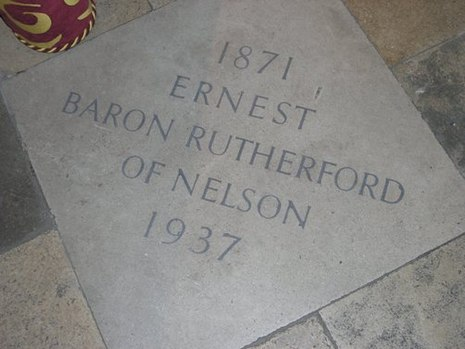
Lord Rutherford's grave in Westminster Abbey
In 1900 he married Mary Georgina Newton (1876–1954)[23][32] to whom he had become engaged before leaving New Zealand; they married at St Paul's Anglican Church, Papanui in Christchurch,[33][34] They had one daughter, Eileen Mary (1901–1930), who married the physicist Ralph Fowler.
For some time before his death, Rutherford had a small hernia, which he had neglected to have fixed, and it became strangulated, causing him to be violently ill. Despite an emergency operation in London, he died four days afterwards at age 66 of what physicians termed "intestinal paralysis", at Cambridge on 19 October 1937.[35] After cremation at Golders Green Crematorium,[35] he was given the high honour of burial in Westminster Abbey, near Isaac Newton and other illustrious British scientists such as Charles Darwin.[36]
Scientific research|
At Cambridge, Rutherford started to work with J. J. Thomson on the conductive effects of X-rays on gases, work which led to the discovery of the electron which Thomson presented to the world in 1897. Hearing of Becquerel's experience with uranium, Rutherford started to explore its radioactivity, discovering two types that differed from X-rays in their penetrating power. Continuing his research in Canada, he coined the terms alpha ray and beta ray[37] in 1899 to describe the two distinct types of radiation. He then discovered that thorium gave off a gas which produced an emanation which was itself radioactive and would coat other substances.[38] He found that a sample of this radioactive material of any size invariably took the same amount of time for half the sample to decay – its "half-life" (111⁄2 minutes in this case).
From 1900 to 1903, he was joined at McGill by the young chemist Frederick Soddy (Nobel Prize in Chemistry, 1921) for whom he set the problem of identifying the thorium emanations. Once he had eliminated all the normal chemical reactions, Soddy suggested that it must be one of the inert gases, which they named thoron (later found to be an isotope of radon). They also found another type of thorium they called Thorium X, and kept on finding traces of helium. They also worked with samples of "Uranium X" from William Crookes and radium from Marie Curie.
In 1903, they published their "Law of Radioactive Change", to account for all their experiments. Until then, atoms were assumed to be the indestructible basis of all matter and although Curie had suggested that radioactivity was an atomic phenomenon, the idea of the atoms of radioactive substances breaking up was a radically new idea. Rutherford and Soddy demonstrated that radioactivity involved the spontaneous disintegration of atoms into other, as yet, unidentified matter. The Nobel Prize in Chemistry 1908 was awarded to Ernest Rutherford "for his investigations into the disintegration of the elements, and the chemistry of radioactive substances".[39]
In 1903, Rutherford considered a type of radiation discovered (but not named) by French chemist Paul Villard in 1900, as an emission from radium, and realised that this observation must represent something different from his own alpha and beta rays, due to its very much greater penetrating power. Rutherford therefore gave this third type of radiation the name of gamma ray. All three of Rutherford's terms are in standard use today – other types of radioactive decay have since been discovered, but Rutherford's three types are among the most common.
In 1904, Rutherford suggested that radioactivity provides a source of energy sufficient to explain the existence of the Sun for the many millions of years required for the slow biological evolution on Earth proposed by biologists such as Charles Darwin. The physicist Lord Kelvin had argued earlier for a much younger Earth (see also William Thomson, 1st Baron Kelvin#Age of the Earth: geology) based on the insufficiency of known energy sources, but Rutherford pointed out at a lecture attended by Kelvin that radioactivity could solve this problem.[40]
In Manchester, he continued to work with alpha radiation. In conjunction with Hans Geiger, he developed zinc sulfide scintillation screens and ionisation chambers to count alphas. By dividing the total charge they produced by the number counted, Rutherford decided that the charge on the alpha was two. In late 1907, Ernest Rutherford and Thomas Royds allowed alphas to penetrate a very thin window into an evacuated tube. As they sparked the tube into discharge, the spectrum obtained from it changed, as the alphas accumulated in the tube. Eventually, the clear spectrum of helium gas appeared, proving that alphas were at least ionised helium atoms, and probably helium nuclei.
A long-standing myth existed, at least as early as 1948,[41][42] running at least to 2017, that Rutherford was the first scientist to observe and report an artificial transmutation of a stable element into another element: nitrogen into oxygen. It was thought by many people to be one of Rutherford's greatest accomplishments.[43][44] The New Zealand government even issued a commemorative stamp in the belief that the nitrogen-to-oxygen discovery belonged to Rutherford.[45]
Beginning in 2017, many scientific institutions corrected their versions of this history to indicate that the discovery credit for the reaction belongs to Patrick Blackett.[46] Rutherford did detect the ejected proton in 1919 and interpreted it as evidence for disintegration of the nitrogen nucleus (to lighter nuclei). In 1925, Blackett showed that the actual product is oxygen and identified the true reaction as 14N + α → 17O + p. Rutherford therefore recognized "that the nucleus may increase rather than diminish in mass as the result of collisions in which the proton is expelled".[47]
Gold foil experiment
Rutherford performed his most famous work after receiving the Nobel prize in 1908. Along with Hans Geiger and Ernest Marsden in 1909, he carried out the Geiger–Marsden experiment, which demonstrated the nuclear nature of atoms by deflecting alpha particles passing through a thin gold foil. Rutherford was inspired to ask Geiger and Marsden in this experiment to look for alpha particles with very high deflection angles, of a type not expected from any theory of matter at that time. Such deflections, though rare, were found, and proved to be a smooth but high-order function of the deflection angle. It was Rutherford's interpretation of this data that led him to formulate the Rutherford model of the atom in 1911 – that a very small charged[12] nucleus, containing much of the atom's mass, was orbited by low-mass electrons.
In 1919–1920, Rutherford found that nitrogen and other light elements ejected a proton, which he called a "hydrogen atom", when hit with α (alpha) particles.[48] This result showed Rutherford that hydrogen nuclei were a part of nitrogen nuclei (and by inference, probably other nuclei as well). Such a construction had been suspected for many years on the basis of atomic weights which were whole numbers of that of hydrogen; see Prout's hypothesis. Hydrogen was known to be the lightest element, and its nuclei presumably the lightest nuclei. Now, because of all these considerations, Rutherford decided that a hydrogen nucleus was possibly a fundamental building block of all nuclei, and also possibly a new fundamental particle as well, since nothing was known from the nucleus that was lighter. Thus, confirming and extending the work of Wilhelm Wien who in 1898 discovered the proton in streams of ionized gas,[49] Rutherford postulated the hydrogen nucleus to be a new particle in 1920, which he dubbed the proton.
In 1921, while working with Niels Bohr (who postulated that electrons moved in specific orbits), Rutherford theorized about the existence of neutrons, (which he had christened in his 1920 Bakerian Lecture), which could somehow compensate for the repelling effect of the positive charges of protons by causing an attractive nuclear force and thus keep the nuclei from flying apart from the repulsion between protons. The only alternative to neutrons was the existence of "nuclear electrons" which would counteract some of the proton charges in the nucleus, since by then it was known that nuclei had about twice the mass that could be accounted for if they were simply assembled from hydrogen nuclei (protons). But how these nuclear electrons could be trapped in the nucleus, was a mystery.
Rutherford's theory of neutrons was proved in 1932 by his associate James Chadwick, who recognized neutrons immediately when they were produced by other scientists and later himself, in bombarding beryllium with alpha particles. In 1935, Chadwick was awarded the Nobel Prize in Physics for this discovery.
Legacy
Rutherford is considered to have been among the greatest scientists in history. At the opening session of the 1938 Indian Science Congress, which Rutherford had been expected to preside over before his death, astrophysicist James Jeans spoke in his place and deemed him "one of the greatest scientists of all time", saying:
In his flair for the right line of approach to a problem, as well as in the simple directness of his methods of attack, [Rutherford] often reminds us of Faraday, but he had two great advantages which Faraday did not possess, first, exuberant bodily health and energy, and second, the opportunity and capacity to direct a band of enthusiastic co-workers. Great though Faraday's output of work was, it seems to me that to match Rutherford's work in quantity as well as in quality, we must go back to Newton. In some respects he was more fortunate than Newton. Rutherford was ever the happy warrior – happy in his work, happy in its outcome, and happy in its human contacts.[50]
Nuclear physics
Rutherford's research, and work done under him as laboratory director, established the nuclear structure of the atom and the essential nature of radioactive decay as a nuclear process. Patrick Blackett, a research fellow working under Rutherford, using natural alpha particles, demonstrated induced nuclear transmutation. Rutherford's team later, using protons from an accelerator, demonstrated artificially-induced nuclear reactions and transmutation.
He is known as the father of nuclear physics. Rutherford died too early to see Leó Szilárd's idea of controlled nuclear chain reactions come into being. However, a speech of Rutherford's about his artificially-induced transmutation in lithium, printed on 12 September 1933 London paper The Times, was reported by Szilárd to have been his inspiration for thinking of the possibility of a controlled energy-producing nuclear chain reaction. Szilard had this idea while walking in London, on the same day.
Rutherford's speech touched on the 1932 work of his students John Cockcroft and Ernest Walton in "splitting" lithium into alpha particles by bombardment with protons from a particle accelerator they had constructed. Rutherford realized that the energy released from the split lithium atoms was enormous, but he also realized that the energy needed for the accelerator, and its essential inefficiency in splitting atoms in this fashion, made the project an impossibility as a practical source of energy (accelerator-induced fission of light elements remains too inefficient to be used in this way, even today). Rutherford's speech in part, read:
We might in these processes obtain very much more energy than the proton supplied, but on the average we could not expect to obtain energy in this way. It was a very poor and inefficient way of producing energy, and anyone who looked for a source of power in the transformation of the atoms was talking moonshine. But the subject was scientifically interesting because it gave insight into the atoms.[51]
Items named in honour of Rutherford's life and work

A statue of a young Ernest Rutherford at his memorial in Brightwater, New Zealand.
Scientific discoveries
- The element rutherfordium, Rf, Z=104. (1997)[52]
- The rutherford (Rd), an obsolete unit of radioactivity equivalent to one megabecquerel.
Institutions
- Rutherford Appleton Laboratory, a scientific research laboratory near Didcot, Oxfordshire.
- Rutherford College, Auckland, a school in Auckland, New Zealand
- Rutherford College, Kent, a college at the University of Kent in Canterbury, England
- Rutherford Institute for Innovation at the University of Cambridge
- Rutherford Intermediate School, Wanganui, New Zealand
- Rutherford Hall, a hall of residence at Loughborough University
Awards
- Rutherford Medal, the highest science medal awarded by the Royal Society of New Zealand
- Rutherford Award at Thomas Carr College for excellence in Victorian Certificate of Education chemistry, Australia.
- Rutherford Memorial Medal is an award for research in the fields of physics and chemistry by the Royal Society of Canada.
- Rutherford Medal and Prize is awarded once every two years by the Institute of Physics for "distinguished research in nuclear physics or nuclear technology".
- Rutherford Memorial Lecture is an international lecture tour under the auspices of the Royal Society created under the Rutherford Memorial Scheme in 1952.
- Rutherford Discovery Fellowships are awarded annually by the Royal Society of New Zealand[53]
Buildings....
Knowledge Web Content (see main node)
Name: Ernest Rutherford
Nickname/Alias: Baron Rutherford of Nelson
Achievements: Discovered that radioactivity was produced by the disintegration of atoms, and that alpha particles consisted of helium nuclei
Born: August 30, 1871; near Spring Grove, New Zealand
Died: October 19, 1937; Cambridge, England (Aged 66)
Field & Discipline: Physics; Nuclear physicist
Language: English
Father: James Rutherford
Mother: Martha Thompson
Siblings: 11 brothers and sisters
Spouse: Mary Newton
Children: Eileen
Education: Nelson College, Nelson, New Zealand; Canterbury College, Christchurch, New Zealand
Life & Times:
Rutherford became the first research student to work under English physicist [first research student of] J.J. Thomson* at the Cavendish Laboratory. In early 1896 Thomson asked Rutherford to help him study the effects of [studied X-rays of] Roentgen*’s X-rays on the discharge of electricity in gases.
Rutherford demonstrated that X-rays broke gas molecules into electrically charged particles, or ions, of positive and negative electricity, which recombined to form neutral molecules. Working alone, Rutherford then developed a technique for measuring the velocity and rate of recombination of these positive and negative ions.
In 1897 Rutherford took up the study of radioactivity, discovered in 1896 by French physicist [work related to] Becquerel*. Rutherford first studied the radioactive emissions of uranium, systematically wrapping uranium in successive layers of aluminum foil to observe the emissions' penetrating ability.
He concluded that uranium emitted two distinct types of radiation, which he named "alpha rays" -- highly powerful in producing ionization, but easily absorbed -- and "beta rays" -- producing less radiation but having more penetrating ability. In 1900, he also observed what was described by French physicist Paul Villard as "gamma" radiation, the most penetrating type of all.
In 1898, Rutherford accepted a professorship in physics at McGill University in Montreal, Canada, considered to have the best-equipped laboratory in the world. Here he turned from uranium to thorium -- another radioactive element -- which he found produced an intensely radioactive gas, a new radioactive substance that he called "emanation.”
This was a decay product of thorium, and Rutherford also observed that the radioactivity of "emanation" gradually decreased geometrically with time, an occurrence now known as the half-life of a radioactive substance -- the measurement of the time it takes for half of a substance to decay.
In 1900 Rutherford and his associate [collaborated with] Soddy* isolated the active part of radioactive thorium, which they named thorium-X, from the apparently-inert parent thorium. They charted how thorium-X gradually lost its radioactivity, while the original thorium regained its activity, illustrating that thorium-X had its own distinctive half-life, much shorter than the half-life of thorium. From this research, Rutherford and Soddy in 1903 were able to put together the modern understanding of radioactivity.
Rutherford's explanation of radioactivity at the atomic level caused a sensation in scientific circles: the idea that atoms could change their identity was revolutionary. This work would earn Rutherford the 1908 Nobel Prize in chemistry.
Rutherford was now sought by such gifted associates as Otto Hahn, a German physicist who would demonstrate the fissioning of uranium in 1939.
Rutherford now began to investigate the nature of alpha rays. He was sure they consisted of positively charged particles and specifically either hydrogen or helium ions.
Deflection of the rays in electric and magnetic fields proved they were positive particles. In 1904, with Bertram Boltwood, Rutherford worked out the series of transformations that radioactive elements go through and suggested that those with extremely long half-lives might provide a source of energy for sustaining the heat of the Earth's interior. This would offer a means for estimating the age of the Earth.
In 1906, he accepted the chair of professor of physics at Manchester University in England, where he built up a renowned laboratory and a group of talented associates including [worked with] Geiger*, and physicist [worked with] Bohr*.
Using their own invention, an apparatus using ionization chambers and scintillation screens, Rutherford and Geiger came up with a method for counting alpha particles precisely. The process entailed firing alpha particles into a nearly evacuated tube with a strong electric field. The resulting ionizing effect in the gas could be detected not only by an electrometer (a device that measured electric charge in a gas), but visually (as the alpha particles struck a zinc sulfide screen, they caused an identifiable flash, or "scintillation").
Counting the particles with the use of the electric radiation "Geiger" counter, they divided the total charge produced by the number of particles counted, and arrived at the conclusion that each particle had two positive charges. The final proof that alpha particles were helium ions came also in 1908, when Rutherford trapped alpha particles in a glass tube and, by sparking the gas that was produced, showed from its spectrum that it was helium.
Rutherford's next major discovery came in 1909. Using a scintillation counter that could be moved around the foil, which was struck by a beam of alpha particles from a radon source, it was observed that when alpha particles were fired at gold foil, a significant number were deflected through angles of more than 90 degrees, and some particles were deflected backwards. Foil made from metals with a large atomic number (such as lead) reflected back even more particles.
This convinced Rutherford that the explanation must lie in the nature of the metal atoms in the foil. He deduced that each contained a positively charged nucleus surrounded by electrons: only that kind of nucleus could repulse the positively charged alpha particles that happened to strike them and produce such enormous deflections.
It was not until more than a year later that Rutherford felt he had enough evidence to postulate the modern concept of the atom, which he announced early in 1911.
He had come to the conclusion that the intense electric field needed to cause such a large particle deflection could occur only if all the positive charge in the atom --and therefore almost all the mass -- were concentrated on a tiny central nucleus, some 10,000 times smaller in diameter than that of the entire atom.
The positive charge on the nucleus would therefore be balanced by an equal charge on all the electrons orbiting the nucleus.
During the First World War, Rutherford, serving in the British Navy's Board of Invention and Research, worked on methods of detecting German U-boats (submarines) by underwater acoustics. His results were used later in [work related to] Langevin’s* development of [work related to] sonar*.
During the War, Rutherford's also continued to work at Manchester. In 1914, he found that positive rays consist of hydrogen nuclei. He and Edward Andrade, by diffracting them with a crystal, showed that gamma rays were electromagnetic waves. Measuring the wavelengths of the rays, they found that they lay beyond X-rays in the electromagnetic spectrum. Earlier, in 1900, Bequerel had identified beta rays with cathode rays, which were shown to be electrons. And so the nature of radioactivity was now fully revealed.
Rutherford returned to full research in 1919, when he made his last great discovery. Pursuing earlier work in which scintillations were noticed in hydrogen bombarded by alpha particles well beyond their range in the gas, Rutherford first concluded that the scintillations were being caused by hydrogen nuclei.
However, he later observed the same effect when alpha particles were fired into nitrogen. After a long series of experiments, Rutherford concluded that the alpha particles had caused the nitrogen nuclei to disintegrate, forming hydrogen and oxygen nuclei -- the first artificial transformation of one element to another.
Rutherford found similar results with other elements and announced that the nucleus of any atom must be composed of hydrogen nuclei . At his suggestion, the name "proton" was given to the hydrogen nucleus in 1920.
Also in 1920, Rutherford speculated that uncharged particles, which were later called neutrons, must also exist in the nucleus.
In 1919, Rutherford succeeded Thomson as director of the Cavendish Laboratory at Cambridge. Under Rutherford's direction, English physicist Patrick Blackett in 1925 used the [made use of] cloud chamber* apparatus, developed by Scottish physicist [used equipment of] C.T.R. Wilson*, to record the tracks of disintegrated nuclei.
Blackett showed that the bombardment of alpha particles combined with the nucleus before disintegration, and did not break the nucleus apart like a bullet. He also showed that bombardment with alpha particles had its limits, finding that large nuclei repelled them without disintegrating.
As a result, Rutherford directed physicists John D. Cockcroft and Ernest Walton in 1932 to construct the world's first particle accelerator, and thereby demonstrate the transmutation of elements by artificial means.
Throughout the 30s, Rutherford maintained close contact with leading world scientists, in particular, physicists Bohr, [corresponded with] Planck*, [corresponded with] Einstein* and [corresponded with] Fermi*.
After his death in 1937, Rutherford was buried in Westminster Abbey, London.
Extra Connections: His work related to that of [work related to] Marie Curie* and [work related to] Ramsay*
He knew [knew] Balfour*.
He influenced [influenced] Dirac*, [influenced] Gamow*, [influenced] Pauli*, [influenced] De Broglie*, [influenced] Born*, [influenced] Schrodinger*, [influenced] Heisenberg* and [influenced]Oppenheimer*.
He worked with [worked with] CP Snow*
His atomic model was anticipated by [work anticipated by] Lenard*
He taught [taught] Bragg*
Assessment: Most renowned achievement was demonstrating that the atom consisted of a small, dense nucleus surrounded by orbiting electrons. Also demonstrated that splitting the atom can transmute one element into another.
Oneliner: Ernest Rutherford, who made possible quantum physics
Bibliography:
- Boersma, Michael, "Ernest Rutherford,” in Notable Twentieth Century Scientists, ed. Emily J. McMurray, New York & London: Gale Research.
- Dictionary of Scientific Biography.
- Encyclopedia Britannica.