Muhammad Ali
Muhammad Ali (/ɑːˈliː/;[4] born Cassius Marcellus Clay Jr.;[5] January 17, 1942 – June 3, 2016) was an American professional boxer and activist. Nicknamed "the Greatest", he is regarded as one of the most significant sports figures of the 20th century and is often regarded as the greatest heavyweight boxer of all time.[6][7][8] He held the Ring magazine heavyweight title from 1964 to 1970. He was the undisputed champion from 1974 to 1978 and the WBA and Ring heavyweight champion from 1978 to 1979. In 1999, he was named Sportsman of the Century by Sports Illustrated and the Sports Personality of the Century by the BBC.
Born and raised in Louisville, Kentucky, he began training as an amateur boxer at age 12. At 18, he won a gold medal in the light heavyweight division at the 1960 Summer Olympics and turned professional later that year. He became a Muslim after 1961. He won the world heavyweight championship, defeating Sonny Liston in a major upset on February 25, 1964, at age 22. During that year, he denounced his birth name as a "slave name" and formally changed his name to Muhammad Ali.
In 1966, Ali refused to be drafted into the military owing to his religious beliefs and ethical opposition to the Vietnam War[9][10] and was found guilty of draft evasion and stripped of his boxing titles. He stayed out of prison while appealing the decision to the Supreme Court, where his conviction was overturned in 1971. He did not fight for nearly four years and lost a period of peak performance as an athlete.[11] Ali's actions as a conscientious objector to the Vietnam War made him an icon for the larger counterculture of the 1960s generation,[12][13] and he was a very high-profile figure of racial pride for African Americans during the civil rights movement and throughout his career.[9] As a Muslim, Ali was initially affiliated with Elijah Muhammad's Nation of Islam (NOI). He later disavowed the NOI, adhering to Sunni Islam.
He fought in several historic boxing matches, including his highly publicized fights with Sonny Liston, Joe Frazier (including the Fight of the Century, the biggest boxing event up until then),[14] the Thrilla in Manila, and his fight with George Foreman in The Rumble in the Jungle.[15][16] Ali thrived in the spotlight at a time when many boxers let their managers do the talking, and he became renowned for his provocative and outlandish persona.[17][18][19]
He was famous for trash-talking, often free-styled with rhyme schemes and spoken word poetry incorporating elements of hip hop.[20][21][22] He often predicted in which round he would knock out his opponent.
Outside boxing, Ali attained success as a spoken word artist, releasing two studio albums: I Am the Greatest! (1963) and The Adventures of Ali and His Gang vs. Mr. Tooth Decay (1976). Both albums received Grammy Award nominations.[22] He also featured as an actor and writer, releasing two autobiographies. Ali retired from boxing in 1981 and focused on religion, philanthropy and activism. In 1984, he made public his diagnosis of Parkinson's syndrome, which some reports attributed to boxing-related injuries,[23] though he and his specialist physicians disputed this.[24] He remained an active public figure globally, but in his later years made fewer public appearances as his condition worsened, and he was cared for by his family.
- Early life
- Amateur career
- Professional career
- Draft resistance
- Exile and comeback
- Return
- Exhibition bouts
- Personal life
- Entertainment career
- Later life
- Death
- Legacy
- In media and popular culture
- Professional boxing record
- Discography
- See also
- Notes
- References
- Further reading
Early life
Cassius Marcellus Clay Jr. (/ˈkæʃəs/ *KASH-əss*) was born on January 17, 1942, in Louisville, Kentucky.[25] He had one brother. He was named after his father, Cassius Marcellus Clay Sr., who had a sister and four brothers[26][27] and who himself was named in honor of the 19th-century Republican politician and staunch abolitionist Cassius Marcellus Clay, also from the state of Kentucky. Clay's father's paternal grandparents were John Clay and Sallie Anne Clay; Clay's sister Eva claimed that Sallie was a native of Madagascar.[28] He was a descendant of slaves of the antebellum South, and was predominantly of African descent, with Irish[29] and English family heritage.[30][31]
Ali's maternal great-grandfather, Abe Grady, emigrated from Ennis, County Clare, Ireland.[32][33] DNA testing performed in 2018 showed that, through his paternal grandmother, Ali was a descendant of the former slave Archer Alexander, who had been chosen from the building crew as the model of a freed man for the Emancipation Memorial, and was the subject of abolitionist William Greenleaf Eliot's book, The Story of Archer Alexander: From Slavery to Freedom.[34] Like Ali, Alexander fought for his freedom.[35]
His father was a sign and billboard painter,[25] and his mother, Odessa O'Grady Clay (1917–1994), was a domestic helper. Although Cassius Sr. was a Methodist, he allowed Odessa to bring up both Cassius Jr. and his younger brother, Rudolph "Rudy" Clay (later renamed Rahaman Ali), as Baptists.[36] Cassius Jr. attended Central High School in Louisville. He was dyslexic, which led to difficulties in reading and writing, at school and for much of his life.[37]
Ali grew up amid racial segregation. His mother recalled one occasion when he was denied a drink of water at a store: "They wouldn't give him one because of his color. That really affected him."[9] He was also strongly affected by the 1955 murder of Emmett Till, which led to young Clay and a friend taking out their frustration by vandalizing a local rail yard. His daughter Hana later wrote that Ali once told her, "Nothing would ever shake me up (more) than the story of Emmett Till."[38][39]
...
Religion and beliefs
Main article: Religious views of Muhammad Ali
Affiliation with the Nation of Islam
Ali said that he first heard of the Nation of Islam when he was fighting in the Golden Gloves tournament in Chicago in 1959, and attended his first Nation of Islam meeting in 1961. He continued to attend meetings, although keeping his involvement hidden from the public. In 1962, Clay met Malcolm X, who soon became his spiritual and political mentor.[191] By the time of the first Liston fight, Nation of Islam members, including Malcolm X, were visible in his entourage. This led to a story in The Miami Herald just before the fight disclosing that Clay had joined the Nation of Islam, which nearly caused the bout to be canceled. The article quoted Cassius Clay Sr. as saying that his son had joined the Black Muslims when he was 18.[192]
 Ali (seen in background) at an address by Elijah Muhammad in 1964
In fact, Clay was initially refused entry to the Nation of Islam (often called the Black Muslims at the time) due to his boxing career. However, after he won the championship from Liston in 1964, the Nation of Islam was more receptive and agreed to publicize his membership.[191] Shortly afterwards on March 6, Elijah Muhammad gave a radio address that Clay would be renamed Muhammad (one who is worthy of praise) Ali (most high).[193] Around that time Ali moved to the south side of Chicago and lived in a series of houses, always near the Nation of Islam's Mosque Maryam or Elijah Muhammad's residence. He stayed in Chicago for about 12 years.[194]
Only a few journalists, most notably Howard Cosell, accepted the new name at that time. Ali stated that his earlier name was a "slave name," and a "white man's name" and added that "I didn't choose it and I don't want it. I am Muhammad Ali, a free name".[195] The person he was formerly named after was a white slave owner turned abolitionist.[196] Ali explained in his autobiography after studying his works, "he may have gotten rid of his slaves, but (he) held on to white supremacy."[197] In truth, Cassius Clay's attachment to slavery went farther than Ali knew. In spite of his abolitionist fervor, Clay owned more slaves in 1865, when the 13th Amendment to the Constitution finally forbade its practice, than he had inherited from his wealthy slave-owning father Green Clay 37 years earlier.[197] With the Clay name coming from a family of enslavers, Ali concluded: "Why should I keep my white slavemaster's name visible and my black ancestors invisible, unknown, unhonored?"[195]
Not afraid to antagonize the white establishment, Ali stated, "I am America. I am the part you won't recognize. But get used to me. Black, confident, cocky; my name, not yours; my religion, not yours; my goals, my own; get used to me."[198] Ali's friendship with Malcolm X ended as Malcolm split with the Nation of Islam a couple of weeks after Ali joined, and Ali remained with the Nation of Islam.[199][200] Ali later said that turning his back on Malcolm was one of the mistakes he regretted most in his life.[201]
Aligning himself with the Nation of Islam, its leader Elijah Muhammad, and a narrative that labeled the white race as the perpetrator of genocide against African Americans made Ali a target of public condemnation. The Nation of Islam was widely viewed by whites and some African Americans as a black separatist "hate religion" with a propensity toward violence; Ali had few qualms about using his influential voice to speak Nation of Islam doctrine.[202] In a press conference articulating his opposition to the Vietnam War, Ali stated, "My enemy is the white people, not Vietcong or Chinese or Japanese."[72] In relation to integration, he said: "We who follow the teachings of Elijah Muhammad don't want to be forced to integrate. Integration is wrong. We don't want to live with the white man; that's all."[203][204] Further articulating his opposition to integration, he told members of the KKK at a Klan rally in 1975 that "black people should marry their own women... blue birds are blue birds, red birds are red birds, pigeons with pigeons, eagles with eagles, God did not make no mistake".[205]
Writer Jerry Izenberg once noted that, "the Nation became Ali's family and Elijah Muhammad became his father. But there is an irony to the fact that while the Nation branded white people as devils, Ali had more white colleagues than most African American people did at that time in America, and continued to have them throughout his career."[46]
Conversion to Sunni/Sufi Islam
In Hauser's biography Muhammad Ali: His Life and Times, Ali says that although he is not a Christian as he thinks the idea of God having a son sounds wrong and does not make sense to him, as he believes, "God don't beget; man begets". He still believes that even good Christians or good Jews can receive God's blessing and enter heaven as he stated, "God created all people, no matter what their religion". He also stated, "If you're against someone because he's a Muslim that's wrong. If you're against someone because he's a Christian or a Jew, that's wrong".[206]
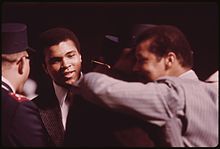
Ali attending a Saviours' Day celebration in 1974
In a 2004 autobiography, Ali attributed his conversion to mainstream Sunni Islam to Warith Deen Muhammad, who assumed leadership of the Nation of Islam upon the death of his father Elijah Muhammad, and persuaded the Nation's followers to become adherents of Sunni Islam. He said some people didn't like the change and stuck to Elijah's teachings, but he admired it and so left Elijah's teachings and became a follower of Sunni Islam.[207]
Ali had gone on the Hajj pilgrimage to Mecca in 1972, which inspired him in a similar manner to Malcolm X, meeting people of different colors from all over the world giving him a different outlook and greater spiritual awareness.[208] In 1977, he said that, after he retired, he would dedicate the rest of his life to getting "ready to meet God" by helping people, charitable causes, uniting people and helping to make peace.[209] He went on another Hajj pilgrimage to Mecca in 1988.[210]
After the September 11 attacks in 2001, he stated that "Islam is a religion of peace" and "does not promote terrorism or killing people", and that he was "angry that the world sees a certain group of Islam followers who caused this destruction, but they are not real Muslims. They are racist fanatics who call themselves Muslims." In December 2015, he stated that "True Muslims know that the ruthless violence of so-called Islamic jihadists goes against the very tenets of our religion", that "We as Muslims have to stand up to those who use Islam to advance their own personal agenda", and that "political leaders should use their position to bring understanding about the religion of Islam, and clarify that these misguided murderers have perverted people's views on what Islam really is."[211]
He also developed an interest in Sufism, which he referenced in his autobiography, The Soul of a Butterfly.[201][212][213] According to Ali's daughter, Hana Yasmeen Ali, who co-authored The Soul of a Butterfly with him, Ali was attracted to Sufism after reading the books of Inayat Khan, which contain Sufi teachings.[214][215]
Muhammad Ali received guidance from Islamic scholars such as Grand Mufti of Syria Al Marhum Al Sheikh Ahmed Kuftaro, Hisham Kabbani, Imam Zaid Shakir, Hamza Yusuf, and Timothy J. Gianotti, who was at Ali's bedside during his last days and ensured that although his funeral was interfaith, it was still in accordance with Islamic rites and rituals.[216][217]
Beatles reunion plan
In 1976, inventor Alan Amron and businessman Joel Sacher partnered with Ali to promote The International Committee to Reunite the Beatles.[218] They asked fans worldwide to contribute a dollar each. Ali said the idea was not to use the proceeds for profit, but to establish an international agency to help poor children. "This is money to help people all over the world", he said. He added, "I love the music. I used to train to their music." He said a reunion of the Beatles "would make a lot of people happy."[219] The former Beatles were indifferent to the plan, which elicited only a tepid response from the public.[220] No reunion happened.
Entertainment career
Further information: Muhammad Ali in media and popular culture
Acting
Ali had a cameo role in the 1962 film version of Requiem for a Heavyweight, and during his exile from boxing, he starred in the short-lived 1969 Broadway musical, Buck White.[221][222] He also appeared in the documentary film Black Rodeo (1972) riding both a horse and a bull.
His autobiography The Greatest: My Own Story, written with Richard Durham, was published in 1975.[223] In 1977 the book was adapted into a film called The Greatest, in which Ali played himself and Ernest Borgnine played Angelo Dundee.
The film Freedom Road, made in 1978, features Ali in a rare acting role as Gideon Jackson, a former slave and Union (American Civil War) soldier in 1870s Virginia, who gets elected to the U.S. Senate and battles alongside former slaves and white sharecroppers to keep the land they have tended all their lives.[224]
Spoken word poetry and rap music
Ali often used rhyme schemes and spoken word poetry, both for when he was trash talking in boxing and as political poetry for his activism outside of boxing. He played a role in the shaping of the black poetic tradition, paving the way for The Last Poets in 1968, Gil Scott-Heron in 1970, and the emergence of rap music in the 1970s.[20] According to The Guardian, "Some have argued that" Ali was "the first rapper."[225]
In 1963, Ali released an album of spoken word music on Columbia Records titled, I Am the Greatest, and in 1964, he recorded a cover version of the rhythm and blues song "Stand by Me".[226][227] I Am the Greatest sold 500,000 copies, and has been identified as an early example of rap music and a precursor to hip hop.[228][229] It reached number 61 on the album chart and was nominated for the Grammy Award for Best Comedy Album at the 6th Annual Grammy Awards in 1964.[230] He later received a second Grammy nomination, for "Best Recording for Children", with his 1976 spoken word novelty record, The Adventures of Ali and His Gang vs. Mr. Tooth Decay.[22]
Ali was an influential figure in the world of hip hop music. As a "rhyming trickster", he was noted for his "funky delivery", "boasts", "comical trash talk", and "endless quotables."[21] According to Rolling Stone, his "freestyle skills" and his "rhymes, flow, and braggadocio" would "one day become typical of old school MCs" like Run–D.M.C. and LL Cool J, and his "outsized ego foreshadowed the vainglorious excesses of Kanye West, while his Afrocentric consciousness and cutting honesty pointed forward to modern bards like Rakim, Nas, Jay-Z, and Kendrick Lamar."[22]
"I've wrestled with alligators, I've tussled with a whale. I done handcuffed lightning and throw thunder in jail. You know I'm bad. Just last week, I murdered a rock, Injured a stone, Hospitalized a brick. I'm so mean, I make medicine sick[231]" "Float like a butterfly, sting like a bee. His hands can't hit what his eyes can't see. Now you see me, now you don't. George thinks he will, but I know he won't.[232]" Ali spoke like no man the world had seen before. So confident in what he said; fluent, smooth, creative, and intimidating. He was a boxer and an activist, but he also had a role in influencing what now dominated pop-culture, hip-hop. In 2006, the documentary Ali Rap was produced by ESPN. Chuck D, a rapper for the band Public Enemy is the host.[233] Other rappers narrated the documentary as well, including Doug E Fresh, Ludacris and Rakim who all spoke on Ali's behalf in the film.
He has been cited as an inspiration by rappers such as LL Cool J,[21] Public Enemy's Chuck D,[234] Jay-Z, Eminem, Sean Combs, Slick Rick, Nas and MC Lyte.[235] Ali has been referenced in a number of hip hop songs, including Migos "Fight Night", The Game's "Jesus Piece", Nas' "The Message", The Sugarhill Gang's "Rapper's Delight", the Fugees' "Ready or Not", EPMD's "You're a Customer" and Will Smith's "Gettin' Jiggy wit It".[235]
...
Declining health
I'm blessed and thankful to God that I understand he's trying me. This is a trial from God. He gave me this illness to remind me that I am not number one; He is.
—Muhammad Ali reflecting on having Parkinson's disease[286][287]
Ali's Parkinson's syndrome led to a gradual decline in his health, though he was still active into the early 2000s, promoting his own biopic, Ali, in 2001. That year he also contributed an on-camera segment to the America: A Tribute to Heroes benefit concert.[288]
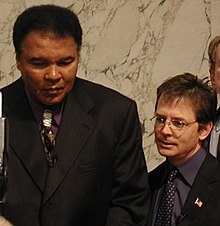 Ali and Michael J. Fox testify before a Senate committee on providing government funding to combat Parkinson's.
In 1998, Ali began working with actor Michael J. Fox, who has Parkinson's disease, to raise awareness and fund research for a cure. They made a joint appearance before Congress to push the case in 2002. In 2000, Ali worked with the Michael J. Fox Foundation for Parkinson's Research to raise awareness and encourage donations for research.[289]
In February 2013, Ali's brother Rahman Ali said Muhammad could no longer speak and could be dead within days.[290] Ali's daughter May May Ali responded to the rumors, stating that she had talked to him on the phone the morning of February 3 and he was fine.[291] On December 20, 2014, Ali was hospitalized for a mild case of pneumonia.[292] Ali was once again hospitalized on January 15, 2015, for a urinary tract infection after being found unresponsive at a guest house in Scottsdale, Arizona.[293] He was released the next day.[294]
Death
Ali was hospitalized in Scottsdale, Arizona, on June 2, 2016, with a respiratory illness. Though his condition was initially described as fair, it worsened, and he died the following day at the age of 74 from septic shock.[295][296][297][298]
News coverage and tributes
Following Ali's death, he was the number-one trending topic on Twitter for over 12 hours and on Facebook for several days. BET played their documentary Muhammad Ali: Made In Miami. ESPN played four hours of non-stop commercial-free coverage of Ali. News networks, such as ABC News, BBC, CNN, and Fox News, also covered him extensively.
He was mourned globally, and a family spokesman said the family "certainly believes that Muhammad was a citizen of the world ... and they know that the world grieves with him."[299] Politicians such as Barack Obama, Hillary Clinton, Bill Clinton, Donald Trump, David Cameron and more paid tribute to Ali.
Ali also received numerous tributes from the world of sports including Michael Jordan, Tiger Woods, Floyd Mayweather, Mike Tyson, the Miami Marlins, LeBron James, Steph Curry and more. Louisville Mayor Greg Fischer stated, "Muhammad Ali belongs to the world. But he only has one hometown."[299]
The day after Ali's death, the UFC paid tribute to Ali at their UFC 199 event in a lengthy video tribute package, crediting Ali for his accomplishments and inspiring multiple UFC champions.[300]
Memorial
| External video |
|---|
 "Muhammad Ali Memorial Service", C-SPAN[301] |
 Ali's headstone, with an inscription of his quote: "Service to others is the rent you pay for your room in heaven"
Ali's funeral had been pre-planned by himself and others for several years prior to his actual death.[302] The services began in Louisville on June 9, 2016, with an Islamic Janazah prayer service at Freedom Hall on the grounds of the Kentucky Exposition Center. The Janazah prayer was attended by Turkish President Recep Tayyip Erdoğan.[303] On June 10, 2016, the funeral procession passed through the streets of Louisville ending at Cave Hill Cemetery, where his body was interred during a private ceremony. A public memorial service for Ali at downtown Louisville's KFC Yum! Center was held during the afternoon of June 10.[304][305][306] Billy Crystal gave the eulogy. The pallbearers included Will Smith, Lennox Lewis and Mike Tyson, with honorary pallbearers including George Chuvalo, Larry Holmes and George Foreman.[307] Ali's memorial was watched by an estimated 1 billion viewers worldwide.[245]
If the measure of greatness is to gladden the heart of every human being on the face of the earth, then he truly was the greatest. In every way he was the bravest, the kindest and the most excellent of men.
— Tribute from Bob Dylan.[308]
Legacy
Ali remains the only three-time lineal heavyweight champion. He is the only boxer to be named *The Ring* magazine Fighter of the Year six times, and was involved in more Ring "Fight of the Year" bouts than any other fighter. He was one of only three boxers to be named "Sportsman of the Year" by Sports Illustrated. Muhammad Ali was inducted into the International Boxing Hall of Fame in its first year and held wins over seven other Hall of Fame inductees during an era that has been called the golden age of heavyweight boxing. The Associated Press ranked him as the second best boxer and best heavyweight of the 20th century.[8] His joint records of beating 21 boxers for the world heavyweight title and winning 14 unified title bouts stood for 35 years.
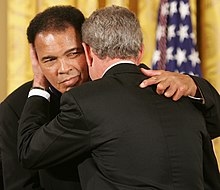
President George W. Bush embraces Ali after presenting him with the Presidential Medal of Freedom in 2005, during ceremonies at the White House.
In 1978, three years before Ali's permanent retirement, the Louisville Board of Aldermen in his hometown of Louisville, Kentucky, voted 6–5 to rename Walnut Street to Muhammad Ali Boulevard. This was controversial at the time, as within a week 12 of the 70 street signs were stolen. Earlier that year, a committee of the Jefferson County Public Schools (Kentucky) considered renaming Ali's alma mater, Central High School, in his honor, but the motion failed to pass. In time, Muhammad Ali Boulevard—and Ali himself—came to be well accepted in his hometown.[312]
Ali was named one of the 100 most influential Americans of the 20th century by Life magazine in 1990. In 1993, the Associated Press reported that Ali was tied with Babe Ruth as the most recognized athlete, out of over 800 dead or living athletes, in America. The study found that over 97% of Americans over 12 years of age identified both Ali and Ruth.[313] He was the recipient of the 1997 Arthur Ashe Courage Award.
At the end of the 20th century he was ranked at or near the top of most lists of the century's greatest athletes. He was crowned Sportsman of the Century by Sports Illustrated.[314] Named BBC's Sports Personality of the Century, he received more votes than the other five candidates combined.[315][7] He was also named BBC Overseas Sports Personality of the Year three times.[316] He was named Athlete of the Century by USA Today, and ranked as the third greatest North American athlete of the 20th century by ESPN *SportsCentury*. Ali was named "Kentucky Athlete of the Century" by the Kentucky Athletic Hall of Fame in ceremonies at the Galt House East.[317]
In 1999, Time magazine named Ali one of the 100 Most Important People of the 20th Century.[318] On January 8, 2001, Muhammad Ali was presented with the Presidential Citizens Medal by President Bill Clinton.[319] In November 2005, he received the Presidential Medal of Freedom from President George W. Bush,[320][321] followed by the Otto Hahn Peace Medal in Gold of the UN Association of Germany (DGVN) in Berlin for his work with the civil rights movement and the United Nations, which he received on December 17, 2005.[322]
 The Muhammad Ali Center, alongside Interstate 64 on Louisville, Kentucky's riverfront
On November 19, 2005, Ali and his wife Lonnie Ali opened the $60 million non-profit Muhammad Ali Center in downtown Louisville.[163] In addition to displaying his boxing memorabilia, the center focuses on core themes of peace, social responsibility, respect, and personal growth. On June 5, 2007, he received an honorary doctorate of humanities at Princeton University's 260th graduation ceremony.[323]
Ali Mall, located in Araneta Center, Quezon City, Philippines, is named after him. Construction of the mall, the first of its kind in the Philippines, began shortly after Ali's victory in a match with Joe Frazier in nearby Araneta Coliseum in 1975. The mall opened in 1976 with Ali attending its opening.[324]
The 1976 Muhammad Ali vs. Antonio Inoki fight played an important role in the history of mixed martial arts.[325] In Japan, the match inspired Inoki's students Masakatsu Funaki and Minoru Suzuki to found Pancrase in 1993, which in turn inspired the foundation of Pride Fighting Championships in 1997. Pride was acquired by its rival, Ultimate Fighting Championship, in 2007.[326][327]
The Muhammad Ali Boxing Reform Act was introduced in 1999 and passed in 2000, to protect the rights and welfare of boxers in the United States. In May 2016, a bill was introduced to United States Congress by Markwayne Mullin, a politician and former MMA fighter, to extend the Ali Act to mixed martial arts.[328] In June 2016, US senator Rand Paul proposed an amendment to the US draft laws named after Ali, a proposal to eliminate the Selective Service System.[329]
In 2015, Sports Illustrated renamed its Sportsman Legacy Award to the Sports Illustrated's Muhammad Ali Legacy Award. The annual award was originally created in 2008 and honors former "sports figures who embody the ideals of sportsmanship, leadership and philanthropy as vehicles for changing the world." Ali first appeared on the magazine's cover in 1963 and went on to be featured on numerous covers during his storied career.[330]
The Society of Voice Arts and Sciences created the Muhammad Ali Voice of Humanity Honor in 2016, which is presented at its annual Voice Arts Awards. The award was created in collaboration with the Muhammad Ali Center and is presented to "an individual whose voice, through humanitarianism, activism or personal sacrifice, has made a decidedly positive impact on our national or global condition as a society." Sculptor Marc Mellon created the bronze sculpture for the award, which depicts Ali mid-speech.[331] Recipients of the honor include Dr. Henry Louis Gates, Ken Burns, Vance Jones, Lonnie Ali, Stacey Abrams, Wes Studi, and Manuela Testolini.[332]
On January 13, 2017, the Muhammad Ali Commemorative Coin Act was introduced into the 115th Congress (2017–2019), but was not enacted.[333][334]
In media and popular culture
Main article: Muhammad Ali in media and popular culture
As a world champion boxer, social activist, sex symbol and pop culture icon, Ali was the subject of numerous creative works including books, films, music, video games, TV shows, and other. Muhammad Ali was often dubbed the world's "most famous" person in the media.[335][336][337] Several of his fights were watched by an estimated 1–2 billion viewers between 1974 and 1980, and his lighting of the torch at the 1996 Atlanta Olympics was watched by an estimated 3.5 billion viewers.[241]
 Muhammad Ali pop art painting by John Stango
Ali appeared on the cover of Sports Illustrated on 38 different occasions,[338] second only to Michael Jordan's 46.[339] He also appeared on the cover of Time Magazine 5 times,[340] the most of any athlete.[citation needed] In 2015, Harris Poll found that Ali was one of the three most recognizable athletes in the United States, along with Michael Jordan and Babe Ruth.[341]
Martial artist and actor Bruce Lee was influenced by Ali, whose footwork he studied and incorporated into his own style while developing Jeet Kune Do in the 1960s.[342]
On the set of Freedom Road Ali met Canadian singer-songwriter Michel,[343] and subsequently helped create Michel's album The First Flight of the Gizzelda Dragon and an unaired television special featuring them both.[344]
Ali was the subject of the British television program This Is Your Life in 1978 when he was surprised by Eamonn Andrews.[citation needed] Ali was featured in Superman vs. Muhammad Ali, a 1978 DC Comics comic book pitting the champ against the superhero. In 1979, Ali guest-starred as himself in an episode of the NBC sitcom Diff'rent Strokes. The show's title itself was inspired by the quote "Different strokes for different folks" popularized in 1966 by Ali, who also inspired the title of the 1967 Syl Johnson song "Different Strokes", one of the most sampled songs in pop music history.[345]
He also wrote several bestselling books about his career, including The Greatest: My Own Story and The Soul of a Butterfly. The Muhammad Ali effect, named after Ali, is a term that came into use in psychology in the 1980s, as he stated in The Greatest: My Own Story: "I only said I was the greatest, not the smartest."[223] According to this effect, when people are asked to rate their intelligence and moral behavior in comparison to others, people will rate themselves as more moral, but not more intelligent than others.[346][347]
When We Were Kings, a 1996 documentary about the Rumble in the Jungle, won the Academy Award for Best Documentary Feature.[348] The 2001 biopic Ali garnered a Best Actor Oscar nomination for Will Smith for his portrayal of Ali.[349] Prior to making the film, Smith rejected the role until Ali requested that he accept it. Smith said the first thing Ali told him was: "Man, you're almost pretty enough to play me."[350]
In 2002, Ali was honored with a star on the Hollywood Walk of Fame for his contributions to the entertainment industry.[351] His star is the only one to be mounted on a vertical surface, out of deference to his request that the name Muhammad—a name he shares with the Islamic prophet—not be walked upon.[352][353]
His 1966 fight against George Chuvalo was the subject of Joseph Blasioli's 2003 documentary film The Last Round: Chuvalo vs. Ali.[354]
The Trials of Muhammad Ali, a documentary directed by Bill Siegel that focuses on Ali's refusal of the draft during the Vietnam War, opened in Manhattan on August 23, 2013.[94][355] A 2013 made-for-TV movie titled Muhammad Ali's Greatest Fight dramatized the same aspect of Ali's life.
Antoine Fuqua's documentary What's My Name: Muhammad Ali was released in 2019.
Documentary filmmaker Ken Burns created the four-part documentary film Muhammad Ali, spanning over eight hours on Ali's life. Burns worked on the film from early 2016 and it was released in September 2021 on PBS.[356][357] Dave Zirin, who watched an 8-hour rough cut of this documentary, called it "utterly outstanding" and said "the footage they found will blow minds".[358]
Professional boxing record
...
https://www.christies.com/en/stories/when-andy-warhol-met-muhammed-ali-76ff100350654017858f0bacd9d4a991