Bragg, William Henry
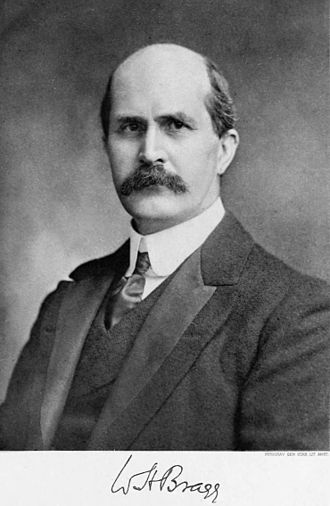
Achievements: Pioneer British scientist in solid-state physics who was jointly awarded with his son, Sir William Lawrence Bragg, the 1915 Nobel Prize for physics in 1915 for his research on the determination of crystal structures.
Born: July 2, 1862; Westward, near Wigton, Cumberland, England
Died: March 12, 1942; London, England (Aged 79)
Field & Discipline: Science; Physics
Language: English
Father: Robert John Bragg
Mother: Mary Wood (d. 1869)
Siblings: Two younger brothers
Spouse: Gwendoline Todd (m. 1889, d. 1929)
Children: William Lawrence (1890-1971); Robert (1891-1915); Gwendoline (b. 1907)
Education: Market Harborough School (1869-75); King William College, Isle of Man (1875-1881); Trinity College, University of Cambridge (1881-85)
Major Work:
“X Rays and Crystal Structure” (1915, with W.L. Lawrence)
Life & Times:
On graduating, Bragg won a partial scholarship to Trinity College, Cambridge, where from 1881 he studied pure mathematics under Dr. E.J. Routh. During his last year (1884-85) Bragg attended lectures at the Cavendish Laboratory given by its director, [taught by] J.J. Thomson* and by [taught by] Rayleigh*, and graduated with a first-class degree in mathematics in 1885.
In 1885, on Thomson's recommendation, Bragg applied and was accepted for a professorship in mathematics and physics at the University of Adelaide, South Australia. He arrived in Adelaide in 1886, and spent the next twenty-three years at the university. In 1889 he married Gwendoline Todd, daughter of Sir Charles Todd, government astronomer and postmaster general of South Australia.
In 1903, while reading of the recent work by [influenced by] Marie Curie* in France, he was struck by an explanation for her results that had not yet been proposed: Curie had shown that when a radium atom breaks into two parts, the smaller part (an atom of helium, otherwise known as an alpha particle) is released into the air as alpha radiation, from which Bragg deduced that the alpha particles must collide with and pass through the air atoms, and so at this moment of collision the atoms must therefore occupy the same space.
He also decided that the alpha particles would collide with the air atoms and scatter only if the protons of the two atoms met:- a chance of about one in a million. Bragg then confirmed his deductions in an experiment in which he passed alpha particles straight through an inch of
air, proving that the atom is not a solid body and that two atoms can indeed occupy the same space.
From 1904 to 1908, during his final years at Adelaide, Bragg continued his experiments on the penetrating power of beta, gamma and especially alpha rays emitted from radioactive substances. His investigations showed that the alpha particles emitted by a given radioactive substance could be divided into well-defined groups with different velocities and ranges, each corresponding to a different kind of radioactivity in its source, with all the particles in one group travelling the same distance before being absorbed by a substance placed in their path.
These unexpected results now meant that the distance an alpha particle travelled could be used to identify the type of radioactive substance from which it came. Bragg sent his results to [encouraged by] Rutherford*, who encouraged him to publish them in two 1907 papers, which appeared in “The Philosophical Magazine” and “The Philosophical Transactions of the Royal Society.”
These findings gained Bragg international renown. During 1907 he was elected a fellow of the [member of] Royal Society* and in 1908 he was appointed to the Cavendish Professorship of Physics at the University of Leeds, and returned to England with his family in 1909. During his first years back in England, Bragg, finding adjustment to the English academic system difficult, threw himself into an investigation of the properties of X-rays.
In 1912 the German physicist [work related to] Laue* announced that crystals could diffract (bend) X rays, producing interference patterns, thus implying that X-rays must be waves like light, but of much shorter wavelength. Bragg began a series of investigations with his elder son, William Lawrence, of crystal structure by means of X-rays.
The younger Bragg proposed a new explanation of [developed] X-ray diffraction*, far less complicated than Laue's, in which the atoms of a crystal are arranged in planes from which X-rays are deflected in patterns determined by the specific arrangement of the atoms - a theory that suggested that X-ray diffraction patterns could be used to identify the atomic structure of crystals.
In 1913 W.L. Bragg then published a formula (now known as Bragg's Law, used to study the molecular structure of complex substances) describing the angle at which X rays should be aimed at a crystal in order to determine its structure from diffraction patterns.
Meanwhile, William Bragg was using his early training in instrument design and construction to invent an instrument called the X-ray spectrometer (1913) for detecting and measuring the wavelengths of diffracted X rays. During the next two years, the Braggs worked together using the X-ray spectrometer to establish a method of determining the atomic structure of a number of crystals using X rays, and were thus able to account for their behaviour and properties. Their findings appeared in a joint publication in 1915 as “X-rays and Crystal Structure,” a seminal paper which gave the scientific world far greater understanding of the nature of solid bodies.
Extra Connections: His work related to that, earlier, of [work related to] RJ Hauy.
Assessment: Bragg's work advanced understanding of the way atoms bond together to form molecules, and has had many practical results.
Oneliner: William Henry Bragg, X-ray diffraction pioneer
Bibliography:
- Dictionary of National Biography.
- Dictionary of Scientific Biography.
- Encyclopedia Britannica.
- Notable 20th-Century Scientists.
- Nobel Prize Winners.
- Obituary Notices of Fellows of the Royal Society (1943), 4:277-300.