Decatur, S
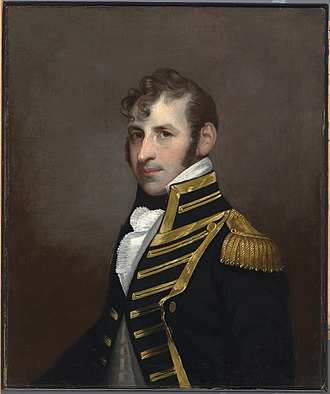
Name: Stephen Decatur
Achievements: Famous officer US Navy.
Born: January 5, 1779; Sinepuxent, Maryland
Died: March 22, 1820; Bladensburg, Maryland (Aged 41)
Field & Discipline: Military, US Naval Officer
Language: English
Father: Stephen Decatur
Mother: Ann Pine
Siblings: 1 sister; 2 brothers
Spouse: Susan Wheeler
Children: None
Education: Schools in Philadelphia
Life & Times:
In May 1798, just after Decatur was acquitted for the murder of a Philadelphia prostitute, he signed on as a midshipman on board the USS United States. His first experience of action was during the naval war with France between 1798 and 1800.
After only a year in the navy, Decatur was promoted to Lieutenant and, in November 1803, he took command of the USS Argus. America had declared war on Tripoli in 1801 and his ship was sent to the Mediterranean. While he was there, he was given command of the USS Enterprise and, in January 1804, captured a Tripolitan ketch, the Mastico, which he renamed Intrepid.
Soon afterwards, the Tripolitanians captured the USS Philadelphia after it ran aground and, on February 16, 1804, Decatur led volunteers on a daring assault in Tripoli Harbour. The American force burned the captured American frigate and, under fire from 141 enemy guns, they escaped with only one man wounded.
Six months later, Decatur led a gunboat division in hand-to-hand combat against pirates in Tripoli Harbour. The combination of the two actions made him the most famous hero of the new US Navy. After becoming the youngest person ever to be promoted to the rank of Captain in the American Navy, Decatur returned to the US.
From 1804 to 1812, he commanded a series of ships, which included the USS Constitution, USS Congress, USS Chesapeake and USS United States. During 1804, he was temporarily stationed at Syracuse, Sicily, where he met the English poet, [met] Coleridge*. Coleridge was based in Valletta, Malta and the two became great friends.
In 1807, Decatur served as one of the judges in the court-martial of Captain James Barron. Barron had commanded the USS Chesapeake in its defensive action against the Royal Navy’s HMS Leopard on 22nd June 1807, now known as the [judge at trial for] Chesapeake Incident* and Decatur declared him to be guilty, sparking a lifetime of hatred between them.
Decatur rose to prominence again in the War of 1812 between Britain and America. He was in command of the USS United States when, on October 25, 1812, he defeated the British frigate HMS Macedonian. He returned to New London, Connecticut and the captured ship was taken to Newport, RI, becoming the first British warship ever to be shown as a prize of war in an American port.
Decatur was then appointed Commodore in command of a squadron in Long Island Sound. There, in early 1813, he was blockaded by British ships and when he tried to run the blockade on June 1, 1813, he was turned back.
During 1814, his command was transferred to the USS President in New York Harbour, which was also being blockaded by the British. On the January 15, 1815, he ran the blockade but ended up wounded. The USS President ran aground on a sandbar and, overtaken by several British ships, he was forced to surrender.
In May of that year, he became Commodore of a nine-ship squadron and sailed to the Mediterranean in record time. There he ended the long American conflict with the North African powers by threatening and intimidating the leaders of Algiers, Tunis and Tripoli into signing treaties with the US.
He arrived home to a hero's welcome and was appointed to the Board of Navy Commissioners in November 1815. In the following year, he replied to a toast to his many successful engagements abroad with the words “Our country! In her intercourse with foreign nations may she always be in the right; but our country, right or wrong.”
In early 1816, Decatur bought a mansion in Washington, DC and became a prominent member of the Washington social scene. He was expected, eventually, to run for high political office and some historians speculate that he might have run as a Presidential candidate against Andrew Jackson in 1828.
This never happened, because the hatred between James Barron and Decatur had festered over the years and, on March 22. 1820, they fought each other in a duel at Bladensburg, Maryland. Barron was badly wounded, but survived, while Decatur, fatally wound, died twelve hours later.
Assessment: Decatur's spectacular naval career was a model for several generations of the early US Navy.
Oneliner: Stephen Decatur, famous US naval officer
Bibliography:
- American National Biography.
- Encyclopedia Britannica.
- Lewis, Charles Lee, The Romantic Decatur, Philadelphia, 1937.