Adams, John
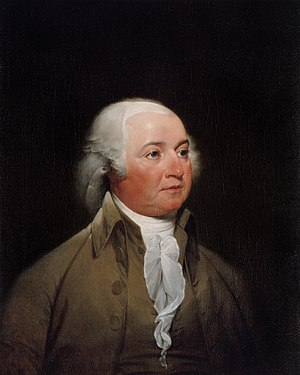
(Trumbull portrait)
John Adams, Jr. (October 30 [O.S. October 19] 1735 – July 4, 1826) was an American lawyer, author, statesman, and diplomat. He served as the second President of the United States (1797–1801), the first Vice President (1789–97),[1] and as a Founding Father was a leader of American independence from Great Britain.[2]
Adams was a political theorist in the Age of Enlightenment who promoted republicanism and a strong central government. His innovative ideas were frequently published. He was also a dedicated diarist and correspondent, particularly with his wife and key advisor Abigail.
He collaborated with his cousin, revolutionary leader Samuel Adams, but he established his own prominence prior to the American Revolution. After the Boston Massacre, despite severe local anti-British sentiment, he provided a successful though unpopular legal defense of the accused British soldiers, driven by his devotion to the right to counsel and the "protect[ion] of innocence".[3] As a delegate from Massachusetts to the Continental Congress, Adams played a leading role in persuading Congress to declare independence.
He assisted Thomas Jefferson in drafting the Declaration of Independence in 1776, and was its foremost advocate in the Congress. As a diplomat in Europe, he helped negotiate the eventual peace treaty with Great Britain, and acquired vital governmental loans from Amsterdam bankers. Adams was the primary author of the Massachusetts Constitution in 1780 which influenced American political theory, as did his earlier Thoughts on Government.
Adams' credentials as a revolutionary secured for him two terms as President George Washington's vice president (1789 to 1797) and also his own election in 1796 as the second president. In his single term as president, he encountered fierce criticism from the Jeffersonian Republicans, as well as the dominant faction in his own Federalist Party, led by his rival Alexander Hamilton. Adams signed the controversial Alien and Sedition Acts, and built up the army and navy in the face of an undeclared naval "Quasi-War" with France.
The major accomplishment of his presidency was a peaceful resolution of the conflict in the face of Hamilton's opposition. Due to his strong posture on defense, Adams is "often called the father of the American Navy".[4] He was the first U.S. president to reside in the executive mansion, now known as the White House.[5]
In 1800, Adams lost re-election to Thomas Jefferson, and retired to Massachusetts. He resumed his friendship with Jefferson upon the latter's own retirement by initiating a correspondence which lasted fourteen years.[6] He and his wife established a family of politicians, diplomats, and historians now referred to as the Adams political family. Adams was the father of John Quincy Adams, the sixth President of the United States. He died on the fiftieth anniversary of the adoption of the Declaration of Independence. Modern historians in the aggregate have ranked his administration favorably.
Contents
- 5 Conceptions of constitutional government
- 6 Vice Presidency
- 7 Presidential Election of 1796
- 8 Presidency: 1797–1801
- 13 Religious views
- 14 Biographies
- 15 See also
- 16 Notes
- 17 References
- 18 Primary sources
- 19 Further reading
- 20 External links
https://en.wikipedia.org/wiki/John_Adams
[both friends of] (https://en.wikipedia.org/wiki/Abigail_Adams)Mercy Otis Warren
Sandbox: 5vmKkJ
American Connections
JOHN ADAMS (MA) was forty. Known as "His
Rotundity." A shoemaker's son turned lawyer, Adams was also known
variously as vain, irritable, and cantankerous. The Declaration of
Independence was his idea, though he later complained that Jefferson got
all the glory.
From the outset Adams said he wanted power and
"reputation." In 1797 he got it as the country's second president, even
though back in revolutionary days he had lobbied against the
left-wingers in favor of royalist trappings like a lifetime presidency,
a hereditary Senate, and personal-fortune requirements for
representatives (£100), senators (£300), and governors (£1,000). The
idea being to reduce the likelihood of corruption. Hope springs eternal.
In 1798 bribery came back to haunt him during negotiations with the
French revolutionaries over their likely help against the Brits
(again!), when the negotiators for zee foreign minister demanded a
quarter-million back-hander for the man himself and twelve million for
la France .
Adams said stick it, and told Congress about the
scam. He referred to the blackmailers as: "X, Y, and Z." Congress went
ape. Things were about to go totally pear-shaped when Napoleon took over
in France. Whereupon sweetness and light supervened.
The mysterious X, Y, and Z turned out to be an American banker living in
Hamburg and two Swiss. One of whom was J. Conrad Hottinguer. Who in 1816
was witness to a contract signed by thirty-one-year-old Laurent Clerc, a
teacher in Paris. The contract (with an American in Europe on a
head-hunting visit) was for Clerc to go to Hartford, Connecticut, and
teach for three years. Clerc's career to this point had been remarkably
successful, and this contract required him to teach geography, history,
Bible studies, arithmetic, and grammar. And sign language, since his
pupils would be deaf (and in some cases, dumb).
No problem. Clerc himself was deaf and had been trained at the Paris
Institute for those similarly challenged. He had happened to be on a
visit to London when he met his future employer, Thomas Gallaudet (whose
son later set up what eventually became the modern-day Gallaudet
University for the deaf in Washington, D.C.). Gallaudet was in the
United Kingdom to check out the Braidwood family schools for the deaf.
The Braidwoods (who'd started out in Edinburgh) taught deaf pupils to
make sounds by feeling their teacher's larynx so as to recognize a
correct sound when they made it themselves, and by using a small
instrument to position their lips, jaw, and tongue. Unfortunately for
Gallaudet, Braidwood required nondisclosure, lots of money, and several
years' training for any would-be teacher.
Braidwood's methods worked remarkably well. In a famous test the famous
Dr. Johnson provided a word one and a half feet long long and a deaf
Braidwood pupil spoke it perfectly.
Another of Braidwood's Edinburgh
pupils, John Philip Wood, was so good he ended up as a qualified
accountant in charge of auditing the Excise Office. Where he revealed
corruption, incompetence, and expenses fraud on a massive scale.
In 1813 Wood got married, marking another triumph for the Braidwood
system and its aim of giving pupils a normal life.
Wood's new wife was
the sister of Scotland's best-known publisher, Robert Cadell, close
friend and business partner of Sir Walter Scott. Scott was very big
business. As the first successful historical novelist (twenty of his
twenty-three books), Scott's work burst upon an English public
fascinated by the Gaelic past it had recently tried so hard to wipe out
with the Highland Clearances (a "sheep in, people out" policy that
emptied Scotland and filled Canada, and that was carried out in savage
retribution for Scotsman Bonnie Prince Charlie and his clans' having
nearly made it to London and the throne). Walter Scott's novels and
their tartan Disneyfication of Scotland sold like hot bannocks, and
everybody involved got very rich.
One of the very few times Scott put a foot wrong was in 1818 with
Provincial Antiquities and Picturesque Scenary (sic) of
Scotland. Which failed in spite of the illustrations by
up-and-coming young painter J. M. W. Turner. Who in 1792 had started
walking all over the country, doing twenty-five miles a day with his
possessions and food in a bag on the end of a stick, producing landcape
sketches and watercolors for a magazine.
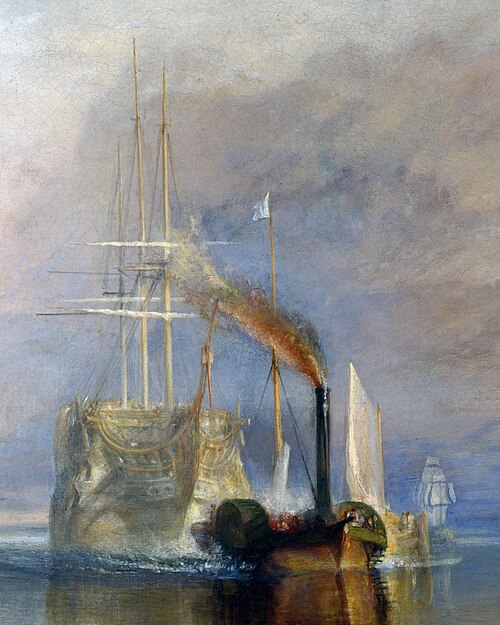
The year after Scott's book came out, Turner left England (as every painter tried to) for Rome and the Great Experience. After a few weeks of the usual Old Masters
copying, Turner developed his own style and changed the world of
painting. His scrapings, blottings, wipings, and scratchings of the wet
paint created dreamlike visions of light and color unlike anything that
had gone before (take a look at *The Fighting Temeraire* .
During another trip to Rome, in 1819, Turner also made the obligatory
visit to the new excavations at Herculaneum, where he met and dined with
Sir Humphry Davy, big science cheese and the darling of London beauties,
who flocked to his lectures at the Royal Institution. Davy isolated
potassium and sodium, invented a miner's lamp, won a Napoleonic prize
(even though there was a war with Napoleon at the time), and wrote the
definitive [Agricultural Chemistry. And wasn't boring.
Davy was in Herculaneum trying to unroll Roman papyrus documents stuck
together by the Vesuvius eruption and seventeen-hundred-plus years in
the ground. After six months' effort, in the face of Italian
obstructiveness and a chemical solution that wasn't the solution, Davy
was the only thing to come unglued and left.
So did his sidekick Peter Elmsley. At 240 pounds, Elmsley was known as
the fattest undergraduate of his day. As genial as he was obese, Elmsley
(rich, Oxford, sinecure vicarage) indulged in two pleasures: food and
ancient Greek. Years of digging in Italian libraries for manuscripts by
Sophocles and Euripides turned Elmsley into the leading Greek scholar in
Britain. In 1822 he applied for the chair of divinity at Oxford. He
didn't get it. Second prize was the offer of the bishopric of Calcutta.
No thanks.
This left the job to Reginald Heber. An altogether more qualified man
since he was a full-time divine, was married to a cathedral dean's
daughter, had traveled widely, and was gung-ho to get the word out to
the idol-worshipping heathens. Heber ended up spending only three hectic
years in India involved with the poor and needy as well as dealing with
the "predicaments of Indian Princes" (caused by the gradual removal, by
the Brits and the East India Company, of their princely authority and valuables) and generally overdoing it until he expired in a bath. But not before writing
fifty-seven hymns. One of which, "Greenland's Icy Mountains," would be
set to music by the man who wrote twelve hundred hymns of his own and
singlehandedly created a musical culture in American schools. Or
(depending on your view) singlehandedly destroyed a flourishing
indigenous musical tradition ("backwoods" and "unscientific," he called
it).
Lowell Mason's "Better Music" movement started in Boston (where he
founded the Academy of Music), then spread to every school curriculum
throughout the country. It earned him America's first doctor of music
degree. Mason's approach to music teaching (based on European classical
music) was influenced by an 1837 European visit to an obscure Swiss
named Johann Naegeli (Mason arranged two of his hymns). Naegeli was the
inventor of the Swiss choir and wrote dozens of tunes for the Swiss
Reformed Church. And inspired Mason by his classroom methods. Which were
inspired in turn by another Swiss, Heinrich Pestalozzi. Who inspired
everybody.
Pestalozzi believed in teaching children through direct experience of
life. Observation led to awareness led to measurement led to description
led to writing. No books, no timetables, no punishment, no teachers
(except other kids). It seemed to work. His school at Yverdon in
Switzerland became the radical-chic must-see after it opened in 1805.
Glitzy visitors included the Russian ambassador. Confusingly, a Greek.
John Capodistria's meteoric rise took him (in only eighteen years) from
obscure Corfu doctor to Russian foreign minister to first republican
Greek head of state. After which (in 1831) he was assassinated for
insulting somebody's family honor. Whereupon the Brits, Russians, and
French opted for a (less-precarious, they thought) monarchy and
installed Otto I. Confusingly, a German.
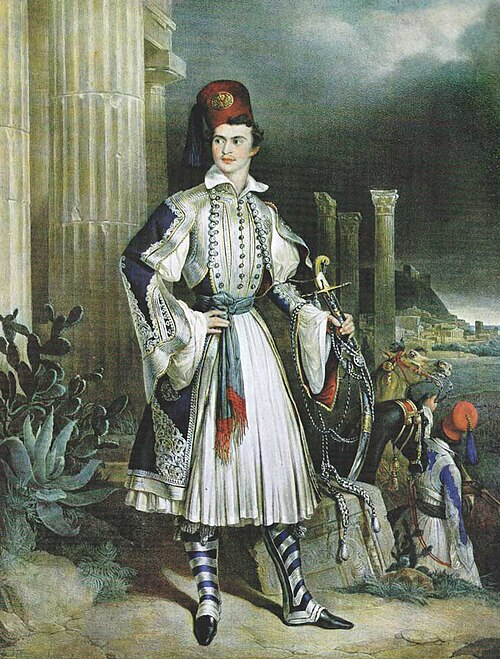
Seventeen-year-old Otto was the son of King Ludwig I of Bavaria and
spoke about as much Greek as he did Sanskrit. Accompanying him were
three regents: two nonentities and Count von Armansperg. Who'd made
enemies cleaning up Bavarian government finances and would soon do the
same for Otto.
Once Otto reached the age of throneship he spent more
time thinking up regulations for chimneysweeps than running cabinet
meetings. The London Morning Chronicle described his reign as
"incompetence and imbecility." Crime levels rose and carriage-jacking
happened right outside the Royal Palace, where nonstop full-dress balls
were held. Athens University was opened with thirty-three professors and
fifty-two students. And the medieval city was indiscriminately destroyed
by German archeologists so as to leave the Greek ruins looking like
museum pieces. Eventually the exasperated Greeks ran Otto and von
Armansperg out of town.
In 1853 Armansperg's daughter Princess Caroline arrived in Hoboken, New
Jersey, where she met and married Julius Froebel, himself on the run
from a death sentence in Germany for his involvement in the 1848
revolution. Froebel (mineralogist, educator, and revolutionary) spent
several years in Central America becoming the authority on Mayan
architecture and linguistics. He and Caroline ended up in Algeria.
Julius's brother Friedrich Froebel went further, becoming a fervent supporter of Karl
Marx, an educator setting up kindergartens in Prussia (the schools were
banned), and finally a political exile in Edinburgh, Scotland. Where in
1875 he opened a school. In 1898 one of his little pupils was Clementine
Hozier (she remembered the school as "a strong smell of haddock").
Hozier was the granddaughter of the tenth earl of Ainslie and known for
her beauty. In 1908 after a classic whirlwind romance she married a
young politico on his way up, then down, then up again.
The second up took him all the way, and in 1940 Winston Churchill was
prime minister just in time to lead Britain through World War II.
Churchill's director of atomic energy research was physicist John
Cockcroft, (A-Bomb, radar, V-1 defense} who after the war ran the U.K. Atomic Energy Research Establishment. In 1953 Cockroft sent a young man to Geneva to help
design and build CERN's first proton synchrotron, in which atomic
particles were (and still are) smashed into each other at high speed. These were detected by Gargamelle, the bubble chamber detector. The name itself is derived from a 16th-century novel by François Rabelais, The Life of Gargantua and of Pantagruel, in which the giantess Gargamelle is the mother of Gargantua (not to be confused with an evil Smurf).
In 1975 Cockcroft's young protégé became CERN's director general. His
name was JOHN ADAMS. CERN later gave us Tim Berners-Lee and the WWW.