Navy
SEE TAG
SEE USN US NAVY
The Royal Navy (RN) is the United Kingdom's naval warfare force. Although warships were used by English and Scottish kings from the early medieval period, the first major maritime engagements were fought in the Hundred Years' War against France. The modern Royal Navy traces its origins to the early 16th century; the oldest of the UK's armed services, it is consequently known as the Senior Service.
From the middle decades of the 17th century, and through the 18th century, the Royal Navy vied with the Dutch Navy and later with the French Navy for maritime supremacy. From the mid 18th century, it was the world's most powerful navy until the Second World War. The Royal Navy played a key part in establishing and defending the British Empire, and four Imperial fortress colonies and a string of imperial bases and coaling stations secured the Royal Navy's ability to assert naval superiority globally.
Owing to this historical prominence, it is common, even among non-Britons, to refer to it as "the Royal Navy" without qualification. Following World War I, it was significantly reduced in size,[7] although at the onset of World War II it was still the world's largest. During the Cold War, the Royal Navy transformed into a primarily anti-submarine force, hunting for Soviet submarines and mostly active in the GIUK gap. Following the collapse of the Soviet Union, its focus has returned to expeditionary operations around the world and it remains one of the world's foremost blue-water navies.[8][9][10]
The Royal Navy maintains a fleet of technologically sophisticated ships, submarines, and aircraft, including 2 aircraft carriers, 2 amphibious transport docks, 4 ballistic missile submarines (which maintain the nuclear deterrent), 5 nuclear fleet submarines, 6 guided missile destroyers, 12 frigates, 11 mine-countermeasure vessels and 26 patrol vessels. As of June 2022, there are 74 operational commissioned ships (including submarines as well as one historic ship, HMS *Victory*) in the Royal Navy, plus 11 ships of the Royal Fleet Auxiliary (RFA); there are also five Merchant Navy ships available to the RFA under a private finance initiative. The RFA replenishes Royal Navy warships at sea, and augments the Royal Navy's amphibious warfare capabilities through its three Bay-class landing ship vessels. It also works as a force multiplier for the Royal Navy, often doing patrols that frigates used to do.
The Royal Navy is part of Her Majesty's Naval Service, which also includes the Royal Marines. The professional head of the Naval Service is the First Sea Lord who is an admiral and member of the Defence Council of the United Kingdom. The Defence Council delegates management of the Naval Service to the Admiralty Board, chaired by the Secretary of State for Defence. The Royal Navy operates from three bases in Britain where commissioned ships and submarines are based: Portsmouth, Clyde and Devonport, the last being the largest operational naval base in Western Europe, as well as two naval air stations, RNAS Yeovilton and RNAS Culdrose where maritime aircraft are based.
Contents
- 1Role
- 2History
- 3Royal Navy today
- 4Naval bases
- 5Command, control and organisation
- 6Titles and naming
- 7Ranks, rates and insignia
- 8Customs and traditions
- 9Navy cadets
- 10In popular culture
- 11See also
- 12Notes
- 13References
- 14Bibliography
- 15Further reading
- 16External links
Role
As the seaborne branch of HM Armed Forces, the RN has various roles. As it stands today, the RN has stated its 6 major roles as detailed below in umbrella terms.[11]
- Preventing Conflict – On a global and regional level
- Providing Security At Sea – To ensure the stability of international trade at sea
- International Partnerships – To help cement the relationship with the United Kingdom's allies (such as NATO)
- Maintaining a Readiness To Fight – To protect the United Kingdom's interests across the globe
- Protecting the Economy – To safeguard vital trade routes to guarantee the United Kingdom's and its allies' economic prosperity at sea
- Providing Humanitarian Aid – To deliver a fast and effective response to global catastrophes
History
Main articles: History of the Royal Navy (before 1707), History of the Royal Navy (after 1707), and Royal Scots Navy
The Royal Navy was formally founded in 1546 by Henry VIII[12] though the Kingdom of England and its predecessor states had possessed less organised naval forces for centuries prior to this.[13]
Earlier fleets
During much of the medieval period, fleets or "king's ships" were often established or gathered for specific campaigns or actions, and these would disperse afterwards. These were generally merchant ships enlisted into service. Unlike some European states, England did not maintain a small permanent core of warships in peacetime. England's naval organisation was haphazard and the mobilization of fleets when war broke out was slow.[14] Control of the sea only became critical to Anglo-Saxon kings in the 10th century.[15] In the 11th century, Aethelred II had an especially large fleet built by a national levy.[16] During the period of Danish rule in the 11th century, the authorities maintained a standing fleet by taxation, and this continued for a time under Edward the Confessor, who frequently commanded fleets in person.[17] After the Norman Conquest, English naval power waned and England suffered naval raids from the Vikings.[18] In 1069, this allowed for the invasion and ravaging of England by Jarl Osborn (brother of King Svein Estridsson) and his sons.[19]
The lack of an organised navy came to a head during the First Barons' War, in which Prince Louis of France invaded England in support of northern barons. With King John unable to organise a navy, this meant the French landed at Sandwich unopposed in April 1216. John's flight to Winchester and his death later that year left the Earl of Pembroke as regent, and he was able to marshal ships to fight the French in the Battle of Sandwich in 1217 – one of the first major English battles at sea.[20]
The outbreak of the Hundred Years War emphasised the need for an English fleet. French plans for an invasion of England failed when Edward III of England destroyed the French fleet in the Battle of Sluys in 1340.[21] England's naval forces could not prevent frequent raids on the south-coast ports by the French and their allies. Such raids halted only with the occupation of northern France by Henry V.[22] A Scottish fleet existed by the reign of William the Lion.[23] In the early 13th century there was a resurgence of Viking naval power in the region. The Vikings clashed with Scotland over control of the isles[24] though Alexander III was ultimately successful in asserting Scottish control.[25] The Scottish fleet was of particular import in repulsing English forces in the early 14th century.[26]
[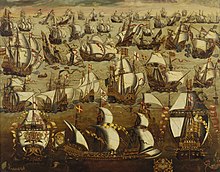
A late 16th-century painting of the Spanish Armada in battle with English warships
Age of Sail
A standing "Navy Royal",[12] with its own secretariat, dockyards and a permanent core of purpose-built warships, emerged during the reign of Henry VIII.[27] Under Elizabeth I, England became involved in a war with Spain, which saw privately owned vessels combining with the Queen's ships in highly profitable raids against Spanish commerce and colonies.[28] The Royal Navy was then used in 1588 to repulse the Spanish Armada. In 1603, the Union of the Crowns created a personal union between England and Scotland. While the two remained distinct sovereign states for a further century, the two navies increasingly fought as a single force. During the early 17th century, England's relative naval power deteriorated until Charles I undertook a major programme of shipbuilding. His methods of financing the fleet contributed to the outbreak of the English Civil War, and the abolition of the monarchy.[29]
The Commonwealth of England replaced many names and symbols in the new commonwealth navy, associated with royalty and the high church, and expanded it to become the most powerful in the world.[30][31] The fleet was quickly tested in the First Anglo-Dutch War (1652–1654) and the Anglo-Spanish War (1654-1660), which saw the conquest of Jamaica and successful attacks on Spanish treasure fleets. The 1660 Restoration saw Charles II rename the Royal Navy again, and started use of the prefix HMS. The navy remained a national institution and not a possession of the Crown as it had been before.[32] Following the Glorious Revolution of 1688, England joined the War of the Grand Alliance which marked the end of France's brief pre-eminence at sea and the beginning of an enduring British supremacy.[33]
[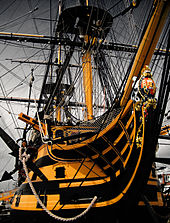
HMS *Victory*, Nelson's flagship at Trafalgar, is still a commissioned Royal Navy ship, although she is now permanently kept in dry-dock
In 1707, the Scottish navy was united with the English Royal Navy. On Scottish men-of-war, the cross of St Andrew was replaced with the Union Jack. On English ships, the red, white, or blue ensigns had the St George's Cross of England removed from the canton, and the combined crosses of the Union flag put in its place. ^[34]. Throughout the 18th and 19th centuries, the Royal Navy was the largest maritime force in the world,[35] maintaining superiority in financing, tactics, training, organisation, social cohesion, hygiene, logistical support and warship design.[36]
The peace settlement following the War of the Spanish Succession (1702–1714) granted Britain Gibraltar and Menorca, providing the Navy with Mediterranean bases. The expansion of the Royal Navy would encourage the British colonization of the Americas, with British (North) America becoming a vital source of timber for the Royal Navy.[37] A new French attempt to invade Britain was thwarted by the defeat of their escort fleet in the extraordinary Battle of Quiberon Bay in 1759, fought in dangerous conditions.[38] In 1762 the resumption of hostilities with Spain led to the British capture of Manila and of Havana, along with a Spanish fleet sheltering there.[39] British naval supremacy could however be challenged still in this period by coalitions of other nations, as seen in the American War of Independence.
The United States was allied to France, and the Netherlands and Spain were also at war with Britain. In the Battle of the Chesapeake, the British fleet failed to lift the French blockade, resulting in the surrender of an entire British army at Yorktown.[40] The French Revolutionary and Napoleonic Wars (1793–1801, 1803–1814 & 1815) saw the Royal Navy reach a peak of efficiency, dominating the navies of all Britain's adversaries, which spent most of the war blockaded in port. Under Lord Nelson, the navy defeated the combined Franco-Spanish fleet at Trafalgar (1805).[41]
Ships of the line and even frigates, as well as manpower, were prioritised for the naval war in Europe, however, leaving only smaller vessels on the North America Station and other less active stations, and a heavy reliance upon impressed labour. This would result in problems countering large, well-armed United States Navy frigates which outgunned Royal Naval vessels in single-opponent actions, as well as United States privateers, when the American War of 1812 broke out concurrent with the war against Napoleonic France and its allies.
The Royal Navy still enjoyed a numerical advantage over the former colonists on the Atlantic, blockading the Atlantic seaboard of the United States throughout the war and carrying out (with Royal Marines, Colonial Marines, British Army, and Board of Ordnance military corps units) various amphibious operations, most notably the Chesapeake campaign. On the Great Lakes, however, the United States Navy established an advantage.[42]

The Battle of Trafalgar, depicted here in its opening phase
Between 1815 and 1914, the Navy saw little serious action, owing to the absence of any opponent strong enough to challenge its dominance, though it did not suffer the drastic cutbacks the various military forces underwent in the period of economic austerity that followed the end of the Napoleonic Wars and the American War of 1812 (when the British Army and the Board of Ordnance military corps were cutback, weakening garrisons around the empire, the Militia became a paper tiger, and the Volunteer Force and Fencible units disbanded, though the Yeomanry was maintained as a back-up to the police).
Britain relied, throughout the 19th Century and the first half of the 20th Century, on Imperial fortress colonies (originally Bermuda, Gibraltar, Halifax, Nova Scotia, and Malta, though military control on Nova Scotia passed to the new Dominion government after the 1867 Confederation of Canada and naval control of the Halifax yard was transferred to the new Royal Canadian Navy in 1905) as bases for naval squadrons with stores and dockyard facilities. These allowed control not only of the Atlantic, but it was presumed also of the other oceans.
Prior to the 1920s, it was presumed that the only navies that could challenge the Royal Navy belonged to nations on the Atlantic ocean or its connected seas. Britain would rely on Malta, in the Mediterranean Sea, to project power to the Indian Ocean and western Pacific Ocean via the Suez Canal after its completion in 1869 and, relying on amity and common interests between Britain and the United States during and after the First World War, on Bermuda (and Halifax) to project power in North America, and later North America and the West Indies.[43][44][45][46][47][48][49][50][51][52]
During this period, naval warfare underwent a comprehensive transformation, brought about by steam propulsion, metal ship construction, and explosive munitions. Despite having to completely replace its war fleet, the Navy managed to maintain its overwhelming advantage over all potential rivals. Owing to British leadership in the Industrial Revolution, the country enjoyed unparalleled shipbuilding capacity and financial resources, which ensured that no rival could take advantage of these revolutionary changes to negate the British advantage in ship numbers.[53]
In 1889, Parliament passed the Naval Defence Act, which formally adopted the 'two-power standard', which stipulated that the Royal Navy should maintain a number of battleships at least equal to the combined strength of the next two largest navies.[54] The end of the 19th century saw structural changes and older vessels were scrapped or placed into reserve, making funds and manpower available for newer ships. The launch of HMS *Dreadnought* in 1906 rendered all existing battleships obsolete.[55] The transition at this time from coal-fired to petrol-powered ships would encourage Britain to colonize former Ottoman territories in the Middle East, especially Iraq.[56]
Exploration
'Ambition leads me ... farther than any other man has been before me.'
–Captain James Cook[57]
The Royal Navy played an historic role in several great global explorations of science and discovery.[58] Beginning in the 18th century many great voyages were commissioned often in co-operation with the Royal Society, such as the Northwest Passage expedition of 1741. James Cook led three great voyages, with goals such as discovering Terra Australis, observing the Transit of Venus and searching for the elusive North-West Passage, these voyages are considered to have contributed to world knowledge and science.[59]

The routes of Captain James Cook's three voyages.
In the late 18th century, during a four year voyage Captain George Vancouver made detailed maps of the Western Coastline of North America. In the 19th century Charles Darwin made further contributions to science during the Second voyage of HMS Beagle.[60] The Ross expedition to the Antarctic made several important discoveries in biology and zoology.[61] Several of the Royal Navy's voyages ended in disaster such as those of Franklin and Scott.[62]
World Wars
During the First World War, the Royal Navy's strength was mostly deployed at home in the Grand Fleet, confronting the German High Seas Fleet across the North Sea. Several inconclusive clashes took place between them, chiefly the Battle of Jutland in 1916.[63] The British fighting advantage proved insurmountable, leading the High Seas Fleet to abandon any attempt to challenge British dominance.[64] For its part, the Royal Navy under John Jellicoe also tried to avoid combat and remained in port at Scapa Flow for much of the war.[65] This was contrary to widespread prewar expectations that in the event of a Continental conflict Britain would primarily provide naval support to the Entente Powers while sending at most only a small ground army. Nevertheless, the Royal Navy played an important role in securing the British Isles and the English Channel, notably ferrying the entire British Expeditionary Force to the Western Front without the loss of a single life at the beginning of the war.[66]

Heavy cruiser HMS *York* berthed in Admiralty Floating Dock No. 1 at the Royal Naval Dockyard, Bermuda, 1934.
At the end of the war, the Royal Navy remained by far the world's most powerful navy. It was larger than the U.S. Navy and French Navy combined, and over twice as large as the Imperial Japanese Navy and Royal Italian Navy combined. Its former primary competitor the Imperial German Navy was destroyed at the end of the war.[67] In the inter-war period, the Royal Navy was stripped of much of its power. The Washington and London Naval Treaties imposed the scrapping of some capital ships and limitations on new construction.[68]
...
The United States Navy (USN) is the maritime service branch of the United States Armed Forces and one of the eight uniformed services of the United States. It is the largest and most powerful navy in the world, with the estimated tonnage of its active battle fleet alone exceeding the next 13 navies combined, including 11 allies or partner nations of the U.S. as of 2009.[8][9]
It has the highest combined battle fleet tonnage[10][8] (4,635,628 tonnes as of 2023)[11] and the world's largest aircraft carrier fleet, with 12 in service, two new carriers under construction, and five other carriers planned. With 336,978 personnel on active duty and 101,583 in the Ready Reserve, the U.S. Navy is the third largest of the United States military service branches in terms of personnel. It has 299 deployable combat vessels and about 4,012 operational aircraft as of July 18, 2023.[11][12]
The United States Navy traces its origins to the Continental Navy, which was established during the American Revolutionary War and was effectively disbanded as a separate entity shortly thereafter. After suffering significant loss of goods and personnel at the hands of the Barbary pirates from Algiers, the United States Congress passed the Naval Act of 1794 for the construction of six heavy frigates, the first ships of the Navy.
The United States Navy played a major role in the American Civil War by blockading the Confederacy and seizing control of its rivers. It played the central role in the World War II defeat of Imperial Japan. The United States Navy emerged from World War II as the most powerful navy in the world. The modern United States Navy maintains a sizable global presence, deploying in strength in such areas as the Western Pacific, the Mediterranean, and the Indian Ocean. It is a blue-water navy with the ability to project force onto the littoral regions of the world, engage in forward deployments during peacetime and rapidly respond to regional crises, making it a frequent actor in American foreign and military policy.
The United States Navy is part of the Department of the Navy, alongside the United States Marine Corps, which is its coequal sister service. The Department of the Navy is headed by the civilian secretary of the Navy. The Department of the Navy is itself a military department of the Department of Defense, which is headed by the secretary of defense. The chief of naval operations (CNO) is the most senior Navy officer serving in the Department of the Navy.[13]
...
History
Main article: History of the United States Navy
Origins
It follows then as certain as that night succeeds the day, that without a decisive naval force we can do nothing definitive, and with it, everything honorable and glorious.
— George Washington 15 November 1781, to Marquis de Lafayette[17]
Would to Heaven we had a navy able to reform those enemies to mankind or crush them into non-existence.
— George Washington 15 August 1786, to Marquis de Lafayette[18]
Naval power . . . is the natural defense of the United States.
— John Adams[19]
The Navy was rooted in the colonial seafaring tradition, which produced a large community of sailors, captains, and shipbuilders.[20] In the early stages of the American Revolutionary War, Massachusetts had its own Massachusetts Naval Militia. The rationale for establishing a national navy was debated in the Second Continental Congress. Supporters argued that a navy would protect shipping, defend the coast, and make it easier to seek support from foreign countries. Detractors countered that challenging the British Royal Navy, then the world's preeminent naval power, was a foolish undertaking.
Commander in Chief George Washington resolved the debate when he commissioned the ocean-going schooner USS *Hannah* to interdict British merchantmen and reported the captures to the Congress. On 13 October 1775, the Continental Congress authorized the purchase of two vessels to be armed for a cruise against British merchantmen; this resolution created the Continental Navy and is considered the first establishment of the U.S. Navy.[21]
The Continental Navy, including notably John Paul Jones, achieved mixed results; it was successful in a number of engagements and raided many British merchant vessels, but it lost twenty-four of its vessels[22] and at one point was reduced to two in active service.[23] In August 1785, after the Revolutionary War had drawn to a close, Congress had sold *Alliance*, the last ship remaining in the Continental Navy due to a lack of funds to maintain the ship or support a navy.[24][25]
In 1972, the Chief of Naval Operations, Admiral Elmo Zumwalt, authorized the Navy to celebrate its birthday on 13 October to honor the establishment of the Continental Navy in 1775.[26][21]
From re-establishment to the Civil War
See also: Union Navy
The United States was without a navy for nearly a decade, a state of affairs that exposed U.S. maritime merchant ships to a series of attacks by the Barbary pirates. The sole armed maritime presence between 1790 and the launching of the U.S. Navy's first warships in 1797 was the U.S. Revenue-Marine, the primary predecessor of the U.S. Coast Guard. Although the United States Revenue Cutter Service conducted operations against the pirates, the pirates' depredations far outstripped its abilities and Congress passed the Naval Act of 1794 that established a permanent standing navy on 27 March 1794.[27]
The Naval Act ordered the construction and manning of six frigates and, by October 1797,[22] the first three were brought into service: USS *United States*, USS *Constellation*, and USS *Constitution*. Due to his strong posture on having a strong standing Navy during this period, John Adams is "often called the father of the American Navy".[28] In 1798–99 the Navy was involved in an undeclared Quasi-War with France.[29] From 1801 to 1805, in the First Barbary War, the U.S. Navy defended U.S. ships from the Barbary pirates, blockaded the Barbary ports and executed attacks against the Barbary' fleets.
The U.S. Navy saw substantial action in the War of 1812, where it was victorious in eleven single-ship duels with the Royal Navy. It proved victorious in the Battle of Lake Erie and prevented the region from becoming a threat to American operations in the area. The result was a major victory for the U.S. Army at the Niagara Frontier of the war, and the defeat of the Native American allies of the British at the Battle of the Thames. Despite this, the U.S. Navy could not prevent the British from blockading its ports and landing troops.[30]
But after the War of 1812 ended in 1815, the U.S. Navy primarily focused its attention on protecting American shipping assets, sending squadrons to the Caribbean, the Mediterranean, where it participated in the Second Barbary War that ended piracy in the region, South America, Africa, and the Pacific.[22] From 1819 to the outbreak of the Civil War, the Africa Squadron operated to suppress the slave trade, seizing 36 slave ships, although its contribution was smaller than that of the much larger British Royal Navy. After 1840 several secretaries of the navy were southerners who advocated for strengthening southern naval defenses, expanding the fleet, and making naval technological improvements.[31]
 USS *Constitution* vs HMS *Guerriere* during the War of 1812.
During the Mexican–American War the U.S. Navy blockaded Mexican ports, capturing or burning the Mexican fleet in the Gulf of California and capturing all major cities in Baja California peninsula. In 1846–1848 the Navy successfully used the Pacific Squadron under Commodore Robert F. Stockton and its marines and blue-jackets to facilitate the capture of California with large-scale land operations coordinated with the local militia organized in the California Battalion.
The Navy conducted the U.S. military's first large-scale amphibious joint operation by successfully landing 12,000 army troops with their equipment in one day at Veracruz, Mexico. When larger guns were needed to bombard Veracruz, Navy volunteers landed large guns and manned them in the successful bombardment and capture of the city. This successful landing and capture of Veracruz opened the way for the capture of Mexico City and the end of the war.[30] The U.S. Navy established itself as a player in United States foreign policy through the actions of Commodore Matthew C. Perry in Japan, which resulted in the Convention of Kanagawa in 1854.
Naval power played a significant role during the American Civil War, in which the Union had a distinct advantage over the Confederacy on the seas.[30] A Union blockade on all major ports shut down exports and the coastal trade, but blockade runners provided a thin lifeline. The Brown-water navy components of the U.S. navy control of the river systems made internal travel difficult for Confederates and easy for the Union. The war saw ironclad warships in combat for the first time at the Battle of Hampton Roads in 1862, which pitted USS *Monitor* against CSS *Virginia*.[32] For two decades after the war, however, the U.S. Navy's fleet was neglected and became technologically obsolete.[33]
20th century
 The Great White Fleet demonstrating U.S. naval power in 1907; it was proof that the U.S. Navy had blue-water capability
A modernization program beginning in the 1880s when the first steel-hulled warships stimulated the American steel industry, and "the new steel navy" was born.[34] This rapid expansion of the U.S. Navy and its decisive victory over the outdated Spanish Navy in 1898 brought a new respect for American technical quality. Rapid building of at first pre-dreadnoughts, then dreadnoughts brought the U.S. in line with the navies of countries such as Britain and Germany.
In 1907, most of the Navy's battleships, with several support vessels, dubbed the Great White Fleet, were showcased in a 14-month circumnavigation of the world. Ordered by President Theodore Roosevelt, it was a mission designed to demonstrate the Navy's capability to extend to the global theater.[22] By 1911, the U.S. had begun building the super-dreadnoughts at a pace to eventually become competitive with Britain.[35] The 1911 also saw the first naval aircraft with the navy[36] which would lead to the informal establishment of United States Naval Flying Corps to protect shore bases. It was not until 1921 US naval aviation truly commenced.
World War I and interwar years
...