Bruckner
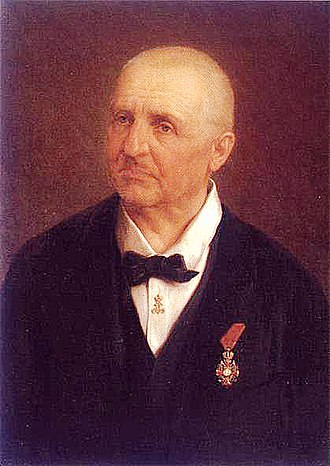
ACHIEVEMENTS: Composer of major symphonic works
NICKNAME: Tonerl
DATE AND PLACE OF BIRTH: 4 September 1824; Ansfelden, Austria
DATE AND PLACE OF DEATH: 11 October 1896; Vienna, Austria. Age 72
DISCIPLINE: Music
FIELD: Composition and performance
LANGUAGE: German
PARENTS: Anton Bruckner; (mother’s name unknown)
SIBLINGS: (ten siblings, names unknown)
SPOUSE: (never married)
CHILDREN: (none)
EDUCATION: Sacred Music School of St. Florian, Teachers’ Preparatory School at Linz, private studies with Simon Sechter in Vienna, Austria
MAJOR WORKS: Nine Symphonies
LIFE AND TIMES:
Anton Bruckner was born in Austria, the son of a teacher and the oldest of 11 children. He exhibited a gift for music early in life and by the age of four played on a small violin.
His father died when he was 12, and his mother was grateful when he was accepted as a chorister at the sacred music school of St. Florian, where he also studied piano, organ and violin. Bruckner intended to follow his father as a teacher and attended the Teachers’ Preparatory School at Linz, entering the profession (at the age of 17) in the small town of Windhaag. He was content to teach, play the organ and write sacred music during these early years.
Throughout this time, Bruckner was hearing and studying music of earlier masters, and synthesizing it with his own formal study. His prodigious ability as an organist, his great theoretical knowledge, and his gift for improvisation won him the post of organist at Linz cathedral in 1856. In 1858 he became a teacher of composition at the Vienna Conservatory. He was a simple and devoutly religious man, and was never completely at ease with the hustle and bustle of the imperial city.
At the age of 40, Bruckner first heard the opera Tannhauser by Wagner*, and was completely transported by it. From that time on he had a boundless admiration of Wagner and his music. He referred to Wagner as the “Master of all Masters.” Although a quiet and unassuming person, Bruckner found himself involved in a major argument being fought at the time about Wagner’s revolutionary music.
Most contemporary authorities considered Brahms the heir apparent to the fame and classical tradition of Beethoven. However, many of Wagner’s contemporaries, including Liszt* (Wagner’s father-in-law), Bruckner and Grieg* considered Wagner’s music the pinnacle of artistry. Bruckner’s early symphonies, full of modern harmony and dramatic orchestration, were strongly influenced by Wagner.
When Bruckner published his first symphonies, the storm broke over his head, and the anti-Wagner critic Eduard Hanslick mounted a systematic and long-term attack on him.. For many years, all performances of Bruckner’s works in Vienna were failures, thanks to Hanslick’s influence. (It did not help that Bruckner had dedicated his third symphony to Wagner!) Without Bruckner’s wishing it, some of Wagner’s followers proclaimed Bruckner to be Brahms’ rival and Brahms often publicly reacted negatively to this. In addition, many musicians and conductors in Vienna considered Bruckner’s compositions to be “titanic, unplayable and unsingable.”
In his private affairs, Bruckner was no more fortunate. When in his early forties he fell in love with a 17-year old girl whose father rejected him because of his age. He fell in love several more times after that, always with very young girls, but never succeeded in marrying.
Gradually, opinion began to turn in favor of Bruckner, and in 1881 Hans Richter performed his Fourth Symphony. Four years later, his Seventh Symphony (considered by many to be his most beautiful creation), was condcted by Hermann Levi and proved a decisive success. In 1886 he was knighted by Emperor Francis Joseph and was given an annual pension.
Bruckner never heard a performance of his eighth symphony, as it was not performed for 18 years after its composition. Although Bruckner was still working on his ninth symphony at the time of his death, most listeners consider it “finished.”
Bruckner was always beloved by his music students at the Vienna Conservatory and his influence left a lasting legacy. Gustav Mahler*, a legendary composer himself, was one of his students. Jaques-Dalcroze*, the Swiss dance theorist and father of Eurhythmics, studied with Bruckner.
ASSESSMENT: A revolutionary composer, often unappreciated in his own times, who strongly influenced music and dance to the present day.
ONELINER: Anton Bruckner, influential 19th century composer
BIBLIOGRAPHY:
“Anton Bruckner and 19th Century Austrian Music, Culture and Society;” Yamada, Yutaka; tamayu@aol.com
Engel, Gabriel, The Life of Anton Bruckner, from Chord and Discord, A Journal of Modern Musical Progress, Vol. 2, No. 1; Jan. 1940.