Grieg
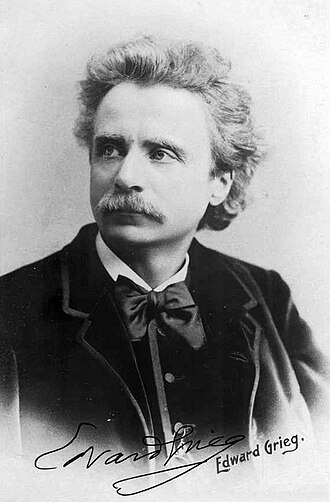
NAME: Grieg, Edvard (Hagerup) .
ACHIEVEMENT(S): Founder of the Norwegian nationalist school of music.
NICKNAME/ALIAS: None.
DATE & PLACE OF BIRTH: June 15th 1843, Bergen, Norway.
DATE/PLACE OF DEATH/AGE AT DEATH: September 4th, 1907, Bergen, Norway, aged 64.
DISCIPLINE: Composer.
FIELD: Music.
LANGUAGE: Norwegian.
PARENTS: Alexander Grieg and Gesine Hagerup, married 1836.
SIBLINGS: 5 children
SPOUSE: His cousin, Nina Hagerup, married June 1867
CHILDREN: A daughter, died aged one (1868)
EDUCATION: 'Tanks Skole', Bergen.
LIFE & TIMES:
Grieg first showed signs of musical ability early in life and from the age of 6 his mother taught him the piano. By the summer of 1858, when he was aged 15, Grieg's parents were wondering how best to further his musical education when, in August, their famous relative, the violinist, composer and noted eccentric Ole Bull (1810-80), came to the family estate at Landas.
Bull insisted that the boy should be sent to the Leipzig Conservatoire, where Grieg arrived that autumn. In Leipzing he heard <attended performance by> Clara Schumann* play Schumann's A minor concerto and went to see Wagner's 'Tannhauser' fourteen times. He left Leipzig with glowing reports, especially for a quartet in D minor and his 'Four Piano Pieces' (opus 1), which he played at his final examination, and which were published in Leipzig in 1863.
That year Grieg decided that he wanted more musical tuition, and, borrowing money from his father, he chose Copenhagen where he met the composer <a pal of> Gade* by chance. Gade invited Grieg to show him some of his compositions, and urged him to try writing a symphony.
In July 1864 Grieg and, his cousin, Nina Hagerup became engaged, despite the opposition of both sets of parents. Nina was already quite an accomplished singer, and Grieg celebrated their betrothal with the 'Six Songs' (opus 4).
Soon after this, he ventured into Danish with his settings of Christian Winther (opus 10) and with the four ''Melodies of the heart', to poems of <arranged poems of> Andersen*, whom he had recently met. These settings won him his fame and approval in Denmark.
In July 1864, Grieg became friendly with another Norwegian, Rikard Nordraak, composer of the Norwegian national anthem. In 1865, Grieg decided to travel to Italy with Nordraak. On this journey, Nordraak was taken ill with pneumonia in Berlin in October, so Grieg left him there to go on to Leipzig. Here, he played some of his own works at two concerts at the Conservatoire, the Piano Sonata in E minor (opus 7) and the Violin Sonata No.1 in F major (opus 8), in November 1865.
In December, Grieg left Leipzig and travelled to Rome via Vienna, Venice, Padua, Ferrara, Bologna and Pisa, arriving in Rome on 11th December. While staying in Rome he spent much of his free time at the Scandinavian Society, and it was here that he met <met> Ibsen*. It was in Rome, that Grieg wrote the ‘Funeral March’ and the Concert Overture, 'I Host' (In Autumn), for Rikard Nordraak on hearing of his death on April 6 1866.
Grieg returned to Denmark in May 1866, settling in Oslo, and remaining there until 1874.
Grieg taught at the music academy but he longed to escape the drudgery of teaching and wished to continue his study.
His petitions for scholarships to study and travel abroad were consistently turned down, despite his new Piano Concerto in A minor, written in the summer of 1868, premiering so successfully in Copenhagen on April 3, 1869. Then came a letter from <encouraged by> Liszt*, praising Grieg's compositions, and this won him a scholarship from the Norwegian Ministry of Education.
In September 1869, Grieg and Nina set out for trip to Italy where they spent four months in early 1870 in Rome. Here he spent two days with Liszt. Grieg left amazed after Liszt had played Grieg's complex piano concerto (1868, opus 16) from manuscript.
Back in Oslo in 1873 he was approached by Ibsen to write incidental music for his 'Peer Gynt'. This proved to be a huge task of twenty-six pieces of music, which, upon collaboration between the pair, was ready to be staged on February 24th 1876. Premiered in Oslo, it was immediately a huge success.
By 1880 Grieg accepted the post of conductor of the Bergen Orchestra, where he stayed for two seasons.
In late 1883 Grieg went on a concert tour to try and raise money to get to Paris. The tour included a hugely successful concert at Weimar, where Liszt, now aged 73, was still the Court Composer and Conductor.
On his return to Norway, Grieg decided to give up his itinerant lifestyle and settle down properly, so he bought a plot of land called the Valley of the Trolls and 1884-5 was spent building their new home. The only real works of note were the 'Holberg Suite' opus 40, written in 1884 and the Violin Sonata No. 3 opus 45, written 1887.
On New Year's Day 1888, in Leipzig, Grieg and Nina went to lunch with the Russian violinist Alfred Brodsky, where <met> Brahms*, Grieg, and <met> Tchaikovsky* were all gathered under one roof..
Grieg was extremely happy as Tchaikovsky was delighted to meet him and the two became great friends. During this time in Leipzig, Grieg also met the English composer <a pal of> Delius* (1862-1934) who was already besotted with all things Norwegian and very happy to meet him. Again, a warm and enduring friendship developed between them. At this time, Grieg was nervous about his debut London concert, on May 3 1889. The concert took place at St James Hall and was attended by an appreciative <concert attended by> Shaw*
Grieg, now almost 50, suffered much from ill-health, and he made a determined attempt to work only in Norway and Denmark. It was during this period that he became intensely interested in Scandinavian folk music and tales again.
In June 1895 he first encountered the poetry of the Norwegian writer Arne Garborg (1851-1924), which gave rise to one of his greatest works, the song-cycle 'The Mountain Maid', opus 67, from Garborg's collection of the same name, which had only just been published. Around the same time he wrote one of his most popular pieces, the Symphonic Dances, opus 64, which is a piano duet.
In March 1898 Grieg was in Vienna where he spent much time with Brahms and <a pal of> Dvorak*, and visited the aged <visited> Bruckner*. Grieg succumbed to respiratory infection and died in Bergen on September 4th. A century after his death, Grieg's legacy extends beyond the field of music. There is a large sculpture of Grieg in Seattle, while one of the largest hotels in Bergen (his hometown) is named Quality Hotel Edvard Grieg and a large crater on the planet Mercury is named after Grieg.
MAJOR WORKS: The incidental music to Peer Gynt, Opus 23, and the suite Holberg, Opus 40.
ASSESSMENT: His nationalist idiom transcended local boundaries, thanks to the strong individuality of his work.
EXTRA CONNECTIONS: His Scots grandfather fought for <grandfather fought for> Prince Charles Stuart*
Player piano*?
He influenced <influenced> Sibelius*
Grieg wrote songs in which he set lyrics by poets Heinrich Heine, Johann Wolfgang von Goethe, Henrik Ibsen, Hans Christian Andersen, Rudyard Kipling and others
On 6 December 1897, Grieg and his wife performed some of his music at a private concert at Windsor Castle for Queen Victoria and her court.[26]
Grieg was awarded two honorary doctorates, first by the University of Cambridge in 1894 and the next from the University of Oxford in 1906.
In 1899, Grieg cancelled his concerts in France in protest of the Dreyfus affair, an antisemitic scandal that was then roiling French politics. Regarding this scandal, Grieg had written that he hoped that the French might, "Soon return to the spirit of 1789, when the French republic declared that it would defend basic human rights." As a result of his statements concerning the affair, he became the target of much French hate mail of that day.[28][29]
ONELINER: Edvard Grieg, founder of Norwegian nationalist school of music
BIBLIOGRAPHY:
Layton, Robert, Grieg, London: Omnibus Press, 1998.