Hindemith
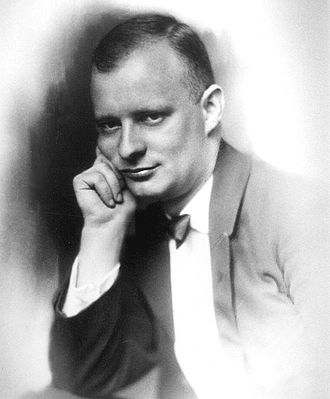
Paul Hindemith (/ˈpaʊlˈhɪndəmɪt/, powl HIN-deh-mitt; 16 November 1895 – 28 December 1963) was a German composer, music theorist, teacher, violist and conductor. He founded the Amar Quartet in 1921, touring extensively in Europe. As a composer, he became a major advocate of the Neue Sachlichkeit (New Objectivity) style of music in the 1920s, with compositions such as Kammermusik, including works with viola and viola d'amore as solo instruments in a neo-Bachian spirit.
Other notable compositions include his song cycle Das Marienleben (1923), Der Schwanendreher for viola and orchestra (1935), the opera Mathis der Maler (1938), the Symphonic Metamorphosis of Themes by Carl Maria von Weber (1943), and the oratorio When Lilacs Last in the Dooryard Bloom'd (1946), a requiem based on Walt Whitman's poem. Hindemith and his wife emigrated to Switzerland and the United States ahead of World War II, after worsening difficulties with the Nazi German regime. In his later years, he conducted and recorded much of his own music.
Most of Hindemith's compositions are anchored by a foundational tone, and use musical forms and counterpoint and cadences typical of the Baroque and Classical traditions. His harmonic language is more modern, freely using all 12 notes of the chromatic scale within his tonal framework, as detailed in his three-volume treatise, The Craft of Musical Composition.
Life and career
Paul Hindemith was born in Hanau, near Frankfurt, the eldest child of the painter and decorator Robert Hindemith from Lower Silesia and his wife Marie Hindemith, née Warnecke.[1] He was taught the violin as a child. He entered Frankfurt's Dr. Hoch's Konservatorium, where he studied violin with Adolf Rebner, as well as conducting and composition with Arnold Mendelssohn and Bernhard Sekles. At first he supported himself by playing in dance bands and musical-comedy groups. He became deputy leader of the Frankfurt Opera Orchestra in 1914 and was promoted to concertmaster in 1916.[2] He played second violin in the Rebner String Quartet from 1914.
After his father's 1915 death in World War I, Hindemith was conscripted into the Imperial German Army in September 1917 and sent to a regiment in Alsace in January 1918.[3] There he was assigned to play bass drum in the regiment band and also formed a string quartet. In May 1918 he was deployed to the front in Flanders, where he served as a sentry; his diary has him "surviving grenade attacks only by good luck", according to New Grove Dictionary.[3] After the armistice he returned to Frankfurt and the Rebner Quartet.[3]
In 1921, Hindemith founded the Amar Quartet, playing viola, and extensively toured Europe with an emphasis on contemporary music. His younger brother Rudolf was the original cellist.[4]

0:13
the opening of the song cycle