Goebbels
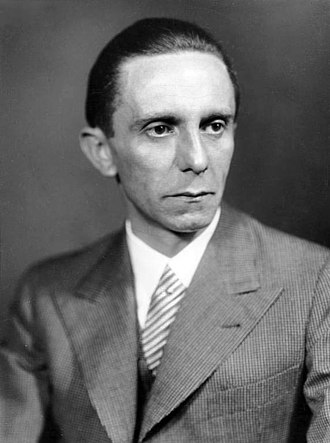
NAME: Goebbels, Paul Joseph
ACHIEVEMENT(S): Minister of propaganda for the German Third Reich under Adolf Hitler.
NICKNAME/ALIAS: None
DATE AND PLACE OF BIRTH: October 29, 1897, Rheydt, Germany
DATE/PLACE OF DEATH/AGE AT DEATH: May 1, 1945, Berlin, Germany. Aged 47
DISCIPLINE: Propagandist
FIELD: Politics
LANGUAGE: German
PARENTS: Fritz Goebbels; Katharina Odenhausen
SIBLINGS: Konrad; Hans; Maria (died in infancy); Elisabeth; Maria
SPOUSE: Magda Quandt (born Johanna Maria Magdalena Ritschel; formerly married to industrialist Gunther Quant)
CHILDREN: Helga; Hilde; Helmut; Holde; Hedda; Heide (all were ordered put to death by their father before he and their mother took their own lives, May 1, 1945)
EDUCATION: Rheydt Gymnasium; Universities of Bonn, Freiberg, Wurzburg, Munich, Heidelberg
MAJOR WORK: None
LIFE AND TIMES:
In 1921 Geobbels received his PhD in philology at the University of Heidelberg, where he studied under Professor Friedrich Gundolf, a Jewish literary historian renowned as a Goethe scholar and close disciple of the poet <influenced by> George*.
In 1925, he was hired as business manager of the Nazi Workers' Party in Elberfeld (Ruhr district), and by the end of the year, had become a collaborator of Gregor Strasser, leader of the social-revolutionary north German wing of the Party.
Because the Nazi Party had been founded and developed in Bavaria, practically no party organization existed in Berlin. To rectify this, <collaborated with> Hitler*, in November, 1926, appointed Goebbels Nazi district leader for Berlin-Brandenburg. In Berlin, Goebbels found a small, disorganized group which he rapidly took over.
He founded and edited his own weekly newspaper, "Der Angriff" ("The Attack") in 1927, designed posters, published his own propaganda, staged impressive parades, and organized his bodyguards to participate in street battles, beer-hall brawls and shootings to increase political agitation.
Immensely impressed by Goebbels's achievements in Berlin and northern Germany, Hitler in 1928 made him a Reichstag deputy, and, in 1929, appointed him Reich Propaganda Leader throughout Germany, with the future commander of the SS <deputy was> Himmler*, as his deputy.
As Propaganda Leader, Goebbels began to create the "Fuhrer" myth. He orchestrated the rise of a pseudo-religious cult, in which Hitler became the savior of Germany from Jews, profiteers and Marxists. After Hitler's coup in 1933, Goebbels was named "Reich Minister for Public Enlightenment and Propaganda" and president of the newly-formed "Chamber of Culture", which gave him total control over Germany's media.
Goebbels rapidly achieved the Nazi plan to "co-ordinate" German culture, "cleansing" the arts by a combination of propaganda, bribery and terrorism. He subjected editors and journalists to State control, and eliminated all Jews and political opponents from positions of influence.
In May, 1933, he staged the infamous book-burning ritual in Berlin, where the works of Jewish, Marxist and other so-considered "subversive" authors were publicly burned on huge bonfires. At the Party Day of Victory in 1933, Goebbels attacked the "Jewish penetration of the professions", claiming that a foreign Jewish boycott of Germany forced the Nazis to resort to "counter-measures". By the mid-1930s, Goebbels and Hitler were close friends.
Although his job as Propaganda Minister was relatively easy during the first three years of the Second World War, from 1939 to 1942, it became more and more challenging as Germany's armies suffered more defeats. In spite of the drastically worsening situation, he largely succeeded in maintaining public morale and confidence in Hitler'.
After the great defeat at Stalingrad in February, 1943, and the Allies' insistence on unconditional surrender, Goebbels was the first official publicly to acknowledge that Germany might lose the war.
Probably the best known of his wartime speeches was his brilliantly crafted "Total War" address of February 18, 1943, in which he stressed the grim truth that catastrophic defeat was a real possibility, but concluded with a rousing call for national mobilization, convincing his audience there was no choice except victory or destruction. An enormous banner proclaimed the rally's slogan: "Total War, Shortest War."
In August, 1944, after the attempted assassination of Hitler on July 20, Hitler made Goebbels Reich Plenipotentiary for the Total War Mobilization. During the final catastrophic months of the War, Goebbels and Armaments Minister Albert Speer directed maximum war production.
In Hitler’s final testament, written just hours before he took his life on April 30, 1945, he Goebbels his successor as Reich Chancellor. After he and his wife had their six children put to death by an SS doctor, Joseph and Magda Goebbels, with Soviet troops just a few hundred yards away, ended their lives by taking cyanide capsules in the courtyard outside the Fuhrer’s bunker on the evening of May 1,1945.
ASSESSMENT: A brilliant propagandist, created a terrifyingly powerful wave of hatred against Jews and other non-Aryan groups.
EXTRA CONNECTIONS: He invited the American choreographer <invited to dance>Martha Graham* to dance (she refused).
Hindemith*?
ONELINER: Joseph Goebbels, Hitler’s Minister for Propaganda
BIBLIOGRAPHY:
EB
Reuth, Ralf Georg, Goebbels: The Life of Joseph Goebbels -- The Mephistophelian Genius of Nazi Propaganda , trans. Krishna Winton, London: Constable, 1993
Weber, Mark, "Goebbels' Place in History", in The Journal for Historical Review, Institute for Historical Review, CA, U.S.A.
Wistrich, Robert S., Who's Who in Nazi Germany, London & New York: Routledge, 1995.