Caravaggio
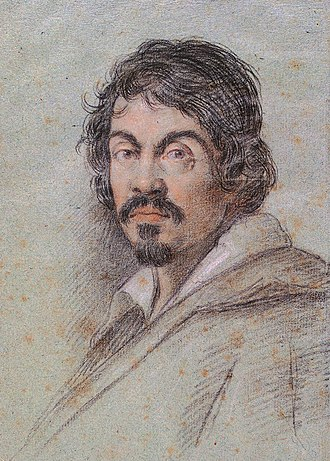
Michelangelo Merisi (Michele Angelo Merigi or Amerighi) da Caravaggio, known as simply Caravaggio (/ˌkærəˈvædʒioʊ/, US: /-ˈvɑːdʒ(i)oʊ/, Italian: [mikeˈlandʒelo meˈriːzi da (k)karaˈvaddʒo]; 29 September 1571[2] – 18 July 1610), was an Italian painter active in Rome for most of his artistic life. During the final four years of his life he moved between Naples, Malta, and Sicily until his death. His paintings have been characterized by art critics as combining a realistic observation of the human state, both physical and emotional, with a dramatic use of lighting, which had a formative influence on Baroque painting.[3][4][5]
Caravaggio employed close physical observation with a dramatic use of chiaroscuro that came to be known as tenebrism. He made the technique a dominant stylistic element, transfixing subjects in bright shafts of light and darkening shadows. Caravaggio vividly expressed crucial moments and scenes, often featuring violent struggles, torture, and death. He worked rapidly with live models, preferring to forgo drawings and work directly onto the canvas. His inspiring effect on the new Baroque style that emerged from Mannerism was profound. His influence can be seen directly or indirectly in the work of Peter Paul Rubens, Jusepe de Ribera, Gian Lorenzo Bernini, and Rembrandt. Artists heavily under his influence were called the "Caravaggisti" (or "Caravagesques"), as well as tenebrists or tenebrosi ("shadowists").
Caravaggio trained as a painter in Milan before moving to Rome when he was in his twenties. He developed a considerable name as an artist and as a violent, touchy and provocative man. A brawl led to a death sentence for murder and forced him to flee to Naples. There he again established himself as one of the most prominent Italian painters of his generation. He travelled to Malta and on to Sicily in 1607 and pursued a papal pardon for his sentence. In 1609 he returned to Naples, where he was involved in a violent clash; his face was disfigured, and rumours of his death circulated. Questions about his mental state arose from his erratic and bizarre behavior. He died in 1610 under uncertain circumstances while on his way from Naples to Rome. Reports stated that he died of a fever, but suggestions have been made that he was murdered or that he died of lead poisoning.
Caravaggio's innovations inspired Baroque painting, but the latter incorporated the drama of his chiaroscuro without the psychological realism.[dubious ^–^ discuss] The style evolved and fashions changed, and Caravaggio fell out of favour. In the 20th century, interest in his work revived, and his importance to the development of Western art was reevaluated. The 20th-century art historian André Berne-Joffroy [fr] stated: "What begins in the work of Caravaggio is, quite simply, modern painting."[6]
Biography
Early life (1571–1592)
[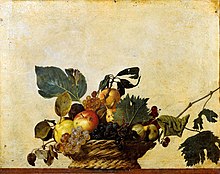
Basket of Fruit, c. 1595–1596, oil on canvas, Pinacoteca Ambrosiana, Milan
Caravaggio (Michelangelo Merisi or Amerighi) was born in Milan, where his father, Fermo (Fermo Merixio), was a household administrator and architect-decorator to the Marchese of Caravaggio, a town 35 km to the east of Milan and south of Bergamo.[7] In 1576 the family moved to Caravaggio (Caravaggius) to escape a plague that ravaged Milan, and Caravaggio's father and grandfather both died there on the same day in 1577.[8][9] It is assumed that the artist grew up in Caravaggio, but his family kept up connections with the Sforzas and the powerful Colonna family, who were allied by marriage with the Sforzas and destined to play a major role later in Caravaggio's life.
Caravaggio's mother had to raise all of her five children in poverty.[10] She later died in 1584, the same year he began his four-year apprenticeship to the Milanese painter Simone Peterzano, described in the contract of apprenticeship as a pupil of Titian. Caravaggio appears to have stayed in the Milan-Caravaggio area after his apprenticeship ended, but it is possible that he visited Venice and saw the works of Giorgione, whom Federico Zuccari later accused him of imitating, and Titian.[11] He would also have become familiar with the art treasures of Milan, including Leonardo da Vinci's Last Supper, and with the regional Lombard art, a style that valued simplicity and attention to naturalistic detail and was closer to the naturalism of Germany than to the stylised formality and grandeur of Roman Mannerism.[12]
Beginnings in Rome (1592/95–1600)
Following his initial training under Simone Peterzano, in 1592, Caravaggio left Milan for Rome in flight after "certain quarrels" and the wounding of a police officer. The young artist arrived in Rome "naked and extremely needy... without fixed address and without provision... short of money."[13] During this period, he stayed with the miserly Pandolfo Pucci, known as "monsignor Insalata".[14] A few months later he was performing hack-work for the highly successful Giuseppe Cesari, Pope Clement VIII's favourite artist, "painting flowers and fruit"[15] in his factory-like workshop.
....
Cultural legacy
Caravaggio's work has been widely influential in late-20th-century American gay culture, with frequent references to male sexual imagery in paintings such as The Musicians and Amor Victorious.[117] British filmmaker Derek Jarman made a critically applauded biopic entitled Caravaggio in 1986.[118] Several poems written by Thom Gunn were responses to specific Caravaggio paintings.[117]
In 2013, a touring Caravaggio exhibition called "Burst of Light: Caravaggio and His Legacy" opened in the Wadsworth Atheneum Museum of Art in Hartford, Connecticut.[119] The show included five paintings by the master artist that included Saint John the Baptist in the Wilderness (1604–1605) and Martha and Mary Magdalene (1589). The whole travelled to France and also to Los Angeles, California. Other Baroque artists like Georges de La Tour, Orazio Gentileschi, and the Spanish trio of Diego Velazquez, Francisco de Zurbaran, and Carlo Saraceni were also included in the exhibitions.
In 2022 a new biopic about Caravaggio was released: L'Ombra di Caravaggio, an Italian-French movie directed by Michele Placido.[120]