Da Vinci
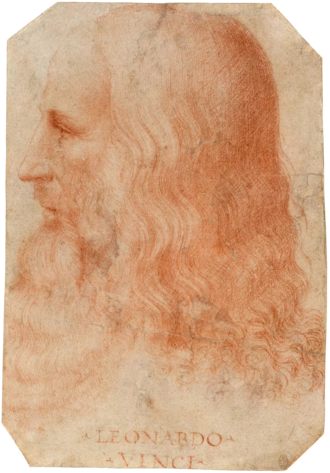
Name:Leonardo Da Vinci
Achievements: Major influence on Western culture
Born: 1452; Vinci, Italy
Died: May 2, 1519; Cloux, France (Aged 67)
Field & Discipline: Art; Medicine; Engineering; Science; Painter; Sculptor; Designer
Language: Italian
Father: Ser Piero (possibly)
Mother: Caterina ?
Siblings: None
Spouse: None
Children: None
Education: Local school
Major Work:
"The Virgin of the Rocks"
"Lady with an Ermine"
"Last Supper"
"Virgin and Child with St Anne"
"Mona Lisa"
Life & Times:
Da Vinci was apprenticed to [apprenticed to] Verrocchio* in Florence under whom he worked until 1477, when he was 25. He also worked with Antonio Pollaiuolo, who is credited with teaching him anatomy.
In 1482, Da Vinci joined the court of Ludovico Sforza, Duke of Milan, where he was employed as painter, sculptor, designer, technical consultant for architectural and military matters, and hydraulic and mechanical engineer.
Only six paintings from this period have been verified as genuine Da Vinci’s. They include the portraits "Lady with an Ermine" and "A Musician,"; the huge mural "The Last Supper", painted for the refectory of the monastery of Santa Maria delle Grazie; and a ceiling painting in the Castello Sforzesco in Milan. He is also believed to have painted a "Nativity" for Emperor [commissioned by] Maximilian I*.
Although Da Vinci worked 12 years on sculpting a 16-foot equestrian statue in honor of Francesco Sforza, it was never completed. All the public saw of it was a clay model displayed in 1493 when Milan was celebrating the marriage of Maximilian I to Bianca Maria Sforza. The statue was to have been cast in bronze soon after, but war threatened and the metal was diverted to military use.
Exceptionally inventive and versatile, Da Vinci designed mobile bridges, mortars, other items of artillery, naval weapons, and armored fighting vehicles. He worked on fortifications, canals and other architectural projects. He designed sets and props that were used in pageants for the duke's court.
Having always had a huge interest in mechanics, architecture, science, and the "science" of art, Da Vinci began to make drawings and notes that he would use in treatises on painting, architecture, mechanics and anatomy.
He was influenced by artists such as [influenced by] Uccello*, who made perspective studies, and by contemporary thinkers like mathematician [met] Pacioli*, who, when they met in 1496, was writing a treatise on proportion.
Toward the end of the 15th century, now in his late 40’s, Da Vinci published a book on the theory of mechanics with precise drawings of the elements of mechanics, such as screws, jacks and gears. He eventually made thousands of pages of notes, including illustrations, (written backward, as if seen in a mirror.)
Although he had taught himself Latin, the language of scholarship, he wrote in the Italian vernacular. His notebooks were a dazzling display of thought, observation, and beautiful drawings. They have influenced thinkers, scientists and artists through the centuries. Anatomist [influenced] Vesalius* and philosophers [influenced] Francis Bacon*, [influenced] Hobbes* and [influenced] Descartes* were all inspired by Da Vinci's work.
When French troops entered Milan in September, 1499, the Duke fled and Leonardo, now without a patron, made his way to Mantua, where he painted [painted] Isabella d'Este*'s portrait. In Florence, in 1500, his cartoon for a painting of the "Virgin and Child with St. Anne" was widely praised for the originality of its composition and the profound emotion it evoked.
In 1502, Da Vinci entered the employ of [employed by] Borgia*, the illegitimate son of Pope [worked for son of] Alexander VI*. Hired as engineer and architect in charge of fortification, Da Vinci traveled with Borgia on his campaigns, surveying the vanquished Italian territories. A year later, Borgia, enthusiastically supported by Florentine philosopher/writer [involved with] Macchiavelli*, asked Da Vinci to develop a scheme that would make the Arno river navigable and connect it by canal to the sea. But the idea proved impracticable.
During his stay in Florence, Da Vinci painted the "Mona Lisa". In 1503, he was commissioned to paint a mural of a battle scene in the new council chamber of Florence's Palazzo Vecchio. The subject was "The Battle of Anghiari", a 1440 encounter in which cavalry from Florence and the Papacy had defeated the Milanese.
Da Vinci spent every spare moment in the pursuit of science. He dissected bodies in the hospital to learn more about anatomy. He recorded the flight of birds. And he researched the properties of water and the movement of flow and currents.
From his research into bird flight and water currents, he deduced that the fundamental laws of the universe dictated the mechanics of force and motion, and that these forces dictated the physical form of all natural objects. (Four centuries later, his ideas on flight stimulated Russian aviation expert [inspired] Sikorsky 2* to develop the helicopter.)
In 1506, Da Vinci was called to Milan by the French governor. He was treated as a revered authority, given a pension, and was asked to advise on architectural matters and, in particular, on the governor's plan to build a canal to link Milan with Lake Como.
In his studio, Da Vinci and his pupils worked on a version of "The Virgin of the Rocks" and also on two paintings he had brought from Florence: the "Virgin and Child with St. Anne" and "Leda." One of his pupils was Francesco Melzi, a young nobleman, who became his close companion for the rest of his life.
Da Vinci and Italian anatomist Marantonio della Torre drafted an anatomical treatise that included illustrations of the human body, all its organs, and studies in comparative anatomy.
After the French were expelled from Milan in 1513, Giuliano de' Medici, brother of Pope Leo X, invited Da Vinci to Rome, housed him at the Vatican, gave him a substantial salary, but, to Da Vinci's intense disappointment, gave him nothing to do.
Da Vinci resented that other artists, such as [contemporary of] Raphael* and [contemporary of] Michelangelo*, were fully employed. To put in the time, he continued his studies and technical experiments, volunteered to help on a project to reclaim land, and made sketches for a Medici house in Florence.
Almost numb with boredom, Da Vinci agreed to join the service of Francis I, the young king of France. He and Melzi settled in at Cloux, a small residence near the King's summer palace at Amboise on the Loire. Francis designated him his premier painter, architect and mechanic.
He finished none of his treatises, but continued to draw with undiminished imagination and power for his "Visions of the End of the World" series until he died at Cloux in 1519.
Extra Connections: Knew [knew] Cardano* family.
His work influenced that of [influenced] Alberti*, [influenced] Durer*, [influenced] Signorelli*, [influenced] Rubens* and [influenced] Tartaglia*
His work related to that of [work related to] Veronese*.
He worked with [worked with] Bramante.
He is one of the people credited with inventing the [possibly invented] camera obscura*
He was influenced by [influenced by] Della Francesca*, [influenced by] Masaccio*, [influenced by] Toscanelli* and [influenced by] Witelo*
[a patron was] Lorenzo de’Medici* was a patron.
[written about by] Venturi* wrote about his work
He met [met] Perugino*
Assessment: Recognized as a genius, with immense energy and limitless curiosity which both fed and dissipated his extraordinary gifts. His scientific imagination, his drawings and notebooks have inspired both artists and scientists through the centuries.
Though a brilliant painter, he left only a small body of pictorial work.
Oneliner: Leonardo Da Vinci, genius
Bibliography:
Gould, Cecil, Leonardo, The Artist and The Non-Artist, Weidenfeld & Nicolson, London, 1975.
Learning from LeonardoFritjof Capra, Ph.D., physicist and systems theorist