De Vries
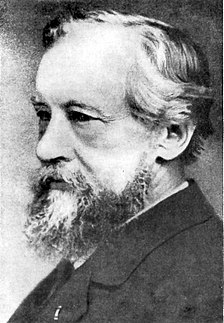
NAME: De Vries, Hugo-Marie
ACHIEVEMENTS: One of three ‘rediscoverers’ of Mendel’s theories of genetics and the segregation of characteristics in hybrid plants.
NICKNAME/ALIAS: Vries, Hugo Marie de
DATE AND PLACE OF BIRTH: February 16, 1848, at Haarlem, Holland
DATE/PLACE OF DEATH/AGE AT DEATH: May 21, 1935, at Lunteren, Holland. Aged 87.
DISCIPLINE: Botanist. Geneticist
FIELD: Botany. Genetics
LANGUAGE: Dutch
EDUCATION: University of Leiden, University of Heidelberg
MAJOR WORK: The Mutation Theory
LIFE AND TIMES:
Hugo-Marie De Vries was born during a time when scientific thought was undergoing a dramatic shift. Charles Darwin*’s “On the Origin of the Species” was published in 1859 and heralded a major paradigm shift in the assumption that species are fixed. At approximately the same time, Mendel* was carrying out meticulous studies of hybridization behavior in peas.
De Vries had an early interest in botany, and upon entering the University of Leiden in 1866, continued in the field. That same year, Mendel published his findings in Germany that quantified the ratios of the segregation of characteristics in hybrid peas.
Unfortunately, the scientific community did not understand the implications of Mendel’s work at that time.
In 1870 De Vries transferred to the University of Heidelberg, where he specialized in plant physiology. The next year he went back to Holland and taught in a high school for four years. Altering his focus again, he began to work for the government of Prussia in the study of agricultural crops. He obtained a position as a faculty member at the University of Halle in 1877, which was then a major center of agricultural study. However, he quickly left to go back to Holland and become a professor of plant physiology.
During this time, the implications of Darwin’s theory was being felt across the scientific community. Darwin had inferred that evolution took place on the basis of his observation of fossils and the variety of species he observed on his travels around the world. What was not known was the mechanism involved in evolution. Darwin, his first cousin Galton 2*, and many other contemporaries were struggling to find a theory. Spencer* was very influential at that time for extending the principles of evolution to the social and economic context (Social Darwinism).
De Vries continued to study botany at the University of Amsterdam, focusing more and more on the evolution of plants and the characteristics of hybrids. From the middle 1890’s he carried on a series of experiments on the Evening Primrose (Oenothera lamarcklana). Although his methods and results were not as precise as Mendel’s, they confirmed Mendel’s findings and paved the way for future research on genetics.
In 1900 De Vries published a series of articles about his studies and wrote the book The Mutation Theory, which made him famous. Although others, including Correns* and Tschermak*, were working on experiments relating to aspects of genetics, De Vries’ work and his recognition of Mendel’s earlier study laid the foundation for subsequent theoretical advances in biology and genetics.
De Vries continued to make progress in the understanding and improvement of plants. He began an experimental garden and made many trips to America to lecture at American universities and visit the celebrated American horticulturist, Burbank*. Although Burbank was not a scientist, he was very talented plant-breeder and De Vries devoted quite a lot of time to studying Burbank’s methods.
De Vries’ 1907 book, ‘Plant Breeding,’ followed up on the practical applications of his theories. De Vries retired from the University of Amsterdam in 1918 but continued his research until his death in 1935.
ASSESSMENT: Provided an important stepping stone between early work in genetics and modern advances.
EXTRA CONNECTIONS: None
ONELINER: Hugo de Vries, early geneticist
BIBLIOGRAPHY:
Hurst, C.C., Experiments in Genetics, Cambridge: Cambridge University Press, 1925
Meijer, O.G., “Hugo de Vries no Mendelian?” Annals of Science, 42, 189-232, 1985
Olby, R., Origins of Mendelism. Chicago: University of Chicago Press, 1966.
PARENTS: Gerrit de Vries; Maria Everardina Reuvens
SIBLINGS:
SPOUSE: ?
CHILDREN: ?