Correns CFJE
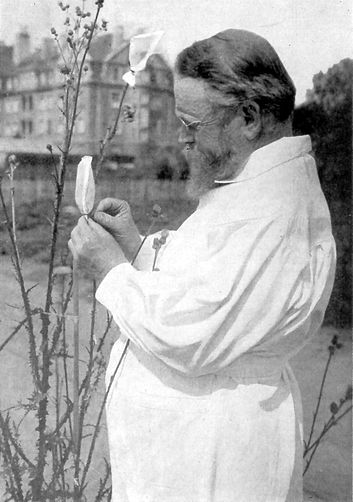
NAME: Correns, Carl Franz Joseph Erich
OTHER-NAME:
BIRTH: 19 September 1864; Munich, Germany
DEATH: 14 February 1933; Berlin, Germany
CATEGORY: Science
DISCIPLINE: Genetics
ASSESSMENT: Foremost in early work on genetics
LANGUAGE: German
EDUCATION: University of Munich; University of Tubingen
ACHIEVEMENT: He rediscovered Mendel’s paper on genetics simultaneously with De Vries and Tschermak
MAJOR-WORK: His 1900 paper on his rediscovery if Mendel’s work.
PARENTS: Father: Erich Correns; Mother: a Swiss
SPOUSE: Elizabeth Widmer (m. 1892)
SIBLINGS: None
CHILDREN: Unknown
DETAILS: Correns was orphaned at 17 and left Munich for St Gall in Switzerland where he was raised by an aunt.
After returning to Munich and attending the university there, in 1892 he married the niece of Swiss botanist Karl von Naegeli* and began lecturing at the University of Tubingen.
In 1902 he was made assistant professor at Leipzig and in 1909 a full professor at Munster. In 1913 he became the first director of the Kaiser Wilhelm Biology Institute in Berlin and remained there for the rest of his life.
Correns had studied under Naegeli and gained from him an interest in plant reproduction. He researched plant shape, sensitivity (questioning the ideas of Darwin* regarding the effect of temperature), leaf growth and reproduction in mosses.
His work on cross-breeding peas showed up patterns in color groupings through the generations, and it was in relation to this work that he first re-discovered (simultaneously with De Vries* and Tschermak*) Mendel, Gregor 2’s earlier work on the same plant, in which Mendel outlined the principles of heredity.
In a study to check on Mendel’s work, in 1909 Correns found in the four-o’clock plant (mirabilis jalapa) proof that some inherited characteristics come through factors in the cytoplasm of the female sex cell. He also discovered incomplete dominance: that in some gene pairs neither gene is dominant nor recessive, but work together to produce a blend or mix: in the four-o’clock plant, red crossed with white produces pink.
Correns went on to do more work helping to provide evidence that the ideas of Mendel* ideas had been correct and that genetic factors were at work in heredity.
Correns work suffered from the fact that he only published in German and very rarely traveled outside Berlin.
EXTRA-CONNECTIONS: None
ONELINER: Carl Erich Correns, genetics pioneer
BIBLIOGRAPHY:
Dictionary of Scientific Biography
Encyclopedia Britannica
http://www.dartmouth.edu/~bio70/syllabus~.html