March of Dimes
March of Dimes is a United States nonprofit organization that works to improve for the health of mothers and babies. According to its website, "We believe that every baby deserves the best possible start. Unfortunately, not all babies get one. We are changing that."[1]
The organization was founded by President Franklin D. Roosevelt in 1938, as the National Foundation for Infantile Paralysis, to combat polio. The name "March of Dimes" was coined by Eddie Cantor. After funding Jonas Salk's polio vaccine, the organization expanded its focus to the prevention of birth defects and infant mortality. In 2005, as preterm birth emerged as the leading cause of death for children worldwide,[2] research and prevention of premature birth became the organization's primary focus.[3]
Contents
- 1Organization
- 2Anti-polio efforts
- 3Change of mission
- 4Initiatives after polio
- 5Legislation supported
- 6Notable staff
- 7Criticism and controversy
- 8References
- 9External links
Organization
March of Dimes improves the health of mothers and babies through five programming areas: medical research, education of pregnant women, community programs, government advocacy, and support of pregnant women and mothers.[4] The organization provides women and families with educational resources on baby health, pregnancy, preconception and new motherhood, as well as supplying information and support to families in the NICU who are affected by prematurity, birth defects, or other infant health problems.[3]
The organization began in 1938 as the National Foundation for Infantile Paralysis. In 1976 it became known as the March of Dimes Birth Defects Foundation. In 2007, the formal name became the March of Dimes Foundation.[5]
Anti-polio efforts
Missy LeHandwith 30,000 letters containing ten-cent contributions to the National Foundation for Infantile Paralysis that arrived at the White House the morning of January 28, 1938
The group was founded by President Franklin D. Roosevelt on January 3, 1938, as a response to U.S. epidemics of polio, a condition that can leave people with permanent physical disabilities. Roosevelt was himself diagnosed with polio in 1921, although his symptoms are now known to be more consistent with Guillain–Barré syndrome – an autoimmune neuropathy which Roosevelt's doctors failed to consider as a diagnostic possibility.[6] The foundation was an alliance between scientists and volunteers, with volunteers raising money to support research and education efforts.[5]
The National Foundation for Infantile Paralysis was a reconstitution of the Georgia Warm Springs Foundation, which Roosevelt and his friend Basil O'Connor founded with other friends in 1927.[7] O'Connor became the foundation's president, a position he held for more than three decades. His first task was to create a network of local chapters that could raise money and deliver aid; more than 3,100 county chapters were established during his tenure.[5]
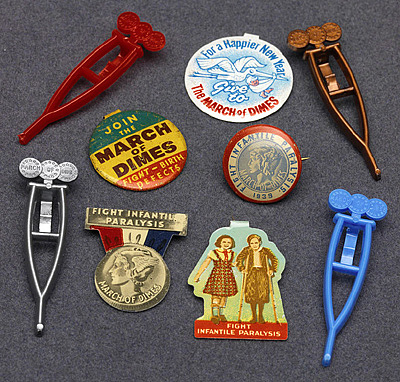
The name "March of Dimes" — a play on the contemporary radio and newsreel series, The March of Time — was coined by stage, screen and radio star Eddie Cantor.[8][9]He inspired a nationwide fundraising campaign in the week preceding President Roosevelt's birthday on January 30, 1938. Lapel pins were sold for ten cents each; special features were produced by the motion picture studios and radio industry; and nightclubs and cabarets held dances and contributed a portion of the proceeds.[10] Thousands of people mailed cards and letters, each containing a dime, to the White House. Cantor's appeal collected more than $85,000 in what the press called "a silver tide which actually swamped the White House."[11]
"During the past few days bags of mail have been coming, literally by the truck load, to the White House," Roosevelt said in birthday celebration broadcast January 30, 1938. "Yesterday between forty and fifty thousand letters came to the mail room of the White House. Today an even greater number — how many I cannot tell you — for we can only estimate the actual count by counting the mail bags. In all the envelopes are dimes and quarters and even dollar bills — gifts from grown-ups and children — mostly from children who want to help other children get well. … It is glorious to have one's birthday associated with a work like this."[12]
The March of Dimes was the title used for the foundation's annual fundraising event that requested each child donate a dime. At the Christmas season, booths were set up in cities where the children could drop their dime in a slot. These were out on the street and sometimes not even overseen by anyone. Gradually the name became synonymous with that of the organization.[13]
"His genius was in generating large numbers of relatively small contributions for a cause," The New York Times wrote of O'Connor. "Over the years he collected and spent more than seven billion dimes — many of them from schoolchildren — with a half-billion dollars of it going to the war on polio."[7]

Publisher Gerard Piel credited O'Connor with a "unique social invention: a permanently self-sustaining source of funds for the support of research — the voluntary health organization." With a centralized administration, state and local chapters and a large corps of volunteers, the National Foundation for Infantile Paralysis became the prototype for dozens of similar foundations.[7]
Because Franklin D. Roosevelt founded the March of Dimes, a redesign of the dime was chosen to honor him after his death.[8] The Roosevelt dime was issued in 1946, on what would have been the president's 64th birthday.
From 1938 through the approval of the Salk vaccine in 1955, the foundation spent $233 million on polio patient care, which led to more than 80 percent of U.S. polio patients' receiving significant[clarification needed] foundation aid.[14][verification needed]
Sabin vaccine and conflict with the March of Dimes
Around the same time, Albert Sabin (also with funding from the March of Dimes) developed a simpler version of the vaccine, which was based on an attenuated live version of the polio virus.[15][16] Both Salk's version and Sabin's version had potential safety concerns; Salk's vaccine had the risk of a virus which is not completely inactivated, while Sabin's vaccine had the risk of reversion to virulence.[17]
In 1955, a batch of Salk's vaccine made by Cutter Laboratories in California was inadequately inactivated and, as a result, 11 children died. After this incident, production methods were changed and no further incidents were reported. Sabin became highly critical of O'Connor and the March of Dimes, who he believed were biased towards Salk's vaccine and made statements inconsistent with the scientific research. In the meantime, trials of the vaccine based on Sabin's version were carried out in the Soviet Union with important contributions made by Mikhail Chumakov. In 1958, the Soviet Union organized industrial production of this vaccine and polio was largely eradicated in Eastern Europe and Japan. This success led to trials in the United States as well and the licensing of the Sabin's vaccine in 1961, over the considerable opposition of the March of Dimes, which supported Salk's vaccine. Eventually, Sabin's vaccine superseded Salk's vaccine based on its advantages, which included a simpler (oral) administration and lifelong immunity.[17][15][6]
Gallery
...
Wikipedia
Multimedia: