Eckert
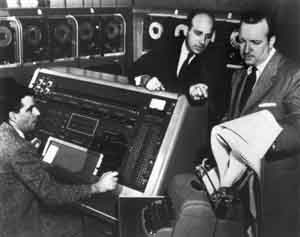
NAME: Eckert, J Presper, Jr (center of photo)
ACHIEVEMENTS:
Co-inventor of first general purpose electronic computer
NICKNAME/ALIAS: Pres
DATE AND PLACE OF BIRTH:
9 April 1919, Philadelphia, PA
DATE AND PLACE OF DEATH AND AGE AT DEATH: 3 June 1995, Bryn Mawr, PA. Aged 76
DISCIPLINE:
Engineer
FIELD:
Computers
LANGUAGE:
English
PARENTS:
Father: John Presper Eckert, Sr.
Mother: Ethel Hallowell
SIBLINGS: None
SPOUSE: Marriage 1: to Hester Caldwell. She died in the early '50s
Marriage 2: to Judith Rewalt in the early '60s.
CHILDREN:
John Presper III and Christopher (by Hester).
Gregory and Laura (by Judith)
EDUCATION:
The Penn Charter School, Germantown, PA
Moore School of Electrical Engineering, University of Pennsylania
MAJOR WORK:
LIFE AND TIMES:
Eckert became involved with the development of computers while at the University of Pennsylvania. In 1942 his professor, Mauchly*, circulated a memo about the need for electronic computing machines. Eckert, who was then studying for his master’s degree, began reading whatever he could find on the subject and became an expert on counting circuits.
In 1943, Mauchly was appointed to head a project for the Army Ballistic Research Laboratory. The army wanted an electronic computing machine for wartime ballistics calculations. Eckert was made second in command to Mauchly and chief engineer. The two developed a digital machine called ENIAC: the Electronic Numerical Integrator and Computer. ENIAC was the largest electronic computing device in existence and operated with 18,000 vacuum tubes.
Operation was laborious, with around 40 large plug-boards and thousands of wires. For a single instruction, several wires had to be plugged in; solving a problem involved thousands of wires. Each time a new problem was fed in, the whole wiring system had to
be re-plugged by hand. Vacuum tubes burned out each day and locating the faulty tube could take a couple of hours.
In 1944 Eckert and Mauchly were joined by Neumann*, a mathematician, who agreed that the plug-wire system and the lack of internal storage capacity on ENIAC needed to be improved. Together, the three men designed a more advanced machine, called EDVAC: Electronic Discrete Variable Automatic Computer.
Eckert and Mauchly worked on the electronic devices and the engineering aspects, while von Neumann worked on the mathematics. In 1945 von Neumann published a report on the EDVIAC under his name. Eckert and Mauchly were bound by security and could not talk about the problem.
In 1946 the university held a summer course sponsored by the Office of Naval Research and the Army Ordnance Department. Its purpose was to share out information on electronic digital computers the government funding available for their development. A number of scientists and also representatives from firms such as General Electric and Eastman-Kodak were invited.
IBM* was on the original guest list but their invitation was withdrawn without explanation. It has been suggested that the reason for this was that Mauchly and Eckert, who were both speaking, had already decided to set up their own firm and did not want competition from IBM.
The trigger for Eckert and Mauchly's move was a new patent ruling introduced by the university under which patents for all work done under in their laboratories were assigned to the university. Eckert and Mauchly refused to sign up for the new deal and at the end of 1946 were obliged to resign. They were then approached by Thomas Watson from IBM who offered them a computing laboratory. Eckert was keen to accept this because he would be able to work independently without worrying about costs but Mauchly vetoed the idea.
In 1946 they set up their own computer-manufacturing firm, the Electronic Control Company, later called the Eckert-Mauchly Computer Corporation. Eckert and Mauchly were not businessmen, and company finances were shaky. They had been given government work and had plenty of contacts but had trouble running the company. In 1948 the American Totalisator Company agreed to buy in. The vice-president of American Totalisator thought that electronic devices might in future be used at race tracks. Unfortunately, the vice-president was killed in a plane crash and there was no more interest from American Totalisator.
Because they were behind with government contracts and needed money, Eckert and Mauchly accepted the job of building a small computer for the Northrop Aircraft Company. BINAC (Binary Automatic Computer), in which the punched cards on which information was stored were replaced with magnetic tape, was finished in 1949. It had cost more and taken much longer to build than anticipated.
In the same year, they produced UNIVAC (Universal Automatic Computer) aimed at the business market. The take-off of the computer business began. The use of magnetic tape to handle punched-card operations was a major innovation and they realised that UNIVAC would be able to read into memory information from magnetic tape, use its memory to rearrange the information, and then write the new information on another tape.
In 1950 Eckert and Mauchly sold out to Remington Rand*. Eckert stayed on as an Executive when Remington Rand merged with Sperry* in 1955.
Eckert continued to invent electronic devices and between 1948 and 1966 was granted 85 patents. In 1967 he was elected to the National Academy of Engineering and received the National Medal of Science in 1969.
ASSESSMENT: The work he and Mauchly did provided the prototype for most computers used in the twentieth century.
EXTRA CONNECTIONS: In high school he joined the Engineer's Club of Philadelphia and spent afternoons at the electronics laboratory of television inventor Philo Farnsworth.
ONELINER: Presper Eckert, co-inventor of first general-purpose electronic computer.
BIBLIOGRAPHY:
Goldstine, Herman H, The Computer, from Pascal to von Neumann, Princeton
University Press, 1972
Pugh, Emerson W, Building IBM, Shaping an Industry and Its Technology, MIT
Press, London, 1995.