Benzene ring
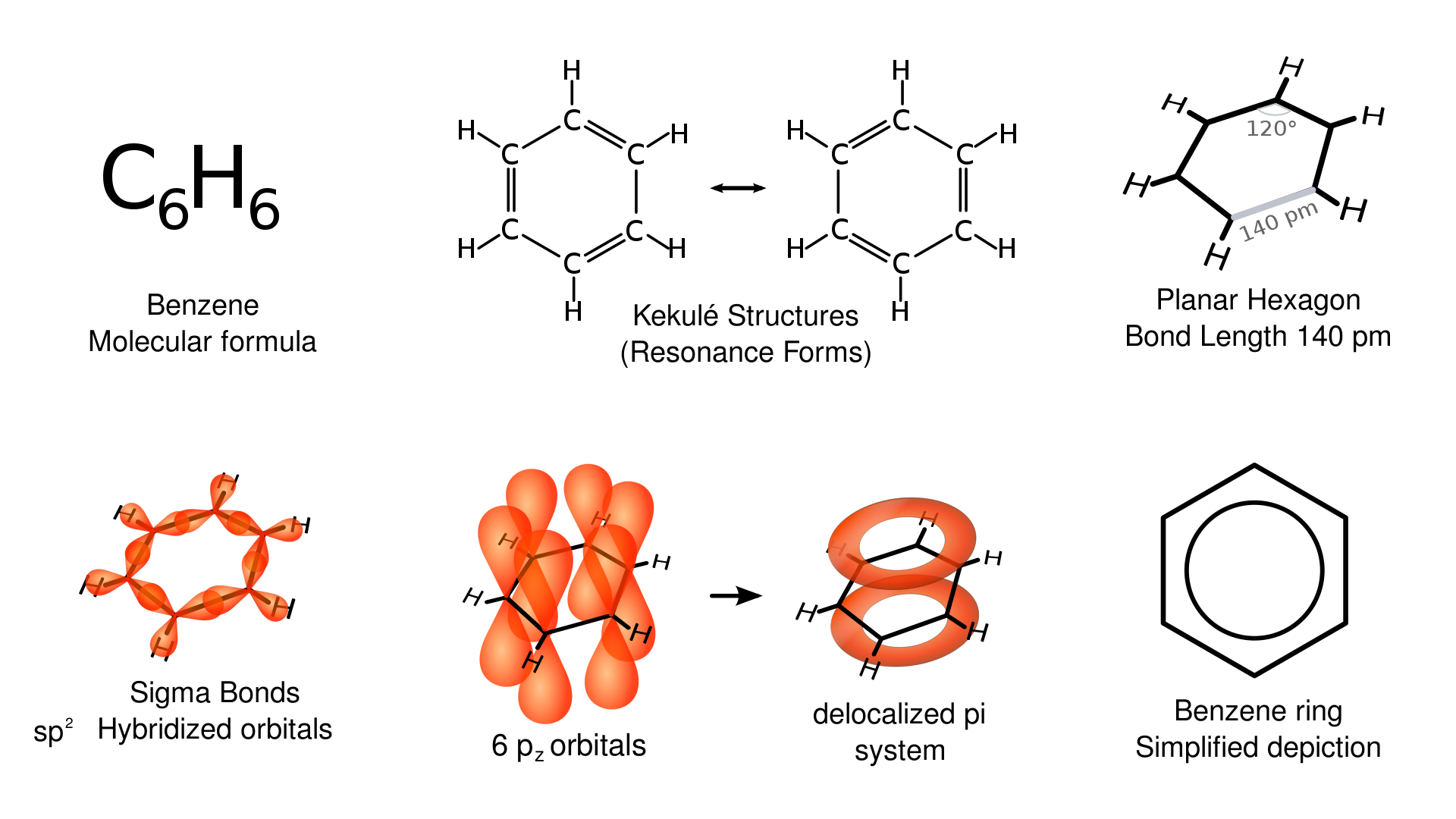
The benzene ring was first described in 1865 by the Czech-German chemist Kekule*. Kekule used his concept of atomc bonding (by which atoms bond together to forms mulecules and solids) through an electrical phenomenon involving the sharing or exchange of one of their electrons.
His new idea was that atoms always made the same number of bonds and that in particular the carbon atom (which formed the basis of benzene) made four bonds.
The benzene ‘ring’ is so-called because it consists of a ring of six carbon atoms, linked to each other by two bonds on one side and one on the other. This leaves one more bond to be made, and this bond happens with a hydrogen atom (which only makes one bond).
With this concept Kekule was able to show that carbon could either link with other carbons in chains, or (in the case of benzene) form closed structures, with the hydrogen bond available to create outer linkages with other atoms and therefore able to generate a variety of molecules. This concept was key to the development and understanding of chemical structures.
OTHER CONNECTIONS: None
ONELINER: The benzene ring
BIBLIOGRAPHY:
Dictionary of Scientific Biography
http//www.science.uwaterloo.ca/cchieh/cact/c120/chembond.html