Kuhne
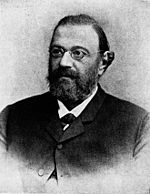
Wilhelm Friedrich Kühne (28 March 1837 – 10 June 1900) was a German physiologist. Born in Hamburg, he is best known today for coining the word enzyme.[1][2]
Contents
- 1Biography
- 2Works
- 3Some notable students
- 4Notes
- 5References
- 6External links
ACHIEVEMENT(S): Retinal photochemistry
DATE/PLACE OF BIRTH: 28 March 1837, at Hamburg, German
DATE/PLACE/AGE AT DEATH: 10 June 1900, in Heidelberg, Germany. Aged 63
DISCIPLINE: Experimental biologist
FIELD: Physiology
LANGUAGE: German
PARENTS: ?
SIBLINGS: Six siblings
SPOUSE: Helene Blum, married 1871
CHILDREN: One daughter, who married the pharmacologist Rudolf Gottlieb
EDUCATION: Luneberg Gymnasium; University of Gottingen, 1854-57; University of Jena, 1857
MAJOR WORK: 'Textbook of Physiological Chemistry', 1868
LIFE AND TIMES: At the University of Gottingen, Kuhn studied chemistry under Friedrich Whole, physics under Wilhelm Weber*, anatomy under Henle*, and physiology under Rudolph Wagner.
In 1856 he obtained his Ph.D. with a thesis on induced diabetes in frogs, and stayed another year at Gottingen as an assistant in Wagner's Physiological Institute, then went for a brief period to the University of Jena, where he worked on diabetes and sugar metabolism.
In 1858 Kuhne moved to Berlin as an assistant in the laboratory of Du Bois-Reymond*, a pioneer in electrophysiology. It was in Berlin that Kuhne's interest in nerve and muscle physiology developed, through his introduction to the frog sartorius muscle which, with its nerve-free end and unique arrangement of muscle fibres, he used in a number of key experiments. Working with Du Bois-Reymond, Kuhne became absorbed with the question as to whether muscle possesses an irritability of its own, independent of its nerve fibres.
He investigated the nature of the motor nerve-endings (1858), finding their terminal processes, which exist as motor end plates in warm-blooded animals. In preparations of the frog sartorius, Kuhne established the two-way conductibility of the nerve fibre (1859) and the direct excitability (independent of the nerve fibres) of the muscle fibre by both electric and chemical stimuli.
While in Berlin, Kuhne also became friendly with Felix Hoppe-Seyler, then chemical assistant to Virchow*, and became interested in bile, the origin of hippuric acid (which he discovered to be produced in the liver), and the cause of jaundice.
Kuhne soon moved on to Paris to work in the laboratory of Bernard*, where he remained for the next two years studying Bernard's experimental methods.
Kuhne left Paris in 1860 and travelled to Vienna, where he spent some time working with Brucke* and Ludwig*, from whom he learned vital microscopic techniques and developed an interest in the physiology of the protozoa and the nature of protoplasm.
Back in Berlin, Kuhne lectured on physiological chemistry and continued his work with muscles and with the microscopic observations of protoplasm. In 1868 his 'Textbook of Physiological Chemistry' was the first textbook in the field, and had a considerable influence on the further development of physiological chemistry.
In 1868 Kuhne was appointed to the chair of physiology at Amsterdam and in 1871 moved to Heidelberg as successor in physiology to Helmholtz*. It was here that Kuhne made major discoveries including the pancreatic enzyme he named trypsin. In 1876 Kuhne introduced the term "enzyme."
He was later able to extract trypsin and make a number of other observations, including the clotting of proteins by this juice, the microscopic observation of the rabbit pancreas during digestion and at rest, and the finding of pancreatic cells whose form changed during secretion and which apparently contained the secretion localized within these cells.
In 1873 he was elected a member of the Naturhistorisch-Medizinischen Verein of Heidelberg, alongside Bunsen*, Kekule*, Helmholtz and Kirchhoff*.
In 1877, at the age of 40, Kuhne entered an entirely new field of study - retinal chemistry and physiology. This interest was sparked in November 1876 by the report by Boll* to the Berlin Academy on the retinal rods. In early 1877, Kuhne repeated and confirmed Boll's observations that the retinal red color is bleached by light and regenerates in the dark, and agreed with Boll that in this reversible change of color lay the secret of vision.
Supposing that there was a primary chemical process that preceded excitation of the optic nerves, Kuhne demonstrated that the retina works like a photographic plate, with light bleaching out the visual purple, which is then regenerated through the pigment epithelium in darkness.
He then succeeded in producing his famous "optograms" - the reproduction of the pattern of crossbars of a window on the chemical substance of the retina of a rabbit, and was the first to see the migrating pigments in the living retina.
Kuhne's observations of many retinas proved that the red color was present in the retinas of many vertebrates, including that of man, and led him to the conclusion that the red color was present in rods but not in cones. He decided that the color might represent a pigment, and later named it 'rhodopsin'. His experiments laid the foundation of retinal photochemistry.
ASSESSMENT: He made a number of important contributions to the development of physiological chemistry.
EXTRA CONNECTIONS: None
ONELINER: FR Kuhne, pioneer in retinal physiology
BIBLIOGRAPHY:
DSB
Crescitelli, Frederick, "Friedrich Wilhelm Kuhne", in Vision Research (1977), 17, 1317-1323