Diving Bell / Bathyscaphe
A diving bell is a rigid chamber used to transport divers from the surface to depth and back in open water, usually for the purpose of performing underwater work. The most common types are the open-bottomed wet bell and the closed bell, which can maintain an internal pressure greater than the external ambient.[1] Diving bells are usually suspended by a cable, and lifted and lowered by a winch from a surface support platform. Unlike a submersible, the diving bell is not designed to move under the control of its occupants, nor to operate independently of its launch and recovery system.
The wet bell is a structure with an airtight chamber which is open to the water at the bottom, that is lowered underwater to operate as a base or a means of transport for a small number of divers. Air is trapped inside the bell by pressure of the water at the interface. These were the first type of diving chamber, and are still in use in modified form.
The closed bell is a pressure vessel for human occupation, which may be used for bounce diving or saturation diving, with access to the water through a hatch at the bottom. The hatch is sealed before ascent to retain internal pressure. At the surface, this type of bell can lock on to a hyperbaric chamber where the divers live under saturation or are decompressed. The bell is mated with the chamber system via the bottom hatchway or a side hatchway, and the trunking in between is pressurized to enable the divers to transfer through to the chamber under pressure. In saturation diving the bell is merely the ride to and from the job, and the chamber system is the living quarters. If the dive is relatively short (a bounce dive), decompression can be done in the bell in exactly the same way it would be done in the chamber.
- History
- 2Mechanics
- 3Use with hyperbaric chambers
- 4Air-lock diving bells
- 5Rescue bell
- 6Diver training
- 7Underwater habitats
- 8In nature
- 9See also
- 10References
- 11External links
History
A diving bell renovated as a tourist attraction onSir John Rogerson's Quay, Dublin

The diving bell is one of the earliest types of equipment for underwater work and exploration.[2] Its use was first described by Aristotle in the 4th century BC: "they enable the divers to respire equally well by letting down a cauldron, for this does not fill with water, but retains the air, for it is forced straight down into the water."[3] According to Roger Bacon, Alexander the Great explored the Mediterranean on the authority of Ethicus the astronomer.
In 1535, Guglielmo de Lorena created and used what is considered to be the first modern diving bell.
In 1616, Franz Kessler built an improved diving bell.[4][clarification ^needed]
In 1642, John Winthrop reports one Edward Bendall building two large wooden barrels, weighted with lead and open at their bottoms, to salvage a ship Mary Rose which had exploded and sunk, blocking the harbor of Charlestown, Boston. Bendall undertook the work on condition that he be awarded all the value of the salvage should he succeed in unblocking the harbor, or half the value he could salvage if he could not.[5]
In 1658, Albrecht von Treileben was permitted to salvage the warship Vasa, which sank in Stockholm harbor on its maiden voyage in 1628. Between 1663 and 1665 von Treileben's divers were successful in raising most of the cannons, working from a diving bell.[6]
A diving bell is mentioned in the 1663 Ballad of Gresham College (stanza 16):
A wondrous Engine is contriveing
In forme, t'is said, much like a Bell,
Most usefull for the Art of Diveing.
If 't hitt, 't will prove a Miracle;
For, gentlemen, 't is no small matter
To make a man breath under water.
In late 1686, Sir William Phipps convinced investors to fund an expedition to what is now Haiti and the Dominican Republic to find sunken treasure, despite the location of the shipwreck being based entirely on rumor and speculation. In January 1687, Phipps found the wreck of the Spanish galleon Nuestra Señora de la Concepción off the coast of Santo Domingo. Some sources say they used an inverted container for the salvage operation while others say the crew was assisted by Indian divers in the shallow waters.The operation lasted from February to April 1687 during which time they salvaged jewels, some gold and 30 tons of silver which, at the time, was worth over £200,000.[7]
In 1689, Denis Papin suggested that the pressure and fresh air inside a diving bell could be maintained by a force pump or bellows. Engineer John Smeaton utilized this concept in 1789.[4][8]
In 1691, Dr. Edmond Halley completed plans for a diving bell capable of remaining submerged for extended periods of time, and fitted with a window for the purpose of undersea exploration. In Halley's design, atmosphere is replenished by sending weighted barrels of air down from the surface.[9]
In 1775, Charles Spalding, an Edinburgh confectioner, improved on Halley's design by adding a system of balance-weights to ease the raising and lowering of the bell, along with a series of ropes for signaling the surface crew.[10] Spalding and his nephew, Ebenezer Watson, later suffocated off the coast of Dublin in 1783 doing salvage work in a diving bell of Spalding's design.[10]

16th century Islamic painting of Alexander the Great lowered in a glass diving bell.
Sir William Phipps used a diving bell to salvage tremendous wealth from a sunken Spanish treasure ship.
Diving bell
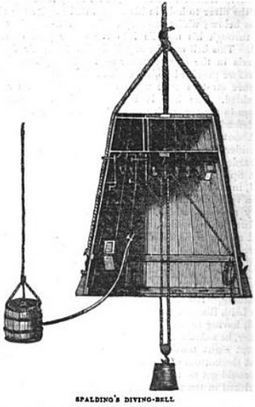
Spalding's Diving Bell, The Saturday Magazine, Vol. 14, 1839
Mechanics

Occupied diving bell illustrated. FromOtto Lueger, Lexikon der gesamten Technik (Dictionary of Technology), 1904
The bell is lowered into the water by cables from a crane, gantry or A-frame attached to a floating platform or shore structure. The bell is ballasted so as to remain upright in the water and to be negatively buoyant, so that it will sink even when full of air.
Hoses, supplied by gas compressors or banks of high pressure storage cylinders at the surface, provide breathing gas to the bell, serving two functions:
- Fresh gas is available for breathing by the occupants.
- Volume reduction of the air in an open bell due to increasing hydrostatic pressure as the bell is lowered is compensated. Adding pressurized gas ensures that the gas space within the bell remains at constant volume as the bell descends in the water. Otherwise the bell would partially fill with water as the gas was compressed.
The physics of the diving bell applies also to an underwater habitat equipped with a moon pool, which is like a diving bell enlarged to the size of a room or two, and with the water–air interface at the bottom confined to a section rather than forming the entire bottom of the structure.
Wet bell
See also: Surface-supplied diving skills
A wet bell is a platform for lowering and lifting divers to and from the underwater workplace, which has an air filled space, open at the bottom, where the divers can stand or sit with their heads out of the water. The air space is at ambient pressure at all times, so there are no great pressure differences, and the greatest structural loads are usually self weight and the buoyancy of the air space. A fairly heavy ballast is often required to counteract the buoyancy of the airspace, and this is usually set low at the bottom of the bell, which helps with stability. The base of the bell is usually a grating or deck which the divers can stand on, and folding seats may be fitted for the divers' comfort during ascent, as in-water decompression may be long. Other equipment that is carried on the bell include cylinders with the emergency gas supply, and racks or boxes for tools and equipment to be used on the job. There may be a tackle for hoisting and supporting a disabled diver so that their head projects into the air space.
...
See also
- Bathysphere – Unpowered spherical deep-sea observation submersible lowered on a cable
- Benthoscope – Unpowered spherical deep-sea observation submersible lowered on a cable
- Caisson (engineering) – Rigid structure to provide workers with a dry working environment below water level
- Cofferdam – Barrier allowing liquid to be pumped out of an enclosed area
- Diving chamber – Hyperbaric pressure vessel for human occupation used in diving operations
- Moon pool – Opening in the base of a hull, platform, or chamber giving access to the water below
- Timeline of diving technology – Chronological list of notable events in the history of underwater diving equipment
- Wet submarine – Ambient pressure diver propulsion vehicle