Papin
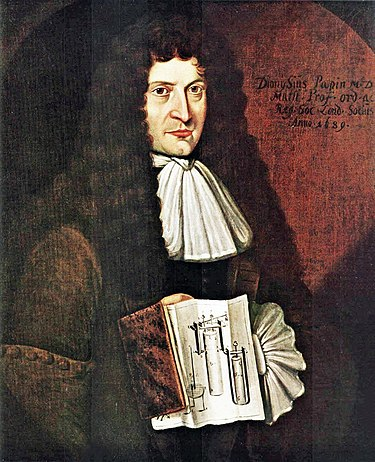
ACHIEVEMENT(S): Invented the pressure cooker and had the idea for the first cylinder and piston steam engine.
DATE/PLACE OF BIRTH: 22nd August 1647, in Blois, France.
DATE/PLACE/AGE AT DEATH: c.1712, in London, England. Aged 65.
DISCIPLINE: Physicist.
FIELD:Physics.
LANGUAGE: French and English.
EDUCATION: Jesuit School, Blois; University of Angers, 1665-69.
MAJOR WORK: 'Ars Nova ad Aquam Ignis Adminiculo Efficacissime Elevandam' ('The New Art of Pumping Water by Using Steam'), 1707.
LIFE AND TIMES:
Papin took his medical degree in 1669, and the following year, set on a scientific career, he moved to Paris, where, in 1671, he began working as an assistant to the Dutch physicist Christiaan Huyghens* on what eventually became the internal combustion engine*
A skilful mechanic, Papin designed an air pump with which he performed a number of experiments under Huyghens' direction.
The results were eventually published in 1674 and were used in some attempts, inspired by Guericke*'s 'New Magdeburg Experiments on the Vacuum' (1672), at preserving food in a vacuum.
Papin worked with Huyghens until 1674, living in Huyghens’ apartments in the Royal Library in Paris. In 1675, he travelled to London with a letter of introduction from Huyghens to Henry Oldenburg at the Royal Society.
Through this important contact, Papin found a job assisting the physicist Boyle*, with whom he remained until 1679.
Papin and Boyle worked together on a number of studies involving the air pump, and it was in London, in 1678, that Papin invented his "steam digester", now known as the pressure cooker.
The steam digester was a closed vessel, with a tightly fitting, self-sealing lid, that heated water to produce very hot steam, forcing the temperature inside the vessel as high as 266° F (130° C). This was significantly higher than the maximum heat possible in an ordinary saucepan, and cooked food very fast.
Papin's most significant innovation was a safety valve on the steam digester, which prevented explosions and was to become technologically important in the development of steam power.
Papin demonstrated the digester to the Royal Society in May 1679. Later that year he became Hooke's* assistant at the Royal Society, and was elected a fellow in late 1680.
Some time during 1680, Papin visited Huyghens in Paris, and then in 1681, he travelled to Venice, where he became director of experiments at Ambrose Sarotti's Accademia Publicca di Scienze. He stayed there until 1684, among his duties being the performance of diverse experiments for the entertainment of the Accademia's members who met periodically in Sarotti's library. This was in part an attempt to turn the Accademia into a society modelled on the Royal Society in London and the Académie Royale in Paris, but the attempt failed from lack of money.
In 1684, Papin left Venice and went back to London. He took a job as temporary curator of experiments to the Royal Society, but was beaten by Halley* to the better-paid of secretary.
While he was at the Royal Society, Papin continued his own work, which at that time mainly consisted of experiments in hydraulics and pneumatics, a number of which were published in the Royal Society's 'Philosophical Transactions'.
In 1687, Papin left England and went to join a number of his fellow Huguenots in Hesse-Kassel, Germany, where he had been appointed professor of mathematics at the University of Marburg.
He stayed there until 1696, when he married. During the years at Marburg, Papin interests in air pumps and steam pressure combined to provide an innovative solution to the need for raising water, specifically the problem of raising water to a canal between Kassel and Karlshaven.
While he was developing his pressure cooker, he had noticed that the enclosed steam in his cooker tended to raise the lid, and Papin came up with an idea for using steam to push a piston in a cylinder (the basic design for early steam engines).
In 1690, he published an account of a single cylinder engine, entitled 'De Novis Quibusdam Machinis', in which water was both boiled and condensed in a tube beneath a piston, forcing the piston up, while atmospheric pressure forced it down again.
While not really practicable, Papin recognized that this piston arrangement only required steam at low pressure, so had the potential to succeed within vessels that could be produced fairly easily. Soon after, this design was exploited independently by Newcomen* in England, to great effect.
In 1695, Papin, tired of the heavy teaching load and low salary, took a job in the court of the Landgrave of Hesse-Kassel. There, he developed a number of pumps and other practical inventions, and constructed a prototype submarine, an air gun and a grenade launcher.
He also tried to build up a glass industry in Hesse-Kassel, and experimented with preserving food both with chemicals and using a vacuum. For his success in raising water from the Fulde using steam pumps, he was made a counsellor to the Landgrave in 1700.
In 1705, the German physicist and philosopher Leibniz* sent Papin a drawing of the first really practical steam engine, Savery*'s high-pressure steam pump for pumping water from mines, which Savery had patented in 1698. Papin was immediately inspired to start work on the steam engine again.
He modified and improved Savery's design, adding a safety valve, to prevent the pressure of steam building up to dangerous levels. In 1707, he published his innovation in his most famous work, 'Ars Nova ad Aquam Ignis Adminiculo Efficacissime Elevandam' (The New Art of Pumping Water by Using Steam'), which detailed the mechanics of a workable engine, but this design did not ultimately prove as successful as his original piston engine.
Later that same year, after falling out with his employers, he went back to London, where he lived in obscurity and poverty until his death on 23rd January 1712, and he is recorded as being deceased in 1714.
ASSESSMENT: Best known for his work as an inventor, particularly his work on the steam engine.
EXTRA CONNECTIONS: His experiments were repeated by Haukesbee*
His idea was used by Pasteur*, who in the 1860s used an autoclave (pressure cooker principle) in pasteurization.
ONELINER: Denis Papin, forerunner of James Watt
BIBLIOGRAPHY:
Klein, C-A, Denis Papin: Illustre Savant Blaisois, Chambray, 1987.
Robinson, H W, "Denis Papin (1647-1712)", in Notes and Records of the Royal Society, 5 (1947), 48-50.
PARENTS: Denys Papin and Magdaleine Pineau.