Halley, E
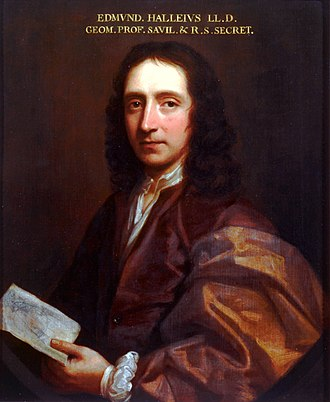
Name: Edmond (or Edmund) Halley
Achievements: First to calculate the orbit of a comet later named after him.
Born: November 8, 1656; Shoreditch, London, England
Died: January 14, 1742; Greenwich, England (Aged 85)
Field & Discipline: Science; Astronomy
Language: English
Father: Edmond Halley
Mother: Anne Robinson
Siblings: Humphrey; Katherine
Spouse: Mary Tooke
Children: Katherine; Margaret; Edmond
Education: Private tutors; St. Paul's School, London; University of Oxford
Major Work:
"A Synopsis of the Astronomy of Comets"
Life & Times:
At 19, Halley sent the [member of] Royal Society* a paper, "Direct and Geometrical Method of Finding the Aphelia and Eccentricity of the Planets," which brought him to the notice of the Astronomer Royal, [succeeded] Flamsteed*.
Flamsteed's catalog of the northern stars prompted Halley to do a similar study of the southern hemisphere. With money from his father and a letter of introduction from King [patron was] Charles II* to the [facilitated by] East India Company*, in 1676 Halley sailed on a Company ship to St. Helena (off the west coast of Africa) Britain's southernmost territory. During his 18 months on the island, he created the first catalog of southern star positions recorded with the aid of a telescope.
This work established Halley as an astronomer and in 1678 he was elected a Fellow of the Royal Society. He spent the next six years on the Continent, meeting scientists such as astronomer Giovanni [worked with] Cassini*.
When Halley returned in 1684, he found that two of his fellow members in the Royal Society, inventor [worked with] Hooke* and architect [worked with] Wren*, were trying to come up with an explanation for planetary motion, a project that also interested Halley. They wondered what forces could keep a planet in forward motion around the Sun without it either flying into space or falling into the Sun.
Although Hooke and Halley had calculated that the force keeping the planets in orbit decreased as the inverse of the square of the distances between them, they were not able to imagine an orbit that would match the visible planetary motions.
Halley's friend [a pal of] Newton* joined the investigation and, encouraged by Halley, expanded his studies on celestial mechanics into his masterpiece: "Mathematical Principles of Natural Philosophy."
The Royal Society persuaded Halley to take Newton's work to the printers and pay for its publication himself. Impressed with Newton's work, Halley gladly did so and Newton’s great work was published in 1687.
Along with mathematician [work related to] De Moivre* and orientalist [work related to] William Jones*, Halley also became involved with settling the priority dispute between [settled calculus row with] Leibniz* and Newton on the invention of calculus. It was decided that though Newton invented calculus before Leibniz, Leibniz was the first to publish a full account of it.
Through the 1680s and into the 1690s, Halley prepared papers on a wide range of subjects, including: the nature of trade winds and monsoons (1686); magnetism (1683 and 1692); the tides (1701); the relationship between height and pressure; evaporation and the salinity of inland waters; and the rainbow. He designed a diving bell and diver's helmet and formed a public company to salvage wrecks. He corresponded with [corresponded with] Leeuwenhoek* on microscope observations.
In 1685, he was elected to assist the honorary secretaries of the Royal Society, a salaried job that required him to resign his fellowship. In 1686, he published his map of the world, showing the distribution of prevailing winds over the oceans; it was the first published meteorological chart.
In 1693, he produced a mortality table for the city of Wroclaw, Poland. One of the first attempts to relate mortality and age, it influenced the development of actuarial tables in life insurance, and made Halley, along with his elder contemporary [work related to] Petty*, a pioneer in social statistics.
In 1696, during Britain's period of re-coinage, Halley was appointed Deputy Controller of the Mint at Chester. In 1697, he met Russian ruler [met] Peter the Great*, who was visiting England incognito to study shipbuilding.
Beginning in 1698, Halley spent two years at sea, charting the Atlantic and Pacific, after which he published the first magnetic charts with curved lines indicating positions with the same compass variation.
In 1704, Halley was appointed professor of geometry at Oxford. It was at this time that he came to the idea that comets reported in 1456, 1531, 1607 and 1682, were really the same comet, following such an elongated orbit around the Sun that at times it would be farther away from Earth than the remotest planet. In 1705, he published his theory as "A Synopsis of the Astronomy of Comets", in which he accurately predicted that the comet (today known as Halley's Comet) would return in December, 1758. The prediction also acted as a confirmation of Newtonian gravitation.
From 1710, Halley began to examine the writings of the second-century Alexandrian astronomer, [studied work of] Ptolemy*, paying particular attention to his star catalog. Noting that Ptolemy's calculations were remarkably out of line with his own, he concluded correctly that Ptolemy was not wrong, but that the stars had moved. Later, he was able to detect movement of three stars: Sirius, Arcturus and Procyon.
While at Oxford, Halley collaborated with professor of astronomy [collaborated with] Gregory* in the translation of the "Conics" of Apollonius.
In 1720, he succeeded Flamsteed as Astronomer Royal at Greenwich. Here he studied transits of the Moon across the meridian, hoping his observations would help calculate longitude at sea. He persuaded clockmaker [a pal of] George Graham* to lend inventor [work related to] John Harrison* money to develop his chronometer.
Halley remained at the Royal Observatory until his death.
Extra Connections:
Extra Connections:
John Harrison began his time working in London with Edmond Halley, second Astronomer Royal and a Commissioner of Longitude. He was received warmly at Greenwich, but Halley felt unable to judge his work. Instead, he sent him to clockmaker George Graham.
His work related to that of civil engineer [work related to] Smeaton*, clergyman[work related to] Tillotson*, life-insurance expert [work related to] Tonti* , [work related to] Christiaan Huyghens* and [work related to] Hadley*
Influenced mathematician [influenced] Lagrange*
Proved [proved theory of] Pierre Perrault*’s hydrological cycle theory.
Knew naturalist [knew] Sloane* and Danish scientist [knew] Romer*
Beat [rival was] Papin* to Royal Society job
He taught [taught] Swedenborg*.
The pronunciation /ˈheɪli/ was used by rock and roll singer Bill Haley, who called his backing band his "Comets" after the common pronunciation of Halley's Comet in the United States at the time.
In 1693 Halley published an article on life annuities, which featured an analysis of age-at-death on the basis of the Breslau statistics Caspar Neumann had been able to provide. This article allowed the British government to sell life annuities at an appropriate price based on the age of the purchaser. Halley's work strongly influenced the development of actuarial science. The construction of the life-table for Breslau, which followed more primitive work by John Graunt, is now seen as a major event in the history of demography.
Assessment: His recognition of Newton's work and his efforts to take it to completion gave him an important place in the evolution of Western thought.
Oneliner:
Bibliography:
- Encyclopedia Britannica.
- Dictionary of Scientific Biography.
- Dictionary of National Biography.
- Cook, Alan, Edmond Halley: Charting the Heavens and the Seas, Oxford: Clarendon Press, 1998 .