Leprosy
Leprosy, also known as Hansen's disease (HD), is a long-term infection by the bacteria Mycobacterium leprae or Mycobacterium lepromatosis.[4][7] Infection can lead to damage of the nerves, respiratory tract, skin, and eyes.[4] This nerve damage may result in a lack of ability to feel pain, which can lead to the loss of parts of a person's extremities from repeated injuries or infection through unnoticed wounds.[3] An infected person may also experience muscle weakness and poor eyesight.[3] Leprosy symptoms may begin within one year, but, for some people, symptoms may take 20 years or more to occur.[4]
Leprosy is spread between people, although extensive contact is necessary.[3][8] Leprosy has a low pathogenicity, and 95% of people who contract M. leprae do not develop the disease.[9] Spread is thought to occur through a cough or contact with fluid from the nose of a person infected by leprosy.[8][9] Genetic factors and immune function play a role in how easily a person catches the disease.[9][10] Leprosy does not spread during pregnancy to the unborn child or through sexual contact.[8] Leprosy occurs more commonly among people living in poverty.[3] There are two main types of the disease – paucibacillary and multibacillary, which differ in the number of bacteria present.[3] A person with paucibacillary disease has five or fewer poorly pigmented, numb skin patches, while a person with multibacillary disease has more than five skin patches.[3] The diagnosis is confirmed by finding acid-fast bacilli in a biopsy of the skin.[3]
Leprosy is curable with multidrug therapy.[4] Treatment of paucibacillary leprosy is with the medications dapsone, rifampicin, and clofazimine for six months.[9] Treatment for multibacillary leprosy uses the same medications for 12 months.[9] A number of other antibiotics may also be used.[3] These treatments are provided free of charge by the World Health Organization.[4]
Leprosy is not highly contagious.[11] People with leprosy can live with their families and go to school and work.[12] In the 1980s, there were 5.2 million cases globally, but this decreased to fewer than 200 thousand by 2020.[4][13][14] Most new cases occur in 14 countries, with India accounting for more than half.[3][4] In the 20 years from 1994 to 2014, 16 million people worldwide were cured of leprosy.[4] About 200 cases per year are reported in the United States.[15] Central Florida accounted for 81% of cases in Florida and nearly 1 out of 5 leprosy cases nationwide.[16] Separating people affected by leprosy by placing them in leper colonies still occurs in some areas of India,[17] China,[18] the African continent,[11] and Thailand.[19]
Leprosy has affected humanity for thousands of years.[3] The disease takes its name from the Greek word λέπρᾱ (léprā), from λεπῐ́ς (lepís; 'scale'), while the term "Hansen's disease" is named after the Norwegian physician Gerhard Armauer Hansen.[3] Leprosy has historically been associated with social stigma, which continues to be a barrier to self-reporting and early treatment.[4] Some consider the word leper offensive, preferring the phrase "person affected with leprosy".[20] Leprosy is classified as a neglected tropical disease.[21] World Leprosy Day was started in 1954 to draw awareness to those affected by leprosy.[22][4]
Signs and symptoms[edit]
Common symptoms present in the different types of leprosy include a runny nose; dry scalp; eye problems; skin lesions; muscle weakness; reddish skin; smooth, shiny, diffuse thickening of facial skin, ear, and hand; loss of sensation in fingers and toes; thickening of peripheral nerves; a flat nose from destruction of nasal cartilages; and changes in phonation and other aspects of speech production.[23] In addition, atrophy of the testes and impotence may occur.[24]
Leprosy can affect people in different ways.[9] The average incubation period is five years.[4] People may begin to notice symptoms within the first year or up to 20 years after infection.[4] The first noticeable sign of leprosy is often the development of pale or pink coloured patches of skin that may be insensitive to temperature or pain.[25] Patches of discolored skin are sometimes accompanied or preceded by nerve problems including numbness or tenderness in the hands or feet.[25][26] Secondary infections (additional bacterial or viral infections) can result in tissue loss, causing fingers and toes to become shortened and deformed, as cartilage is absorbed into the body.[27][28] A person's immune response differs depending on the form of leprosy.[29]
Approximately 30% of people affected with leprosy experience nerve damage.[30] The nerve damage sustained is reversible when treated early, but becomes permanent when appropriate treatment is delayed by several months. Damage to nerves may cause loss of muscle function, leading to paralysis. It may also lead to sensation abnormalities or numbness, which may lead to additional infections, ulcerations, and joint deformities.[30]
...
Epidemiology:
Main article: Epidemiology of leprosy
[ ]
New cases of leprosy in 2016[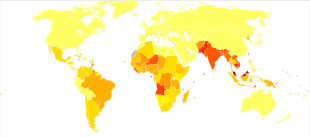 ]
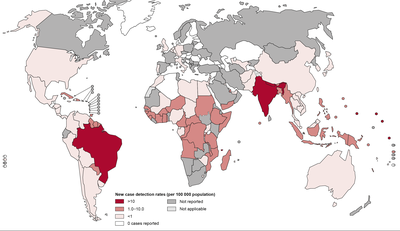
In 2018, there were 208,619 new cases of leprosy recorded, a slight decrease from 2017.[94] In 2015, 94% of the new leprosy cases were confined to 14 countries.[95] India reported the greatest number of new cases (60% of reported cases), followed by Brazil (13%) and Indonesia (8%).[95] Although the number of cases worldwide continues to fall, there are parts of the world where leprosy is more common, including Brazil, South Asia (India, Nepal, Bhutan), some parts of Africa (Tanzania, Madagascar, Mozambique), and the western Pacific.[95] About 150 to 250 cases are diagnosed in the United States each year.[96]
In the 1960s, there were tens of millions of leprosy cases recorded when the bacteria started to develop resistance to dapsone, the most common treatment option at the time.[4][14] International (e.g., the WHO's) and national (e.g., the International Federation of Anti-Leprosy Associations) initiatives have reduced the total number and the number of new cases of the disease.[14][97]
...
History
Main article: History of leprosy
 G. H. A. Hansen, discoverer of M. leprae
Historical distribution[edit]
Using comparative genomics, in 2005, geneticists traced the origins and worldwide distribution of leprosy from East Africa or the Near East along human migration routes. They found four strains of M. leprae with specific regional locations:[101] Monot et al. (2005) determined that leprosy originated in East Africa or the Near East and traveled with humans along their migration routes, including those of trade in goods and slaves. The four strains of M. leprae are based in specific geographic regions where each predominantly occurs:[101]
- strain 1 in Asia, the Pacific region, and East Africa;
- strain 2 in Ethiopia, Malawi, Nepal, north India, and New Caledonia;
- strain 3 in Europe, North Africa, and the Americas;
- strain 4 in West Africa and the Caribbean.
This confirms the spread of the disease along the migration, colonisation, and slave trade routes taken from East Africa to India, West Africa to the New World, and from Africa into Europe and vice versa.[102]
Skeletal remains discovered in 2009 represent the oldest documented evidence for leprosy, dating to the 2nd millennium BC.[103][104] Located at Balathal, Rajasthan, in northwest India, the discoverers suggest that, if the disease did migrate from Africa to India during the 3rd millennium BC "at a time when there was substantial interaction among the Indus Civilization, Mesopotamia, and Egypt, there needs to be additional skeletal and molecular evidence of leprosy in India and Africa to confirm the African origin of the disease".[105] A proven human case was verified by DNA taken from the shrouded remains of a man discovered by researchers from the Hebrew University of Jerusalem in a tomb next to the Old City of Jerusalem, Israel, dated by radiocarbon methods to the first half of the 1st century.[106]
The oldest strains of leprosy known from Europe are from Great Chesterford in southeast England and dating back to AD 415–545. These findings suggest a different path for the spread of leprosy, meaning it may have originated in Western Eurasia. This study also indicates that there were more strains in Europe at the time than previously determined.[107]
Discovery and scientific progress
Literary attestation of leprosy is unclear because of the ambiguity of many early sources, including the Indian Atharvaveda and Kausika Sutra, the Egyptian Ebers papyrus, and the Hebrew Bible's various sections regarding signs of impurity (tzaraath).[108] Clearly leprotic symptoms are attested in the Indian doctor Sushruta's Compendium, originally dating to c. 600 BC but only surviving in emended texts no earlier than the 5th century. They were separately described by Hippocrates in 460 BC. However, Hansen's disease probably did not exist in Greece or the Middle East before the Common Era.[109][110][111] In 1846, Francis Adams produced The Seven Books of Paulus Aegineta which included a commentary on all medical and surgical knowledge and descriptions and remedies to do with leprosy from the Romans, Greeks, and Arabs.[112][113]
Leprosy did not exist in the Americas before colonization by modern Europeans[114] nor did it exist in Polynesia until the middle of the 19th century.[115]
 Distribution of leprosy around the world in 1891.
The causative agent of leprosy, M. leprae, was discovered by Gerhard Armauer Hansen in Norway in 1873, making it the first bacterium to be identified as causing disease in humans.[116]
Treatment
The first effective treatment (promin) became available in the 1940s.[117] In the 1950s, dapsone was introduced. The search for further effective antileprosy drugs led to the use of clofazimine and rifampicin in the 1960s and 1970s.[118] Later, Indian scientist Shantaram Yawalkar and his colleagues formulated a combined therapy using rifampicin and dapsone, intended to mitigate bacterial resistance.[119] Multi-drug therapy (MDT) combining all three drugs was first recommended by the WHO in 1981. These three antileprosy drugs are still used in the standard MDT regimens.[120]
Leprosy was once believed to be highly contagious and was treated with mercury, as was syphilis, which was first described in 1530. Many early cases thought to be leprosy could actually have been syphilis.[121]
Resistance has developed to initial treatment. Until the introduction of MDT in the early 1980s, leprosy could not be diagnosed and treated successfully within the community.[122]
Japan still has sanatoriums (although Japan's sanatoriums no longer have active leprosy cases, nor are survivors held in them by law).[123]
The importance of the nasal mucosa in the transmission of M. leprae was recognized as early as 1898 by Schäffer, in particular, that of the ulcerated mucosa.[124][verification ^needed] The mechanism of plantar ulceration in leprosy and its treatment was first described by Ernest W. Price.[125]
Etymology
The word "leprosy" comes from the Greek word "λέπος (lépos) – skin" and "λεπερός (leperós) – scaly man"....
Historical texts
Written accounts of leprosy date back thousands of years. Various skin diseases translated as leprosy appear in the ancient Indian text, the Atharava Veda, by 600 BC.[131] Another Indian text, the Manusmriti (200 BC), prohibited contact with those infected with the disease and made marriage to a person infected with leprosy punishable.[132]
The Hebraic root tsara or tsaraath (צָרַע, – tsaw-rah' – to be struck with leprosy, to be leprous) and the Greek (λεπρός–lepros), are of broader classification than the more narrow use of the term related to Hansen's Disease.[133] Any progressive skin disease (a whitening or splotchy bleaching of the skin, raised manifestations of scales, scabs, infections, rashes, etc....), as well as generalized molds and surface discoloration of any clothing, leather, or discoloration on walls or surfaces throughout homes all, came under the "law of leprosy" (Leviticus 14:54–57).[134]
Ancient sources such as the Talmud (Sifra 63) make clear thattzaraath refers to various types of lesions or stains associated with ritual impurity and occurring on cloth, leather, or houses, as well as skin. Traditional Judaism and Jewish rabbinical authorities, both historical and modern, emphasize that the tsaraath of Leviticus is a spiritual ailment with no direct relationship to Hansen's disease or physical contagions. The relation of tsaraath to "leprosy" comes from translations of Hebrew Biblical texts into Greek and ensuing misconceptions.[135]
All three Synoptic Gospels of the New Testament describe instances of Jesus healing people with leprosy (Matthew 8:1–4, Mark 1:40–45, and Luke 5:12–16). The Bible's description of leprosy is congruous (if lacking detail) with the symptoms of modern leprosy, but the relationship between this disease, tzaraath, and Hansen's disease has been disputed.[136] The biblical perception that people with leprosy were unclean can be found in a passage from Leviticus 13: 44–46. While this text defines the leper as impure, it did not explicitly make a moral judgement on those with leprosy.[137] Some Early Christians believed that those affected by leprosy were being punished by God for sinful behavior. Moral associations have persisted throughout history. Pope Gregory the Great (540–604) and Isidor of Seville (560–636) considered people with the disease to be heretics.[138]
Middle Ages
 Medieval leper bell.
The social perception of leprosy in the general population was in general mixed. On one hand, people feared getting infected with the disease and thought of people suspected of leprosy to be unclean, untrustworthy, and occasionally morally corrupt.[138] On the other hand, Jesus' interaction with lepers, the writing of church leaders and the Christian focus on charitable works led to viewing the lepers as "chosen by God"[139] or seeing the disease as a means of obtaining access to heaven.[140]
Early medieval understanding of leprosy was influenced by early Christian writers such as Gregory of Nazianzus and John Chrysostom, whose writings were later embraced by Byzantine and Latin writers.[141] Gregory, for example, did not only compose sermons urging Christians to assist victims of the disease, but also condemned pagans or Christians who justified rejecting lepers on the allegation that God had sent them the disease to punish them. As cases of leprosy increased during these years in the Eastern Roman Empire, becoming a major health issue, the ecclesiastic leaders of the time discussed how to assist those affected as well as change the attitude of society towards them.
They also tried this by using the name "Holy disease" instead of the commonly used "Elephant's disease" (elephantiasis), implying that God did not create this disease to punish people but to purify them for heaven.[142] Although not always successful in persuading the public and a cure was never found by Greek medicians, they created an environment where victims could get palliative care and were never expressly banned from society, as sometimes happened in Western Europe. Theodore Balsamon, a 12th-century jurist in Constantinople, noted that lepers were allowed to enter the same churches, cities and assemblies that healthy people attended.[141]
As the disease became more prevalent in Western Europe in the fifth century, efforts began to set up permanent institutions to house and feed lepers. These efforts were, inclusively, the work of bishops in France at the end of the sixth century, such as in Chalon-sur-Saône.[141] The increase in hospitals or leprosaria (sing. leprosarium) that treated people with leprosy in the 12th and 13th century seems to indicate a rise in cases,[143][144][145] possibly in connection with the increase in urbanisation ^[146] as well as returning crusaders from the Middle East.[141]
France alone had nearly 2,000 leprosaria during this period.[147] Additionally to the new leprosia, further steps were taken by secular and religious leaders to prevent further spread of the disease. The third Lateran Council of 1179 required lepers to have their own priests and churches[146] and a 1346 edict by King Edward expelled lepers from city limits. Segregation from mainstream society became common, and people with leprosy were often required to wear clothing that identified them as such or carry a bell announcing their presence.[147] As in the East, it was the Church who took care of the lepers due to the still persisting moral stigma and who ran the leprosaria.[138][148] Although the leprosaria in Western Europe removed the sick from society, they were never a place to quarantine them or from which they could not leave: lepers would go beg for alms for the upkeep of the leprosaria or meet with their families.[146][141]
19th century
 A 24-year-old man with leprosy (1886).
Norway
Norway was the location of a progressive stance on leprosy tracking and treatment and played an influential role in European understanding of the disease. In 1832, Dr. JJ Hjort conducted the first leprosy survey, thus establishing a basis for epidemiological surveys. Subsequent surveys resulted in the establishment of a national leprosy registry to study the causes of leprosy and for tracking the rate of infection.[citation ^needed]
Early leprosy research throughout Europe was conducted by Norwegian scientists Daniel Cornelius Danielssen and Carl Wilhelm Boeck. Their work resulted in the establishment of the National Leprosy Research and Treatment Center. Danielssen and Boeck believed the cause of leprosy transmission was hereditary. This stance was influential in advocating for the isolation of those infected by sex to prevent reproduction.[149][150][151]
Leprosy and imperialism
 Father Damien on his deathbed in 1889.
Though leprosy rates were again on the decline in the Western world by the 1860s, authorities in the West frequently embraced isolation treatment due to a combination of reasons, including fears of the disease spreading from the Global South, efforts by Christian missionaries and a lack of understanding concerning bacteriology, medical diagnosis and how contagious the disease was.[127]
The rapid expansion of Western imperialism during the Victorian era resulted in Westerners coming into increasing contact with regions where the disease was endemic, including British India. English surgeon Henry Vandyke Carter observed isolation treatment for leprosy patients first-hand while visiting Norway, applying these methods in British India with the financial and logistical assistance of Protestant missionaries. Colonialist and religious viewpoints of the disease continued to be a major factor in the treatment and public perception of the disease in the Global South until decolonization in the mid-twentieth century.[127]
20th century
United States
The National Leprosarium at Carville, Louisiana, known in 1955 as the Louisiana Leper Home, was the only leprosy hospital on the mainland United States. Leprosy patients from all over the United States were sent to Carville in order to be kept in isolation away from the public, as not much about leprosy transmission was known at the time and stigma against those with leprosy was high (see Leprosy stigma). The Carville leprosarium was known for its innovations in reconstructive surgery for those with leprosy. In 1941, 22 patients at Carville underwent trials for a new drug called promin. The results were described as miraculous, and soon after the success of promin came dapsone, a medicine even more effective in the fight against leprosy.[152]
21st century
United States
In 2022 cases of leprosy were reported to be increasing in central Florida.[153] Gov Desantis appointed an anti-vaxxer as Surgeon General, so no doubt it will all work out fine.
Stigma
See also: Leprosy stigma
Despite now effective treatment and education efforts, leprosy stigma continues to be problematic in developing countries where the disease is common. Leprosy is most common amongst impoverished populations where social stigma is likely to be compounded by poverty. Fears of ostracism, loss of employment, or expulsion from family and society may contribute to a delayed diagnosis and treatment.