Mercury
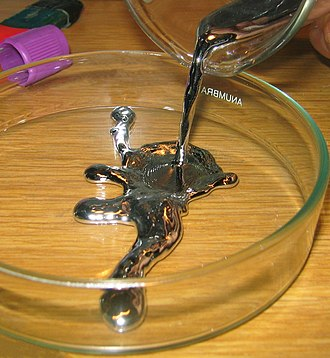
Mercury is a chemical element; it has symbol Hg and atomic number 80. It is also known as quicksilver and was formerly named hydrargyrum (/haɪˈdrɑːrdʒərəm/ hy-DRAR-jər-əm) from the Greek words hydor (water) and argyros (silver).[7] A heavy, silvery d-block element, mercury is the only metallic element that is known to be liquid at standard temperature and pressure; the only other element that is liquid under these conditions is the halogen bromine, though metals such as caesium, gallium, and rubidium melt just above room temperature.
Mercury occurs in deposits throughout the world mostly as cinnabar (mercuric sulfide). The red pigment vermilion is obtained by grinding natural cinnabar or synthetic mercuric sulfide. Exposure to mercury and mercury-containing organic compounds is toxic to the nervous system, immune system and kidneys of humans and other animals; mercury poisoning can result from exposure to water-soluble forms of mercury (such as mercuric chloride or methylmercury) either directly or through mechanisms of biomagnification.
Mercury is used in thermometers, barometers, manometers, sphygmomanometers, float valves, mercury switches, mercury relays, fluorescent lamps and other devices, although concerns about the element's toxicity have led to the phasing out of such mercury-containing instruments.[8] It remains in use in scientific research applications and in amalgam for dental restoration in some locales. It is also used in fluorescent lighting. Electricity passed through mercury vapor in a fluorescent lamp produces short-wave ultraviolet light, which then causes the phosphor in the tube to fluoresce, making visible light.
Properties
Physical properties
 An old[9] pound coin (density ~7.6 g/cm3) floats on mercury due to the combination of the buoyant force and surface tension.
Mercury is a heavy, silvery-white metal that is liquid at room temperature. Compared to other metals, it is a poor conductor of heat, but a fair conductor of electricity.[10]
It has a freezing point of −38.83 °C and a boiling point of 356.73 °C,[11][12][13] both the lowest of any stable metal, although preliminary experiments on copernicium and flerovium have indicated that they have even lower boiling points.[14] This effect is due to lanthanide contraction and relativistic contraction reducing the radius of the outermost electrons, and thus weakening the metallic bonding in mercury.[11] Upon freezing, the volume of mercury decreases by 3.59% and its density changes from 13.69 g/cm3 when liquid to 14.184 g/cm3 when solid. The coefficient of volume expansion is 181.59 × 10⁻⁶ at 0 °C, 181.71 × 10⁻⁶ at 20 °C and 182.50 × 10⁻⁶ at 100 °C (per °C). Solid mercury is malleable and ductile, and can be cut with a knife.[15]
Table of thermal and physical properties of liquid mercury:[16][17]
...
Chemical properties
Mercury does not react with most acids, such as dilute sulfuric acid, although oxidizing acids such as concentrated sulfuric acid and nitric acid or aqua regia dissolve it to give sulfate, nitrate, and chloride. Like silver, mercury reacts with atmospheric hydrogen sulfide. Mercury reacts with solid sulfur flakes, which are used in mercury spill kits to absorb mercury (spill kits also use activated carbon and powdered zinc).[18]
...
Etymology
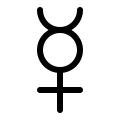
The symbol for the planet Mercury (☿) has been used since ancient times to represent the element.
"Hg" is the modern chemical symbol for mercury. It is an abbreviation of hydrargyrum, a romanized form of the ancient Greek name for mercury, ὑδράργυρος (hydrargyros). Hydrargyros is a Greek compound word meaning "water-silver", from ὑδρ- (hydr-), the root of ὕδωρ (hydor) "water", and ἄργυρος (argyros) "silver".[7] Like the English name quicksilver ("living-silver"), this name was due to mercury's liquid and shiny properties.[24]
The modern English name "mercury" comes from the planet Mercury. In medieval alchemy, the seven known metals—quicksilver, gold, silver, copper, iron, lead, and tin—were associated with the seven planets. Quicksilver was associated with the fastest planet, which had been named after the Roman god Mercury, who was associated with speed and mobility. The astrological symbol for the planet became one of the alchemical symbols for the metal, and "Mercury" became an alternative name for the metal. Mercury is the only metal for which the alchemical planetary name survives, as it was decided it was preferable to "quicksilver" as a chemical name.[25][26]
History
Mercury was found in Egyptian tombs that date from 1500 BC;[27] cinnabar, the most common natural source of mercury, has been in use since the Neolithic Age.[28]
In China and Tibet, mercury use was thought to prolong life, heal fractures, and maintain generally good health, although it is now known that exposure to mercury vapor leads to serious adverse health effects.[29] The first emperor of a unified China, Qín Shǐ Huáng Dì—allegedly buried in a tomb that contained rivers of flowing mercury on a model of the land he ruled, representative of the rivers of China—was reportedly killed by drinking a mercury and powdered jade mixture formulated by Qin alchemists intended as an elixir of immortality.[30][31] Khumarawayh ibn Ahmad ibn Tulun, the second Tulunid ruler of Egypt (r. 884–896), known for his extravagance and profligacy, reportedly built a basin filled with mercury, on which he would lie on top of air-filled cushions and be rocked to sleep.[32]
In November 2014 "large quantities" of mercury were discovered in a chamber 60 feet below the 1800-year-old pyramid known as the "Temple of the Feathered Serpent," "the third largest pyramid of Teotihuacan," Mexico along with "jade statues, jaguar remains, a box filled with carved shells and rubber balls".[33]
Aristotle recounts that Daedalus made a wooden statue of Venus move by pouring quicksilver in its interior.[34] In Greek mythology Daedalus gave the appearance of voice in his statues using quicksilver. The ancient Greeks used cinnabar (mercury sulfide) in ointments; the ancient Egyptians and the Romans used it in cosmetics. In Lamanai, once a major city of the Maya civilization, a pool of mercury was found under a marker in a Mesoamerican ballcourt.[35][36] By 500 BC mercury was used to make amalgams (Medieval Latin amalgama, "alloy of mercury") with other metals.[37]
Alchemists thought of mercury as the First Matter from which all metals were formed. They believed that different metals could be produced by varying the quality and quantity of sulfur contained within the mercury. The purest of these was gold, and mercury was called for in attempts at the transmutation of base (or impure) metals into gold, which was the goal of many alchemists.[25]
The mines in Almadén (Spain), Monte Amiata (Italy), and Idrija (now Slovenia) dominated mercury production from the opening of the mine in Almadén 2500 years ago, until new deposits were found at the end of the 19th century.[38]
Occurrence
See also: Category:Mercury minerals and Category:Mercury mines
Mercury is an extremely rare element in Earth's crust, having an average crustal abundance by mass of only 0.08 parts per million (ppm).[39] Because it does not blend geochemically with those elements that constitute the majority of the crustal mass, mercury ores can be extraordinarily concentrated considering the element's abundance in ordinary rock. The richest mercury ores contain up to 2.5% mercury by mass, and even the leanest concentrated deposits are at least 0.1% mercury (12,000 times average crustal abundance). It is found either as a native metal (rare) or in cinnabar, metacinnabar, sphalerite, corderoite, livingstonite and other minerals, with cinnabar (HgS) being the most common ore.[40][41] Mercury ores often occur in hot springs or other volcanic regions.[42]
Beginning in 1558, with the invention of the patio process to extract silver from ore using mercury, mercury became an essential resource in the economy of Spain and its American colonies. Mercury was used to extract silver from the lucrative mines in New Spain and Peru. Initially, the Spanish Crown's mines in Almadén in Southern Spain supplied all the mercury for the colonies.[43] Mercury deposits were discovered in the New World, and more than 100,000 tons of mercury were mined from the region of Huancavelica, Peru, over the course of three centuries following the discovery of deposits there in 1563. The patio process and later pan amalgamation process continued to create great demand for mercury to treat silver ores until the late 19th century.[44]
 Native mercury with cinnabar, Socrates mine, Sonoma County, California. Cinnabar sometimes alters to native mercury in the oxidized zone of mercury deposits.
Former mines in Italy, the United States and Mexico, which once produced a large proportion of the world supply, have now been completely mined out or, in the case of Slovenia (Idrija) and Spain (Almadén), shut down due to the fall of the price of mercury. Nevada's McDermitt Mine, the last mercury mine in the United States, closed in 1992. The price of mercury has been highly volatile over the years and in 2006 was $650 per 76-pound (34.46 kg) flask.[45]