Father Damien
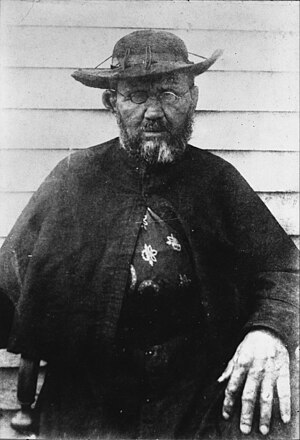
Father Damien or Saint Damien of Molokai, SS.CC. or Saint Damien De Veuster (Dutch: Pater Damiaan or Heilige Damiaan van Molokai; 3 January 1840 – 15 April 1889),[2] born Jozef De Veuster, was a Roman Catholic priest from Belgium and member of the Congregation of the Sacred Hearts of Jesus and Mary,[3] a missionary religious institute. He was recognized for his ministry, which he led from 1873 until his death in 1889, in the Kingdom of Hawaiʻi to people with leprosy (Hansen's disease), who lived in government-mandated medical quarantine in a settlement on the Kalaupapa Peninsula of Molokaʻi.[4]
During this time, he taught the Catholic faith to the people of Hawaii. Father Damien also cared for the patients and established leaders within the community to build houses, schools, roads, hospitals, and churches. He dressed residents' ulcers, built a reservoir, made coffins, dug graves, shared pipes, and ate poi with them, providing both medical and emotional support.
After eleven years of caring for the physical, spiritual, and emotional needs of those in the leper colony, Father Damien contracted leprosy. He continued with his work despite the infection but finally succumbed to the disease on 15 April 1889. Father Damien also had tuberculosis which worsened his condition, but some believe that the reason he volunteered in the first place was due to his illness of tuberculosis.[5]
Father Damien has been described as a "martyr of charity".[6] Damien De Veuster is venerated as a saint in the Catholic Church. In the Anglican Communion and other Christian denominations, Damien is considered the spiritual patron for leprosy and outcasts. Father Damien Day, 15 April, the day of his death, is also a minor statewide holiday in Hawaii. Father Damien is the patron saint of the Diocese of Honolulu and of Hawaii.
Father Damien was canonized by Pope Benedict XVI on 11 October 2009.[7][8] Libert H. Boeynaems, writing in the Catholic Encyclopedia, calls him "the Apostle of the Lepers."[9] Damien De Veuster's feast day is 10 May.
Early life
Father Damien was born Jozef ("Jef") De Veuster, the youngest of seven children and fourth son of the Flemish corn merchant Joannes Franciscus ("Frans") De Veuster and his wife Anne-Catherine ("Cato") Wouters in the village of Tremelo in Flemish Brabant in rural Belgium on 3 January 1840. His older sisters Eugénie and Pauline became nuns, and his older brother Auguste (Father Pamphile) joined the Congregation of the Sacred Hearts of Jesus and Mary (Picpus Fathers). Jozef was forced to quit school at age 13 to work on the family farm.[10] His father sent him to a college at Braine-le-Comte to prepare for a commercial profession, but as a result of a mission given by the Redemptorists in 1858, Joseph decided to pursue a religious vocation.[9]
Jozef entered the novitiate of the Fathers of the Sacred Heart of Jesus and Mary at Louvain and took in religion the name of Damien, presumably after the first Saint Damien, a fourth-century physician and martyr.[11][12] He was admitted to the religious profession on 7 October 1860.
His superiors thought that he was not a good candidate for the priesthood because he lacked education. However, he was not considered unintelligent. Because he learned Latin well from his brother, his superiors decided to allow him to become a priest. During his religious studies, Damien prayed daily before a picture of St. Francis Xavier, patron of missionaries, to be sent on a mission.[13][14] Three years later when his brother Father Pamphile (Auguste) could not travel to Hawaiʻi as a missionary because of illness, Damien was allowed to take his place.[15]
Mission in Hawaii
 Father Damien in 1873 before he sailed for Hawaii
On 19 March 1864, Damien arrived at Honolulu Harbor on Oʻahu. He was ordained into the priesthood on 21 May 1864, at what is now the Cathedral of Our Lady of Peace.[16]
In 1865, Damien was assigned to the Catholic Mission in North Kohala on the island of Hawaiʻi. While he was serving in several parishes on Oʻahu, the Kingdom of Hawaiʻi was struggling with a labor shortage and a public health crisis.[17] Many of the Native Hawaiian parishioners had high mortality rates due to infectious diseases such as leprosy (from which he later died), smallpox, cholera, influenza, syphilis, and whooping cough, brought to the Hawaiian Islands by foreign traders, sailors and immigrants. Thousands of Hawaiians died of such diseases, to which they had not acquired immunity.[18]
It is believed that Chinese workers carried leprosy (later known as Hansen's disease) to the islands in the 1830s and 1840s. At that time, leprosy was thought to be highly contagious and was incurable. In 1865, out of fear of this contagious disease, Hawaiian King Kamehameha V and the Hawaiian Legislature passed the "Act to Prevent the Spread of Leprosy." This law quarantined the lepers of Hawaii, requiring the most serious cases to be moved to a settlement colony of Kalawao on the eastern end of the Kalaupapa peninsula on the island of Molokaʻi. Later the settlement of Kalaupapa was developed. Kalawao County, where the two villages are located, is separated from the rest of Molokaʻi by a steep mountain ridge. From 1866 through 1969, about 8,000 Hawaiians were sent to the Kalaupapa peninsula for medical quarantine.[19]
The Royal Board of Health initially provided the quarantined people with food and other supplies, but it did not have the workforce and resources to offer proper health care.[9] According to documents of that time, the Kingdom of Hawaiʻi did not intend for the settlements to be penal colonies. Still, the Kingdom did not provide enough resources to support them.[4] The Kingdom of Hawaii had planned for the lepers to be able to care for themselves and grow their crops. However, due to the effects of leprosy and the peninsula's local environmental conditions, this was impractical.
By 1868, according to the Catholic Encyclopedia (1911), "Drunken and lewd conduct prevailed. The easy-going, good-natured people seemed wholly changed."[20][21]
Mission on Molokai
...