Hope, Bob
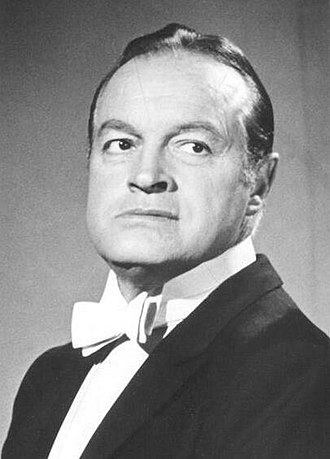
Leslie Townes "Bob" Hope, KBE, KC*SG, KSS (May 29, 1903 – July 27, 2003), was an English-born American comedian, vaudevillian, actor, singer, dancer, athlete, and author.
With a career spanning nearly 80 years, Hope appeared in over 70 films and shorts, including a series of "Road" movies co-starring Bing Crosby and Dorothy Lamour. In addition to hosting the Academy Awards fourteen times (more than any other host), he appeared in many stage productions and television roles and was the author of fourteen books. The song "Thanks For the Memory" is widely regarded as Hope's signature tune.
Celebrated for his long career performing United Service Organizations (USO) shows to entertain active service American military personnel—he made 57 tours for the USO between 1941 and 1991—Hope was declared an honorary veteran of the United States Armed Forces in 1997 by act of the U.S. Congress.[1]
Hope participated in the sports of golf and boxing, and owned a small stake in his hometown baseball team, the Cleveland Indians. He was married to performer Dolores Hope (née DeFina) for 69 years. Hope died at age 100 at his home in Toluca Lake, California.
Contents
- 1 Early years
- 2 Career
- 3 Sports
- 4 Personal life
- 5 Later years
- 6 Death
- 7 Estate
- 8 Awards and honors
- 9 Discography
- 10 Bibliography
- 11 See also
- 12 References
- 13 Further reading
- 14 External links
Early years
From age 12, Hope earned pocket money by busking (frequently on the streetcar to Luna Park), singing, dancing, and performing comedy.[3] He entered many dancing and amateur talent contests (as Lester Hope) and won a prize in 1915 for his impersonation of Charlie Chaplin.[4] For a time, he attended the Boys Industrial School in Lancaster, Ohio. As an adult, he donated sizable sums of money to the institution.[5]
Hope was born in Eltham, London, the fifth of seven sons. His English father, William Henry Hope, was a stonemason from Weston-super-Mare, Somerset, and his Welshmother, Avis (Townes), was a light opera singer from Barry[citation needed] who later worked as a cleaner. They married in April 1891 and lived at 12 Greenwood Street, Barry, before moving to Whitehall and then St George, Bristol. In 1908, the family emigrated to the United States aboard the SS *Philadelphia* and passed through Ellis Island on March 30, 1908, before moving to Cleveland, Ohio.[2]
Hope worked as a butcher's assistant and a lineman in his teens and early twenties. Deciding on a show business career, he and his girlfriend signed up for dance lessons. Encouraged after they performed in a three-day engagement at a club, Hope formed a partnership with Lloyd Durbin, a friend from the dance school.[6]
Silent film comedian Fatty Arbuckle saw them perform in 1925 and found them work with a touring troupe called Hurley's Jolly Follies. Within a year, Hope had formed an act called the Dancemedians with George Byrne and the Hilton Sisters, conjoined twins who performed a tap dancing routine in the vaudeville circuit. Hope and Byrne had an act as a pair of Siamese twins as well, and danced and sang while wearing blackface, before friends advised Hope that he was funnier as himself.[7]
In 1929, Hope informally changed his first name to "Bob". In one version of the story, he named himself after racecar driver Bob Burman.[8] In another, he said he chose the name because he wanted a name with a "friendly 'Hiya, fellas!' sound" to it.[9] In a 1942 legal document, Hope's legal name is given as Lester Townes Hope; it is unknown if this reflects a legal name change from Leslie.[10] After five years on the vaudeville circuit, Hope was "surprised and humbled" when he failed a 1930 screen test for the French film production company Pathé at Culver City, California.[11]
Career
In the early days, Hope's career included appearances on stage in Vaudeville shows and Broadway productions. He began performing on the radio in 1934 and switched to television when that medium became popular in the 1950s. He began doing regular TV specials in 1954,[12] and hosted the Academy Awards fourteen times in the period from 1941 to 1978.[13] Overlapping with this was his movie career, spanning the years 1934 to 1972, and his USO tours, which he did from 1941 to 1991.[14][15]
Film
Main articles: Bob Hope filmography and Bob Hope short subjects
Hope signed a contract for six short films with Educational Pictures of New York. The first was a comedy, Going Spanish (1934). He was not happy with the film, and told Walter Winchell, "When they catch John Dillinger, they're going to make him sit through it twice."[16] Educational dropped his contract, but he soon signed with Warner Brothers. He made movies during the day and performed Broadway shows in the evenings.[17]

Hope moved to Hollywood when Paramount Pictures signed him for the 1938 film The Big Broadcast of 1938, also starring W. C. Fields. The song "Thanks for the Memory", which later became his trademark, was introduced in this film as a duet with Shirley Ross as accompanied by Shep Fields and his orchestra.[18] The sentimental, fluid nature of the music allowed Hope's writers (he depended heavily upon joke writers throughout his career[19]) to later create variations of the song to fit specific circumstances, such as bidding farewell to troops while on tour.[20]
Hope teamed with Crosby for the "Road" pictures and countless stage, radio, and television appearances over the decades, from their first meeting in 1932[24] until Crosby's death in 1977. The two invested together in oil leases and other business ventures, but did not see each other socially.[25]
As a movie star, he was best known for comedies like My Favorite Brunette and the highly successful "Road" movies in which he starred with Bing Crosby and Dorothy Lamour. The series consists of seven films made between 1940 and 1962, Road to Singapore(1940), Road to Zanzibar (1941), Road to Morocco (1942), Road to Utopia (1946), Road to Rio (1947), Road to Bali (1952), and The Road to Hong Kong (1962).
Hope had seen Lamour as a nightclub singer in New York,[21] and invited her to work on his United Service Organizations (USO) tours. Lamour sometimes arrived for filming prepared with her lines, only to be baffled by completely re-written scripts or ad-lib dialogue between Hope and Crosby.[22] Hope and Lamour were lifelong friends, and she remains the actress most associated with his film career. Hope made movies with dozens of other leading ladies, including Katharine Hepburn, Hedy Lamarr, Lucille Ball, Rosemary Clooney, Jane Russell and Elke Sommer.[23]
...
USO involvement
See also: USO – Honoring Bob Hope
While aboard the RMS *Queen Mary* when World War II began in September 1939, Hope volunteered to perform a special show for the passengers, during which he sang "Thanks for the Memory" with rewritten lyrics.[50] He performed his first USO show on May 6, 1941, at March Field in California,[51] and continued to travel and entertain troops for the rest of World War II, later during the Korean War, the Vietnam War, the third phase of the Lebanon Civil War, the latter years of the Iran–Iraq War, and the 1990–91 Persian Gulf War.[23] His USO career lasted a half-century during which he headlined 57 times.[23]
He had a deep respect for the men and women who served in the armed forces, and this was reflected in his willingness to go anywhere to entertain them.[52] However, during the highly controversial Vietnam War, Hope had trouble convincing some performers to join him on tour, but he was accompanied on at least one USO tour by Ann-Margret. Anti-war sentiment was high, and his pro-troop stance made him a target of criticism from some quarters. Some shows were drowned out by boos; others were listened to in silence.[53]
The tours were funded by the U.S. Department of Defense, Hope's television sponsors, and by NBC, the network that broadcast the television specials created after each tour from footage shot on location. However, the footage and shows were owned by Hope's own production company, which made them very lucrative ventures for him, as outlined by writer Richard Zoglin in his 2014 biography Hope: Entertainer of the Century.
 Hope at Lackland Air Force Base in Texas in 1990
Hope sometimes recruited his own family members for USO travel. His wife, Dolores, sang from atop an armored vehicle during the Desert Storm tour, and granddaughter Miranda appeared alongside him on an aircraft carrier in the Indian Ocean.[52] Of Hope's USO shows in World War II, novelist John Steinbeck, who then was working as a war correspondent, wrote in 1943:
When the time for recognition of service to the nation in wartime comes to be considered, Bob Hope should be high on the list. This man drives himself and is driven. It is impossible to see how he can do so much, can cover so much ground, can work so hard, and can be so effective. He works month after month at a pace that would kill most people.[54]
Along with his best friend Bing Crosby, Hope was offered a commission in the United States Navy as lieutenant commander during World War II, but FDR intervened, believing it would be better for troop morale if they kept doing what they were doing by playing for all branches of military service.[55]
For his service to his nation through the USO, he was awarded the Sylvanus Thayer Award by the United States Military Academy at West Point in 1968, the first entertainer to receive the award.[56][57] A 1997 act of Congress signed by President Bill Clinton named Hope an "Honorary Veteran". He remarked, "I've been given many awards in my lifetime, but to be numbered among the men and women I admire most is the greatest honor I have ever received."[58] In an homage to Hope, comedian/TV host Stephen Colbert carried a golf club on stage during the week of USO performances he taped for his TV show The Colbert Report during the 2009 season.[59]
Dear Bob... Bob Hope's Wartime Correspondence with the G.I.s of WW2, written by Martha Bolton (first woman staff writer for Bob Hope) and Linda Hope (eldest daughter of Bob Hope), reveals the heart of the entertainer who became a best friend to the troops.
 Hope and actress Ann Jillian perform in the USO Christmas Tour during Operation Desert Shield, 1990
Theater
Hope's first Broadway appearances, in 1927's The Sidewalks of New York and 1928's Ups-a-Daisy, were minor walk-on parts.[60] He returned to Broadway in 1933 to star as Huckleberry Haines in the Jerome Kern / Dorothy Fields musical Roberta.[61] Stints in the musicals Say When, the 1936 Ziegfeld Follies with Fanny Brice, and Red, Hot and Blue with Ethel Merman and Jimmy Durante followed.[62] Hope reprised his role as Huck Haines in a 1958 production of Roberta at The Muny Theater in Forest Park in St. Louis, Missouri.[63]
Additionally, Hope rescued the Eltham Little Theatre in England from closure by providing funds to buy the property. He continued his interest and support, and regularly visited the facility when in London. The theater was renamed in his honor in 1982.[64]
...
Later appearances
 With Clark Gable, Cary Grant, and David Niven in the 1950s
Hope made a guest appearance on The Golden Girls, season 4, episode 17 (aired February 25, 1989) called "You Gotta Have Hope" in which Rose is convinced Bob Hope is her father. In 1992, Hope made a guest appearance as himself on the animated Fox series The Simpsons in the episode "Lisa the Beauty Queen" (season 4, episode 4).[66] His 90th birthday television celebration in May 1993, Bob Hope: The First 90 Years, won an Emmy Award for Outstanding Variety, Music Or Comedy Special.[67]
Toward the end of his career, worsening vision problems rendered him unable to read his cue cards.[68] In October 1996, he announced he was ending his 60-year contract with NBC, joking that he "decided to become a free agent".[69] His final television special, Laughing with the Presidents, was broadcast in November 1996, with host Tony Danza helping him present a personal retrospective of presidents of the United States known to Hope, a frequent White House visitor over the years.[70]
The special, though different from his usual specials, received high praise from Variety,[70] as well as other reviews.[71] Following a brief appearance at the 50th Primetime Emmy Awards in 1997, Hope made his last TV appearance in a 1997 commercial about the introduction of Big Kmart, directed by Penny Marshall.[72]
Legacy
 Douglass Montgomery, Bob Hope, Paulette Goddard and John Beal in The Cat and the Canary (1939)
Hope helped establish modern American stand-up comedy.[19] He was widely praised for his comedic timing and his specialization in the use of one-liners and rapid-fire delivery of jokes. He was known for his style of self-deprecating jokes, first building himself up and then tearing himself down. He performed hundreds of times per year.[73]
Such early films as The Cat and the Canary (1939) and The Paleface (1948) were financially successful and praised by critics,[74] and by the mid-1940s, with his radio program getting good ratings as well, he was one of the most popular entertainers in the United States.[75] When Paramount threatened to stop production of the "Road" pictures in 1945, they received 75,000 letters of protest.[76]
 Hope and his comic sidekick, Jerry Colonna, sporting his trademark handlebar mustache in 1940
Hope had no faith in his skills as a dramatic actor, and his performances of that type were not as well received.[77] He had been well known in radio until the late 1940s; however, as his ratings began to slip in the 1950s, he switched to television and became an early pioneer of that medium.[47][78] He published several books, notably dictating to ghostwriters about his wartime experiences.[75]
Although Hope made an effort to keep his material up to date, he never adapted his comic persona or his routines to any great degree. As Hollywood began to transition to the "New Hollywood" era in the 1960s, he reacted negatively, such as when he hosted the 40th Academy Awards in 1968 and voiced his contempt by mocking the show's delay because of the assassination of Martin Luther King Jr. and condescendingly greeted attending younger actors on stage—such as Dustin Hoffman, who was 30 at the time—as children.[79]
By the 1970s, his popularity was beginning to wane with military personnel and with the movie-going public in general.[80] However, he continued doing USO tours into the 1980s[81] and continued to appear on television into the 1990s. Former First Lady Nancy Reagan, a close friend and frequent host to him at the White House, called Hope "America's most honored citizen and our favorite clown".[82]
 Hope, a golf fan, putting a golf ball into an ashtray held by President Richard Nixon in the Oval Office in 1973
Hope was well known as an avid golfer, playing in as many as 150 charity tournaments a year.[83] Introduced to the game in the 1930s while performing in Winnipeg, Canada,[84] he eventually played to a four handicap. His love for the game—and the humor he could find in it—made him a sought-after foursome member. He once remarked that President Dwight D. Eisenhower gave up golf for painting: "Fewer strokes, you know."[85] He also was quoted as saying, "It's wonderful how you can start out with three strangers in the morning, play 18 holes, and by the time the day is over you have three solid enemies."[86]
A golf club became an integral prop for Hope during the standup segments of his television specials and USO shows. In 1978 he putted against the then-two-year-old Tiger Woods in a television appearance with the actor Jimmy Stewart on The Mike Douglas Show.[87]
The Bob Hope Classic, founded in 1960, made history in 1995 when Hope teed up for the opening round in a foursome that included Presidents Gerald Ford, George H. W. Bush, and Bill Clinton, the only time three U.S. presidents played in the same golf foursome.[88] The event, now known as the CareerBuilder Challenge, was one of the few PGA Tour tournaments that took place over five rounds, until the 2012 tournament when it was cut back to the conventional four.[89]


Bob Hope's four stars for Radio broadcasting, Television, Live performance, and Motion pictures on Hollywood Walk of Fame in Los Angeles
Hope had a heavy interest in sports beyond golf and his brief fling as a professional boxer in his youth. In 1946, he bought a small stake in the Cleveland Indians professional baseball team[90] and held it for most of the rest of his life.[91] He appeared on the June 3, 1963, cover of Sports Illustrated magazine wearing an Indians uniform,[92] and sang a special version of "Thanks for the Memory" after the Indians' last game at Cleveland Stadium on October 3, 1993.[93]
He also bought a share with Bing Crosby of the Los Angeles Rams football team in 1947, but sold it in 1962.[94] He frequently used his television specials to promote the annual AP College Football All-America Team. The players would come onstage one by one and introduce themselves, then Hope, often dressed in a football uniform, would give a one-liner about the player or his school.[95]
Personal life
Marriage
 The Hope family; Back, from left: Tony, Dolores, and Linda; Front, from left: Kelly, Bob, and Nora
Hope was briefly married to vaudeville partner Grace Louise Troxell (1912–1992), a secretary from Chicago, Illinois, who was the daughter of Edward and Mary (McGinnes) Troxell. They were married on January 25, 1933, in Erie, Pennsylvania.[96] They divorced in November 1934.[97]
The couple had shared headliner status with Joe Howard at the Palace Theatre in April 1931, performing "Keep Smiling" and the "Antics of 1931".[98] They worked together at the RKO Albee, performing the "Antics of 1933" along with Ann Gillens and Johnny Peters in June of that year.[99] The following month, singer Dolores Reade joined Hope's vaudeville troupe and was performing with him at Loew's Metropolitan Theater. She was described as a "former Ziegfeld beauty and one of society's favorite nightclub entertainers, having appeared at many private social functions at New York, Palm Beach, and Southampton".[100]...
Last years and death
 Hope (left) with Nancy Reagan and President Ronald Reagan in 1981
Hope continued an active entertainment career past his 90th birthday, concentrating on his television specials and USO tours. Although he had given up starring in feature films after Cancel My Reservation, he made several cameos in various films and co-starred with Don Ameche in the 1986 television film A Masterpiece of Murder.[114]
A television special created for his 80th birthday in 1983 at the Kennedy Center in Washington, D.C., featured President Ronald Reagan, actress Lucille Ball, comedian-actor-writer George Burns (a fellow centenarian), and many others.[115] In 1985 he was presented with the Life Achievement Award at the Kennedy Center Honors,[116] and in 1998 he was appointed an honorary Knight Commander of the Most Excellent Order of the British Empire (KBE) by Queen Elizabeth II. Upon accepting the appointment, Hope quipped, "I'm speechless. 70 years of ad lib material and I'm speechless."[117]
In July 1997 at age 94, he attended the funeral of Jimmy Stewart, where many pointed out his frail appearance.[118] At the age of 95, Hope made an appearance at the 50th anniversary of the Primetime Emmy Awards with Milton Berle and Sid Caesar.
Contemporaries Fay Wray and Gloria Stuart were also present.[119] Two years later, he was present at the opening of the Bob Hope Gallery of American Entertainment at the Library of Congress. The Library of Congress has presented two major exhibitions about Hope's life: "Hope for America: Performers, Politics and Pop Culture" and "Bob Hope and American Variety".[120][121] He last made an appearance at the Hope Classic in 2000, where he hugged Swedish golfer Jesper Parnevik.[122] In August 2001, Hope was hospitalized for pneumonia.[123]
 Hope and his wife Dolores on Capitol Hill as he received an award in 1978
Hope celebrated his 100th birthday on May 29, 2003.[124] To mark this event, the intersection of Hollywood and Vine in Los Angeles was named "Bob Hope Square" and his centennial was declared "Bob Hope Day" in 35 states. Even at 100, Hope maintained his self-deprecating sense of humor, quipping, "I'm so old, they've canceled my blood type."[125]
Hope converted to Catholicism seven years before his death.[126][127]
 Hope at a USO show
In 1998, five years before his death, a prepared obituary written by the Associated Press was inadvertently released, resulting in Hope's death being announced on the floor of the U.S. House of Representatives.[128][129] However, Hope remained in relatively good health until late in his old age, though he became somewhat frail in his last few years.[130] In June 2000 at age 97, he spent nearly a week in a California hospital being treated for gastrointestinal bleeding.[131] In August 2001 at age 98, he spent close to two weeks in a hospital recovering from pneumonia.[132]
 Graves of Bob and Dolores Hope, on the grounds of the Mission San Fernando Rey de España
On the morning of July 27, 2003, Hope died of pneumonia at his home in Toluca Lake, California two months after his 100th birthday.[125] His grandson Zach Hope told TV interviewer Soledad O'Brien that, when asked on his deathbed where he wanted to be buried, Hope is alleged to have told his wife, Dolores, "Surprise me."[133]
His remains were temporarily placed in a mausoleum vault before the construction of the Bob Hope Memorial Garden at San Fernando Mission Cemetery in Los Angeles, joined in 2011 by Dolores when she died four months after her 102nd birthday.[134][135] After his death, newspaper cartoonists worldwide paid tribute to his work for the USO, and some featured drawings of Bing Crosby, who had died in 1977, welcoming Hope to Heaven.[136]