Hepburn K
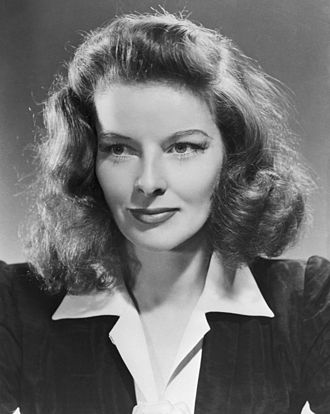
Katharine Houghton Hepburn (May 12, 1907 – June 29, 2003) was an American actress. Known for her fierce independence and spirited personality, Hepburn was a leading lady in Hollywood for more than 60 years. She appeared in a range of genres, from screwball comedy to literary drama, and received four Academy Awards forBest Actress—a record for any performer. In 1999, Hepburn was named by the American Film Institute as the greatest female star in Hollywood history.
Raised in Connecticut by wealthy, progressive parents, Hepburn began to act while studying at Bryn Mawr College. After four years in the theatre, favorable reviews of her work on Broadway brought her to the attention of Hollywood. Her early years in the film industry were marked with success, including an Academy Award for her third picture, Morning Glory (1933), but this was followed by a series of commercial failures which led her to be labeled "box office poison" in 1938.
Hepburn masterminded her own comeback, buying out her contract with RKO Radio Pictures and acquiring the film rights to The Philadelphia Story, which she sold on the condition that she be the star. In the 1940s she was contracted to Metro-Goldwyn-Mayer, where her career focused on an alliance with Spencer Tracy. The screen-partnership spanned 25 years, and produced nine movies.
Hepburn challenged herself in the latter half of her life, as she regularly appeared in Shakespearean stage productions and tackled a range of literary roles. She found a niche playing middle-aged spinsters, such as in The African Queen (1951), a persona the public embraced.
Three more Oscars came for her work in Guess Who's Coming to Dinner (1967), The Lion in Winter (1968) and On Golden Pond (1981). In the 1970s she began appearing in television films, which became the focus of her career in later life. She remained active into old age, making her final screen appearance in 1994 at the age of 87. After a period of inactivity and ill health, Hepburn died in 2003 at the age of 96.
Hepburn famously shunned the Hollywood publicity machine, and refused to conform to society's expectations of women. She was outspoken, assertive, athletic, and wore trousers before it was fashionable for women to do so. She married once, as a young woman, but thereafter lived independently. A 26-year affair with her co-star Spencer Tracy was hidden from the public. With her unconventional lifestyle and the independent characters she brought to the screen, Hepburn epitomized the "modern woman" in 20th century America and is remembered as an important cultural figure.
Contents
- 1 Early life and education
- 2 Career
- 2.1 Breaking into theatre (1928–1932)
- 2.2 Hollywood success (1932–1934)
- 2.3 Career struggles, "box office poison" (1934–1938)
- 2.4 Revival (1939–1942)
- 2.5 Slowing in the 1940s (1942–1949)
- 2.6 Professional expansion (1950–1952)
- 2.7 Spinsters and Shakespeare (1953–1962)
- 2.8 Success in later years (1963–1970)
- 2.9 Film, television, and theatre (1971–1983)
- 2.10 Focus on television (1984–1994)
- 3 Personal life
- 4 Performances: technique and analysis
- 5 Legacy
- 6 Awards and nominations
- 7 Filmography and theatre credits
- 8 References
- 9 External links
Early life and education
Hepburn was born in Hartford, Connecticut, on May 12, 1907, the second of six children. Her parents were Thomas Norval Hepburn (1879–1962), a urologist at Hartford Hospital, and Katharine Martha Houghton(1878–1951), a feminist campaigner. Both parents fought for social change in America: Thomas Hepburn helped establish the New England Social Hygiene Association, which educated the public about venereal disease,[1] while the elder Katharine headed the Connecticut Woman Suffrage Association and later campaigned for birth control with Margaret Sanger.[2]
As a child, Hepburn joined her mother on several "Votes For Women" demonstrations.[3] The Hepburn children were raised to exercise freedom of speech and encouraged to think and debate on any topic they wished.[4] Her parents were criticized by the community for their progressive views, which stimulated Hepburn to fight against barriers she encountered.[5][6] Hepburn said she realized from a young age that she was the product of "two very remarkable parents",[7] and credited her "enormously lucky" upbringing with providing the foundation for her success.[8][9] She remained close to her family throughout her life.[10]
On April 3, 1921, while visiting friends in Greenwich Village, Hepburn discovered the body of her adored older brother, Tom,[17] dead from an apparent suicide. He had tied a sheet around a beam and hanged himself.[18] The Hepburn family denied it was suicide and maintained that Tom's death must have been an experiment that had gone wrong.[19] The incident made the teenage Hepburn nervous, moody, and suspicious of people.[20] She shied away from other children, dropped out of Oxford School, and began receiving private tutoring.[21]
For many years she used Tom's birthday (November 8) as her own. It was not until her 1991 autobiography, Me: Stories of My Life, that Hepburn revealed her true birth date.[22]The young Hepburn was a tomboy who liked to call herself Jimmy, and cut her hair short like a boy's.[11] Thomas Hepburn was eager for his children to use their minds and bodies to the limit, and taught them to swim, run, dive, ride, wrestle, and play golf and tennis.[12]
Golf became a passion of Katharine's; she took daily lessons and became very adept, reaching the semi-final of the Connecticut Young Women's Golf Championship.[13] She loved swimming in Long Island Sound, and took ice-cold baths every morning in the belief that "the bitterer the medicine, the better it was for you."[14] Hepburn was a fan of movies from a young age, and went to see one every Saturday night.[15] She would put on plays and perform for her neighbors with friends and siblings for 50 cents a ticket to raise money for the Navajo people.[16]
In 1924 Hepburn gained a place at Bryn Mawr College. She attended the institution primarily to satisfy her mother, who had studied there, and recalled disliking the experience.[23] It was the first time she had been in school for several years, and she was self-conscious and uncomfortable with her classmates.[24] She struggled with the scholastic demands of university, and once was suspended for smoking in her room.[25] Hepburn was drawn to acting, but roles in college plays were conditional on good grades. Once her marks had improved, she began performing regularly.[25] She performed the lead role in a production of The Woman in the Moon in her senior year, and the positive response it received cemented Hepburn's plans to pursue a theatrical career.[13] She graduated with a degree in history and philosophy in June 1928.[26]
...
Hollywood success (1932–1934)
Hepburn arrived in California in July 1932, at 25 years old. She starred in A Bill of Divorcement opposite John Barrymore, but showed no sign of intimidation.[48][49] Although she struggled to adapt to the nature of film acting, Hepburn was fascinated by the industry from the start.[50] The picture was a success and Hepburn received positive reviews.[51] Mordaunt Hall of The New York Times called her performance "exceptionally fine ... Miss Hepburn's characterization is one of the finest seen on the screen".[52]The Variety review declared, "Standout here is the smash impression made by Katharine Hepburn in her first picture assignment. She has a vital something that sets her apart from the picture galaxy."[53]
On the strength of A Bill of Divorcement, RKO signed the actress to a long-term contract.[54] George Cukor became a lifetime friend and colleague—he and Hepburn made ten films together.[55]A scout for the Hollywood agent Leland Hayward spotted Hepburn's appearance in The Warrior's Husband, and asked her to test for the part of Sydney Fairfield in the upcoming RKO film A Bill of Divorcement.[44]
Director George Cukor was impressed by what he saw: "There was this odd creature," he recalled, "she was unlike anybody I'd ever heard." He particularly liked the manner in which she picked up a glass: "I thought she was very talented in that action."[45] Offered the role, Hepburn demanded $1,500 a week, a large amount for an unknown actress.[46] Cukor encouraged the studio to accept her demands and they signed Hepburn to a temporary contract with a three-week guarantee.[27][47] RKO head David O. Selznick recounted that he took a "tremendous chance" in casting the unusual actress.[48]

AsJo March in Little Women (1933), which was one of the most popular movies of its day
Hepburn's second film was Christopher Strong (1933), the story of an aviatrix and her affair with a married man. The picture was not commercially successful, but Hepburn's own reviews were good.[56] Regina Crewe wrote in the Journal American that although her mannerisms were grating, "they compel attention, and they fascinate an audience. She is a distinct, definite, positive personality."[57] Hepburn's third picture confirmed her as a major actress in Hollywood.[58]
For playing aspiring actress Eva Lovelace in Morning Glory, she won an Academy Award for Best Actress. She had seen the script on the desk of producer Pandro S. Berman and, convinced that she was born to play the part, insisted that the role be hers.[59] Hepburn chose not to attend the awards ceremony—as she would not for the duration of her career—but was thrilled with the win.[60] Her success continued with the role of Jo in a screen adaptation of Little Women (1933). The picture was a hit, one of the film industry's biggest successes to date,[48] and Hepburn won the Best Actress prize at the Venice Film Festival. Little Women was one of Hepburn's personal favorites and she was proud of her performance, later saying, "I defy anyone to be as good [as Jo] as I was".[58]
By the end of 1933 Hepburn was a respected film actress, but she yearned to prove herself on Broadway.[61] Jed Harris, one of the most successful theatre producers of the 1920s, was going through a career slump.[62] He asked Hepburn to appear in the play The Lake, which she agreed to do for a low salary.[63] Before she was given leave, RKO asked that she film Spitfire (1934). Hepburn's role in the movie was Trigger Hicks, an uneducated mountain girl. It is widely considered one of her worst films, and Hepburn received poor reviews for the effort.[64] She kept a picture of Hicks in her bedroom throughout her life to "[keep] me humble."[65]
The Lake previewed in Washington, D.C., where there was a large advance sale.[63] Harris's poor direction had eroded Hepburn's confidence, and she struggled with the performance.[66] Despite this, Harris moved the play to New York without further rehearsal. It opened at the Martin Beck Theatre on December 26, 1933, and Hepburn was roundly panned by the critics.[67]
Dorothy Parker quipped, "She runs the gamut of emotions all the way from A to B."[68] Already tied to a ten-week contract, she had to endure the embarrassment of rapidly declining box office sales.[69] Harris decided to take the show to Chicago, saying to Hepburn, "My dear, the only interest I have in you is the money I can make out of you." Hepburn refused, and paid Harris $14,000 to close the production instead.[70] She later referred to Harris as "hands-down the most diabolical person I have ever met",[62] and claimed this experience was important in teaching her to take responsibility for her career.[71]
Career struggles, "box office poison" (1934–1938)
Given the choice of her next feature, Hepburn decided to star in George Cukor's new project, Sylvia Scarlett (1935), which paired her for the first time with Cary Grant.[76] Her hair was cut short for the part, as her character masquerades as a boy for much of the film. Critics disliked Sylvia Scarlett and it was unpopular with the public.[77] She next played Mary Stuart inJohn Ford's Mary of Scotland (1936), which met with a similarly poor reception.[78] A Woman Rebels (1937) followed, a Victorian era drama where Hepburn's character fights against convention. Quality Street (1937) also had a period setting, this time a comedy. Neither movie was popular with the public, which meant she had made four unsuccessful pictures in a row.[79]
After the failure of Spitfire and The Lake, RKO cast Hepburn in The Little Minister (1934), based on a Victorian novel by James Barrie, in an attempt to repeat the success of Little Women.[72] There was no such recurrence, and the picture was a commercial failure.[73] The romantic drama Break of Hearts (1935) with Charles Boyer was poorly reviewed and also lost money.[74] After three forgettable films, success returned to Hepburn with Alice Adams (1935), the story of a girl's desperation to climb the social ladder. Hepburn loved the bookand was delighted to be offered the role.[75] The film was a hit, one of Hepburn's personal favorites, and gave the actress her second Oscar nomination. She received the second most votes, after winner Bette Davis.[76]
Alongside a series of unpopular films, problems arose from Hepburn's attitude.[80] She had a difficult relationship with the press, with whom she could be rude and provocative.[81]When asked if she had any children, she snapped back, "Yes I have five: two white and three colored."[82] She would not give interviews and denied requests for autographs,[83] which earned her the nickname "Katharine of Arrogance".[84] The public was also baffled by her boyish behavior and fashion choices, and she became a largely unpopular figure.[81][85]
Hepburn sensed that she needed to leave Hollywood,[86] so she returned east to star in a theatrical adaptation of Jane Eyre. It had a successful tour,[87] but, uncertain about the script and unwilling to risk failure after the disaster of The Lake, Hepburn decided against taking the show to Broadway.[86] Towards the end of 1936, Hepburn vied for the role of Scarlett O'Hara in Gone With The Wind.[88] Producer David O. Selznick refused to offer her the part because he felt she had no sex appeal. He reportedly told Hepburn, "I can't see Rhett Butler chasing you for twelve years."[89]
After the release of Bringing up Baby, the Independent Theatre Owners of America included Hepburn on a list of actors considered "Box Office Poison".[96] Her reputation at a low, the next film RKO offered her was Mother Carey's Chickens, a B movie with poor prospects.[96] Hepburn turned it down, and instead opted to buy herself out of her contract for $75,000.[97] Many actors were afraid to leave the stability of the studio system at the time, but Hepburn's personal wealth meant she could afford to be independent.[98]
She signed on for the film version of Holiday (1938) with Columbia Pictures, pairing her for the third time with Grant. The comedy was well received by critics, but it failed to draw much of an audience,[99] and the next script offered to Hepburn came with a salary of $10,000—less than she had received at the start of her film career.[100] Reflecting on this change in fortunes, Andrew Britton writes of Hepburn, "No other star has emerged with greater rapidity or with more ecstatic acclaim. No other star, either, has become so unpopular so quickly for so long a time."[101]
Hepburn's next feature, Stage Door (1937), paired her with Ginger Rogers in a role which mirrored her own life—that of a wealthy society girl trying to make it as an actress.[91] Hepburn was praised for her work at early previews, which gave her top billing over Rogers.[92] The film was nominated for Best Picture at the Academy Awards, but it was not the box-office hit RKO had hoped for.[91] Industry pundits blamed Hepburn for the small profit, but the studio continued its commitment to resurrecting her popularity.[93]
She was cast in Howard Hawks' screwball comedy Bringing Up Baby (1938) alongside Cary Grant. Hepburn played the physical comedy of the film with confidence,[93] and took tips on comedic timing from her costar Walter Catlett.[94] Bringing Up Baby was acclaimed by critics, but it was nevertheless unsuccessful at the box-office.[95] With the genre and Grant both hugely popular at the time, biographer A. Scott Berg believes the blame lay with moviegoers' rejection of Hepburn.[96]
Revival (1939–1942)
Several of the major film studios approached Hepburn to produce the movie version of Barry's play.[105] She chose to sell the rights to Metro-Goldwyn-Mayer (MGM), Hollywood's number one studio,[106] on the condition that she be the star. As part of the deal she also received the director of her choice, George Cukor, but the costars she wanted, Clark Gableand Spencer Tracy, were both unavailable.
Louis B. Mayer promised her James Stewart and $150,000 "for anyone else you want or can get."[107] Hepburn chose her friend and previous costar, Cary Grant, to whom she ceded top billing.[108] Before filming began, Hepburn shrewdly noted, "I don't want to make a grand entrance in this picture. Moviegoers ... think I'm too la-di-da or something. A lot of people want to see me fall flat on my face." Thus the film began with Grant knocking the actress flat on her backside.[109] Berg describes how the character was crafted to have audiences "laugh at her enough that they would ultimately sympathize with her", which Hepburn felt was crucial in "recreating" her public image.[110]
The Philadelphia Story was one of the biggest hits of 1940, breaking records at Radio City Music Hall.[27] The review in Time declared, "Come on back, Katie, all is forgiven."[111] Herb Golden of Variety stated, "It's Katharine Hepburn's picture ... The perfect conception of all flighty but characterful Main Line socialite gals rolled into one, the story without her is almost inconceivable."[112] Hepburn was nominated for her third Academy Award for Best Actress, and won the New York Film Critics Circle Award for Best Actress.[113][114]
Following this decline in her career, Hepburn took action to create her own comeback vehicle. She left Hollywood to look for a stage project, and signed on to star in Philip Barry's new play, The Philadelphia Story. It was tailored to showcase the actress, with the character of socialite Tracy Lord incorporating a mixture of humor, aggression, nervousness, and vulnerability.[102] Howard Hughes, Hepburn's partner at the time, sensed that the play could be her ticket back to Hollywood stardom and bought her the film rights before it even debuted on stage.[103] The Philadelphia Story first toured the United States, to positive reviews, and then opened in New York at the Schubert Theatre on March 29, 1939.[104] It was a big hit, critically and financially, running for 417 performances and then going on a second successful tour.[27]
Hepburn was also responsible for the development of her next project, the romantic comedy Woman of the Year. The idea for the film was proposed to her by Garson Kanin in 1941. Hepburn passed the outline on to Joseph L. Mankiewicz at MGM, who expressed an interest in the picture. Kanin recalled how Hepburn contributed to the script, suggesting cuts and word changes, and provided helpful enthusiasm for the project.[115] Hepburn presented the finished product to MGM and demanded $250,000—half for her, half for the authors,Michael Kanin and Ring Lardner, Jr.[116]
Her terms accepted, Hepburn was also given the director and costar of her choice, George Stevens and Spencer Tracy. Released in 1942,Woman of the Year was another success. Critics praised the chemistry between the stars, and, says Higham, noted Hepburn's "increasing maturity and polish".[117] The World-Telegram commended two "brilliant performances",[118] and Hepburn received a fourth Academy Award nomination for her role as independent career-woman Tess Harding. During the course of the movie, Hepburn signed a star contract with MGM.[108]
Slowing in the 1940s (1942–1949)
In 1942, Hepburn returned to Broadway to appear in another Philip Barry play, Without Love, which was also written with the actress in mind.[118] Critics were unenthusiastic about the production but with Hepburn's popularity at a high it ran for 16 sold-out weeks.[119] MGM was eager to reunite Tracy and Hepburn for a new picture, and settled on Keeper of the Flame (1942). A dark mystery with a propaganda message on the dangers of fascism, the film was seen by Hepburn as an opportunity to make a worthy political statement.[120] It received poor notices but was a financial success, confirming the popularity of the Tracy–Hepburn pairing.[121]

The majority of films Hepburn did in this period were withSpencer Tracy. She later said the partnership did much to advance her career, as he was the more popular star at the time.[122] The pair are seen here in one of their most successful outings, Adam's Rib (1949).
Since Woman of the Year, Hepburn had committed to a romantic relationship with Tracy and dedicated herself to helping the star, who suffered from alcoholism and insomnia.[123] Her career slowed as a result, and she worked less for the remainder of the decade than she had done in the 1930s—notably by not appearing on-stage again until 1950.[124]
Her only appearance in 1943 was a cameo in the morale-building wartime film Stage Door Canteen, playing herself. She took an atypical role in 1944, playing a Chinese peasant in the high-budget drama Dragon Seed. Hepburn was enthusiastic about the film, but it met with a tepid response and she was described as miscast.[125] She then reunited with Tracy for the film version of Without Love (1945), after which she turned down a role in The Razor's Edge to support Tracy through his return to Broadway.[126] Without Love received poor reviews, but a new Tracy–Hepburn picture was a big event and it was popular on release, selling a record number of tickets over Easter-weekend 1945.[127]
Hepburn's next film was Undercurrent (1946), a film noir with Robert Taylor and Robert Mitchum that was poorly received.[128] A fourth film with Tracy came in 1947: a drama set in the American Old West entitled The Sea of Grass. Similarly to Keeper of the Flame and Without Love, a lukewarm response from critics did not stop it from being a financial success both at home and abroad.[129]
The same year, Hepburn portrayed Clara Wieck Schumann in Song of Love. She trained intensively with a pianist for the role.[130] By the time of its release in October, Hepburn's career had been significantly affected by her public opposition to the growing anti-communist movement in Hollywood. Viewed by some as dangerously progressive, she was not offered work for nine months and people reportedly threw things at screenings of Song of Love.[131]
Her next film role came unexpectedly, as she agreed to replace Claudette Colbert only days before shooting began on Frank Capra's political drama State of the Union (1948).[132] Tracy had long been signed to play the male- lead, and so Hepburn was already familiar with the script and stepped up for the fifth Tracy–Hepburn picture.[131] Critics responded positively to the film and it performed well at the box-office.[133]
Tracy and Hepburn appeared onscreen together for a third consecutive year in the 1949 film Adam's Rib. Like Woman of the Year, it was a "battle of the sexes" comedy, and was written specifically for the duo by their friends Garson Kanin and Ruth Gordon. A story of married lawyers who oppose each other in court, Hepburn described it as "perfect for [Tracy] and me".[134] Although her political views still prompted scatteredpicketing at theatres around the country, Adam's Rib was a hit, favorably reviewed and the most profitable Tracy–Hepburn picture to date.[135] The New York Times critic Bosley Crowther was full of praise for the film and hailed the duo's "perfect compatibility".[136]
Professional expansion (1950–1952)
Hepburn often worked abroad in the 1950s, beginning withThe African Queen (1951), which was shot on location in Africa. Pictured is a promotional image for the film, with co-star Humphrey Bogart.

The 1950s saw Hepburn take on a series of professional challenges, and stretch herself further than at any other point in her life at an age when most other actresses began to retreat.[137] Berg describes the decade as "the heart of her vast legacy" and "the period in which she truly came into her own."[138]
In January 1950, Hepburn ventured into Shakespeare, playing Rosalind in As You Like It. She hoped to prove that she could play already established material,[28] and said, "It's better to try something difficult and flop than to play it safe all the time."[139] It opened at the Cort Theatre in New York to a capacity audience, and was virtually sold out for 148 shows.[140] The production then went on tour. Reviews for Hepburn varied, but she was noted as the only leading-lady in Hollywood who was performing high-caliber material onstage.[141]
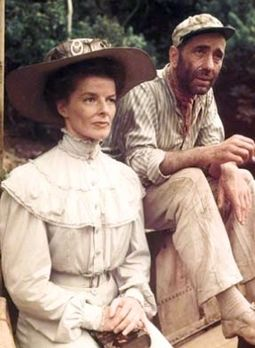
In 1951, Hepburn filmed The African Queen, her first movie in Technicolor. She played Rose Sayer, a prim spinster missionary living in German East Africa at the outbreak ofWorld War I. Costarring Humphrey Bogart, The African Queen was shot mostly on location in the Belgian Congo, an opportunity Hepburn embraced.[142] It proved a difficult experience, however, and Hepburn became ill with dysentery during filming.[143] Later in life, she released a memoir about the experience.[144] The movie was released at the end of 1951 to popular support and critical acclaim,[145] and gave Hepburn her fifth Best Actress nomination at the Academy Awards. The first successful film she had made without Tracy since The Philadelphia Story a decade earlier, it proved that she could be a hit without him and fully reestablished her popularity.[146]
Hepburn went on to make the sports comedy Pat and Mike (1952), the second film written specifically as a Tracy–Hepburn vehicle by Kanin and Gordon. She was a keen athlete, and Kanin later described this as his inspiration for the film: "As I watched Kate playing tennis one day ... it occurred to me that her audience was missing a treat."[147] Hepburn was under pressure to perform several sports to a high standard, many of which did not end up in the film.[148] Pat and Mike was one of the team's most popular and critically acclaimed films, and it was also Hepburn's personal favorite of the nine films she made with Tracy.[149] The performance brought her a nomination for the Golden Globe Award for Best Actress – Motion Picture Musical or Comedy.[150]
In the summer of 1952, Hepburn appeared in London's West End for a ten-week run of George Bernard Shaw's The Millionairess. Her parents had read Shaw to her when she was a child, which made the play a special experience for the actress.[151] Two years of intense work had left her exhausted, however, and her friend Constance Collier wrote that Hepburn was "on the verge of a nervous breakdown".[152] Widely acclaimed, The Millionairess was brought to Broadway.[153] In October 1952 it opened at the Shubert Theatre, where despite a lukewarm critical response it sold out its ten-week run.[152] Hepburn subsequently tried to get the play adapted into a film: a script was written by Preston Sturges, and she offered to work for nothing and pay the director herself, but no studio picked up the project.[154] She later referred to this as the biggest disappointment of her career.[151]
Spinsters and Shakespeare (1953–1962).
Pat and Mike was the last film Hepburn completed on her MGM contract, making her free to select her own projects.[153] She spent two years resting and traveling, before committing to David Lean's romantic drama Summertime (1955). The movie was filmed in Venice, with Hepburn playing a lonely spinster who has a passionate love affair. She described it as "a very emotional part" and found it fascinating to work with Lean.[155] At her own insistence, Hepburn performed a fall into a canal and developed a chronic eye infection as a result.[156]
The role earned her another Academy Award nomination and has been cited as some of her finest work.[157][158] Lean later said it was his personal favorite of the films he made, and Hepburn his favorite actress.[159] The following year, Hepburn spent six months touring Australia with the Old Vic theatre company, playing Portia in The Merchant of Venice, Kate inThe Taming of the Shrew, and Isabella in Measure for Measure. The tour was successful and Hepburn earned significant plaudits for the effort.[160]
Hepburn received an Academy Award nomination for the second year running for her work opposite Burt Lancaster in The Rainmaker (1956). Again she played a lonely woman empowered by a love affair, and it became apparent that Hepburn had found a niche in playing "love-starved spinsters" that critics and audiences enjoyed.[161] Hepburn said of playing such roles, "With Lizzie Curry [The Rainmaker] and Jane Hudson [Summertime] and Rosie Sayer [The African Queen]—I was playing me. It wasn't difficult for me to play those women, because I'm the maiden aunt."[161]
Less success that year came from The Iron Petticoat (1956), a reworking of the classic comedy Ninotchka, with Bob Hope. Hepburn played a cold-hearted Soviet pilot, a performance Bosley Crowther called "horrible".[162] It was a critical and commercial failure, and Hepburn considered it the worst film on her resume.[161][162]
Tracy and Hepburn reunited on screen for the first time in five years for the office-based comedy Desk Set (1957). Berg notes that it worked as a hybrid of their earlier romantic-comedy successes and Hepburn's spinster persona,[163] but it performed poorly at the box-office.[164] That summer, Hepburn returned to Shakespeare. Appearing in Stratford, Connecticut, at the American Shakespeare Theatre, she repeated her Portia in The Merchant of Venice and played Beatrice in Much Ado About Nothing. The shows were positively received.[163]
Hepburn returned to Stratford in the summer of 1960 to play Viola in Twelfth Night and Cleopatra in Antony and Cleopatra. The New York Post wrote of her Cleopatra, "Hepburn offers a highly versatile performance ... once or twice going in for her famous mannerisms and always being fascinating to watch."[170] Hepburn herself was proud of the role.[171]
Her repertoire was further improved when she appeared in Sidney Lumet's film version of Eugene O'Neill's Long Day's Journey Into Night (1962). It was a low-budget production, and she appeared in the film for a tenth of her established salary.[172] She called it "the greatest [play] this country has ever produced" and the role of morphine-addicted Mary Tyrone "the most challenging female role in American drama", and felt her performance was the best screen work of her career.[173]
Long Day's Journey Into Night earned Hepburn an Oscar nomination and the Best Actress Award at the Cannes Film Festival. It remains one of her most praised performances.[174]After two years away from the screen, Hepburn starred in a film adaptation of Tennessee Williams' controversial play Suddenly, Last Summer (1959) with Elizabeth Taylorand Montgomery Clift. The movie was shot in London, and was "a completely miserable experience" for Hepburn.[165] She clashed with director Joseph L. Mankiewiczduring filming, which culminated with her spitting at him in disgust.[166] The picture was a financial success, and her work as creepy aunt Violet Venable gave Hepburn her eighth Oscar nomination.[167]
Williams was pleased with the performance, writing, "Kate is a playwright's dream-actress. She makes dialogue sound better than it is by a matchless beauty and clarity of diction".[168] He wrote The Night of the Iguana (1961) with Hepburn in mind, but the actress, although flattered, felt the play was wrong for her and declined the part, which went to Bette Davis.[169]
Success in later years (1963–1970)
Hepburn quickly returned to acting after Tracy's death, choosing to preoccupy herself as a remedy against grief.[179] She received numerous scripts[180] and chose to play Eleanor of Aquitaine in The Lion in Winter (1968), a part she called "fascinating".[181]
She is their descendent. She read extensively in preparation for the role, in which she starred opposite Peter O'Toole.[182]Filming took place in Montmajour Abbey in the south of France, an experience she loved despite being—according to director Anthony Harvey—"enormously vulnerable" throughout.[183]
John Russell Taylor of The Times suggested that Eleanor was "the performance of her ... career", and proved that she was "a growing, developing, still surprising actress".[184] The movie was nominated in all the major categories at the Academy Awards, and for the second year running Hepburn won the Oscar for Best Actress (shared withBarbra Streisand for Funny Girl).[185] The role, combined with her performance in Guess Who's Coming to Dinner, also received a British Academy Film Award (BAFTA) for Best Actress.
Hepburn's next appearance was in The Madwoman of Chaillot (1969), which she filmed in Nice immediately after completing The Lion in Winter.[186] The picture was a failure critically and financially, and reviews targeted Hepburn for giving a misguided performance.[187]Following the completion of Long Day's Journey Into Night, Hepburn took a break in her career to care for ailing Spencer Tracy.[175]
She did not work again until 1967's Guess Who's Coming to Dinner, her ninth film with Tracy. The movie dealt with the subject of interracial marriage, with Hepburn's niece, Katharine Houghton, playing her daughter. Tracy was dying by this point, suffering the effects of heart disease,[176] and Houghton later commented that her aunt was "extremely tense" during the production.[177] Tracy died 17 days after filming his last scene. Guess Who's Coming to Dinner was a triumphant return for Hepburn and her most commercially successful picture to that point.[178] She won her second Best Actress Award at the Oscars, 34 years after winning her first. Hepburn felt the award was not just for her, but was also given to honor Tracy.[178]
From December 1969 to August 1970, Hepburn starred in the Broadway musical Coco, about the life of Coco Chanel. She admitted that before the show, she had never sat through a theatrical musical.[188] She was not a strong singer, but found the offer irresistible and, as Berg puts it, "what she lacked in euphony she made up for in guts".[189] The actress took vocal lessons six times a week in preparation for the show.[189]
She was nervous about every performance, and recalled "wondering what the hell I was doing there."[190] Reviews for the production were mediocre, but Hepburn herself was praised and Coco was popular with the public—with its run twice extended.[191] She later said Coco marked the first time she accepted that the public was not against her, but actually seemed to love her.[28] Her work earned a Tony Award nomination for Best Actress in a Musical.[192]
Film, television, and theatre (1971–1983)
...
The most significant relationship of Hepburn's life was with Spencer Tracy. In her autobiography she wrote, "It was a unique feeling that I had for [Tracy]. I would have done anything for him."[261] Lauren Bacall, a close friend, later wrote of how "blindingly" in love Hepburn was with the actor.[262] The relationship has subsequently received much publicity, and it is often cited as one of Hollywood's legendary love affairs.[216][234][263]
Meeting when she was 34 and he was 41, Tracy was initially wary of Hepburn, unimpressed by her dirty fingernails and suspecting that she was a lesbian,[264] but Hepburn said she "knew right away that I found him irresistible."[265] Tracy remained married throughout their relationship; although he and his wife Louise had been living separate lives since the 1930s, there was never an official split and neither party pursued a divorce.[266] Hepburn did not interfere, and never fought for marriage.[267]
With Tracy determined to conceal the relationship with Hepburn from his wife, it had to remain private.[268] They were careful not to be seen in public together, and maintained separate residences.[263][269] Tracy was an alcoholic and was frequently depressed; Hepburn described him as "tortured",[270] and she devoted herself to making his life easier.[271]Reports from people who saw them together describe how Hepburn's entire demeanor changed when around Tracy.[272] She mothered and obeyed him, and Tracy became heavily dependent on her.[273] They often spent stretches of time apart due to their work, particularly in the 1950s when Hepburn was largely abroad for career commitments.[274]
Tracy's health declined significantly in the 1960s, and Hepburn took a five-year break in her career to care for him.[175] She moved into Tracy's house for this period, and was with him when he died on June 10, 1967.[275] Out of consideration for Tracy's family, she did not attend his funeral.[276] It was only after Louise Tracy's death, in 1983, that Hepburn began to speak publicly about her feelings for her frequent co-star.[277] In response to the question of why she stayed with Tracy for so long, despite the nature of their relationship, she said, "I honestly don't know. I can only say that I could never have left him."[175] She claimed to not know how he felt about her[278] and that they "just passed twenty-seven years *[sic*] together in what was to me absolute bliss."[278]
Final years and death
Hepburn's death received considerable public attention. Many tributes were held on television, and newspapers and magazines dedicated issues to the actress.[284] American president George W. Bush said Hepburn "will be remembered as one of the nation's artistic treasures."[285] In honor of her extensive theatre work, the lights of Broadway were dimmed for the evening of July 1, 2003.[285] In 2004, in accordance with Hepburn's wishes, her belongings were put up for auction with Sotheby's in New York. The event garnered $5.8 million, which Hepburn willed to her family.[286]
Hepburn stated in her eighties, "I have no fear of death. Must be wonderful, like a long sleep."[28] Her health began to deteriorate not long after her final screen appearance. In the winter of 1996 she was hospitalized with pneumonia.[279] By 1997 she had become very weak, was speaking and eating very little, and it was feared she would die.[280] She showed signs of dementia in her final years.[281] In May 2003, an aggressive tumor was found in Hepburn's neck. The decision was made not to medically intervene,[282] and she died on June 29, 2003, at the Hepburn family home in Fenwick, Connecticut. She was 96 years old and was buried in Cedar Hill Cemetery in Hartford. Hepburn requested that there be no memorial service.[283]
Extra Connections:
Henry II and Eleanor of Aquitaine were her 23 great-grandparents. She was also related to John Adams. Hollywood Royals: The Royal Ancestry of Katharine Hepburn
Sandbox: TheBrain (7/26)