Munroe, Chls E
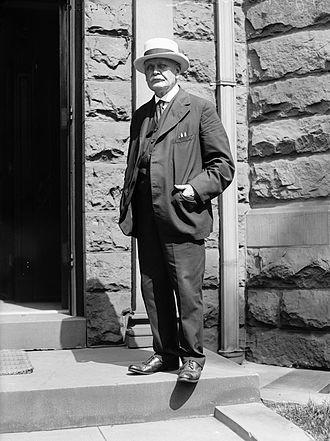
ACHIEVEMENTS:
Discovered new information about the nature of the detonation wave of nitroglycerine
DATE AND PLACE OF BIRTH:
24 May 1849, Cambridge, MA.
DATE AND PLACE OF DEATH AND AGE AT DEATH:
7 December 1938, Forest Glen, MD. Aged 89
DISCIPLINE:
Chemist
FIELD:
Chemistry
EDUCATION:
Harvard University
George Washington University
MAJOR WORK:
None
LIFE AND TIMES:
Munroe was the son of an instrument maker. He graduated from the scientific school at Harvard in 1871 and took a job as an assistant professor in the chemical department. During the next three years, he set up a course in chemical technology, a summer school in chemistry, and established the foundations of modern chemical engineering.
In 1874 he became professor of chemistry at the United States Naval Academy where he began investigating explosives. From 1886-92 he was engaged in chemical research at the Naval Torpedo Station and War College in Newport, Rhode Island. At Newport, he began working to produce a smokeless gunpowder.
The smokeless powders already in military use in Europe were made of cellulose nitrates and other compounds, but Munroe wanted to produce a powder made of a single cellulose nitrate. He succeeded in making a chemically pure, highly nitrated powder called indurite.
It was the first smokeless powder used by the US Navy in big guns but was not actually adopted by the US military because large-scale production proved troublesome.
During his work on indurite, Munroe discovered by accident that if the surface of a block of explosive is hollowed out, and then placed in contact with a piece of steel plate and detonated, the shape and size of the hollowed out area in the explosive is reproduced on the steel plate. The indentation in the metal plate was often magnified, and the plate was sometimes actually pierced. It was the explosive furthest away from the metal surface which had the most marked effect on the metal.
At the time this was considered to be no more than an entertaining demonstration.
For example, when a block of gun cotton with letters carved into it was exploded against a steel plate the impression of the letters was stamped into the plate. If the letters were raised above the surface of the gun cotton they could be reproduced in relief on a metal plate.
The phenomenon is now known as the Munroe effect and became important in the twentieth century for the production of armor-piercing ammunition used to combat the tank*.
In 1910 a German scientist, Egon Neumann, discovered independently that a block of TNT with a conical indentation in it would blow a hole through a steel plate. When an explosive is detonated, the shock wave moves rapidly in all directions; what Munroe and Neumann had discovered was that the shock wave could be focused and concentrated mainly in one direction. Although this gave rise to ideas for a new type of weapon, none of the experiments undertaken were successful.
In 1892 Munroe became professor of chemistry and dean of the scientific school at the Columbian University in Washington. He was instrumental in the founding of the graduate school there and became its dean in 1893.
The Munroe effect was finally exploited successfully at the beginning of the second world war. When a conical hole is made in one end of a cylindrical charge and the charge is detonated at the other end, the shock wave is directed along the axis of the cylinder. If the conical hole is lined with metal, the impact of the detonation wave collapses the metal liner and converts it into vapor and molten metal.
The jet of molten metal and gas is projected forward at enormously high speeds – around 7, 720 m (25,000 ft) per second – and when it emerges it will pierce through several centimeters of armor plating. The hot jet of gas passes through the pierced hole and reacts with any obstacle inside (men, fuel tanks, ammunition).
From around 1940, this new type of ammunition, called the ‘Hollow Charge’, was in use. The advantage of hollow charge shell is that performance is governed by the explosive in the shell so it does not need to be fired at high velocity. For same reason, its performance was a constant figure which did not reduce as the range lengthened.
ASSESSMENT: The “Munroe effect” was instrumental in the development of new armour-piercing ammunition in the twentieth century.
EXTRA CONNECTIONS: His discovery spurred the development of carbide armor (from the work of Acheson*)
ONELINER: CE Monroe, inventor of armor-piercing ordnance
BIBLIOGRAPHY:
Brown, G I, The Big Bang, A History of Explosives,Sutton Publishing, 1998
ANB