De Lassus
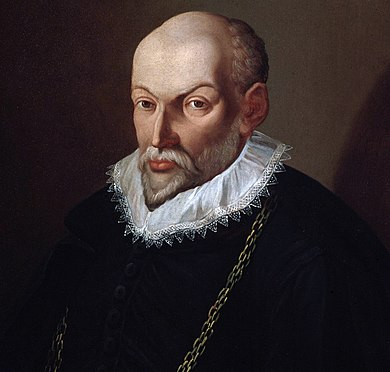
NAME: De Lassus, Orlande [Roland]
ACHIEVEMENTS:
One of the most versatile, prolific, and admired composers of the sixteenth century.
COMMON NAME: Orlando De Lassus
DATE AND PLACE OF BIRTH:
1530 or 1532, in Mons, Hainaut (Netherlands).
DATE/PLACE OF DEATH/AGE AT DEATH:
14th June 1594, Munich, Germany. Aged 62 or 64.
DISCIPLINE: Musician.
FIELD: Composition, choral music.
LANGUAGE: Included French, Italian, German, and Latin.
EDUCATION: As a choirboy at the Mantuan court.
MAJOR WORKS:
Choral masses, motets, madrigals, Prophetiae Sibyllarum
LIFE AND TIMES:
Little is known for certain about his childhood, other than that he had an outstanding singing voice; legend has it that he was abducted three times during his youth because his voice was so beautiful.
The earliest verifiable fact is that at about age 12 he became a singer in the service of Ferrante Gonzaga, a member of the ducal house of Mantua. De Lassus traveled to Italy with the Gonzaga household in 1545, spending part of the year at the Mantuan court before moving on to Sicily, Palermo, and Milan.
His introduction to Italian music and culture at such a distinguished center of the arts made a profound impression on the teenager and would have a significant influence on his compositional style.
De Lassus parted ways with the Gonzaga family in early 1549, when he went to Naples, entered the service of Constantine Castrioto, and most likely began composing music. After several years he took a musical post in the household of Antonio Altoviti, Archbishop of Florence, who was living in Rome at the time.
In 1553, still only in his early twenties, De Lassus became maestro di capella at the church of San Giovanni in Laterno, an important leadership position that gives some idea of his reputation in Rome and his skills as a musician. Only a year later, De Lassus abruptly left Rome in the hope of visiting his ill parents, who died before he could reach the Netherlands.
By early 1555 he was in Antwerp, where he became friends with the printers Tylman Susato and Jean de Laet; he may even have worked in Susato's shop for a while. The friendship was fortuitous for all concerned, as Susato printed a collection of De Lassus' madrigals, chansons and motets for four voices, a publication that is often considered De Lassus's Opus 1.
The same year, Antonio Gardane of Venice printed De Lassus's first book of five-part madrigals.
Publications of his work continued through 1556, and as the printed music circulated, he began to build a reputation as a skilled composer. The publication of so many pieces in such a short period of time indicates that De Lassus had probably been writing music throughout his years in Italy, and waited until he had a substantial body of work before he committed them to print.
There is also evidence that he was composing larger-scale works at this point as well, including at least one mass and, possibly, the Prophetiae Sibyllarum, a collection of ambitious musical settings for humanistic Latin texts. De Lassus's progressive style in this work earned him fame during his lifetime and even attracted the attention of King Charles IX of France.
Duke Albrecht V of Bavaria invited De Lassus to join his court in 1556. De Lassus accepted the position and moved to Munich, where he sang as a tenor in the chapel under the direction of Ludwig Daser. De Lassus was one of a number of newly-hired Flemish singers at the court, brought in to lend international shine to a provincial German musical establishment.
But his letters during his first few years in Munich indicate that he was unhappy with his job there; even though his salary gradually increased, he was still stuck in the same singing position after two years, and he made some attempt to find another job. Things took a positive turn when Daser retired in 1563 and De Lassus was promoted to musical leadership of the chapel.
He would hold this position for thirty years, until his death. Under his direction the musical culture of the chapel was changed dramatically, thanks to his employment of Italian singers and instrumentalists, his abilities as supervisor of musical education for the choirboys, and his brilliance as a composer.
As part of his duties De Lassus composed numerous religious works, including "parody" masses based on melodic material from his own songs, and from the popular French chansons and Italian madrigals of Palestrina*, Jacques Arcadelt, and Cipriano de Rore. De Lassus also provided music for special occasions at the Bavarian court: state visits, banquets, and hunting parties. In addition to his professional duties, he enjoyed a friendship with both Duke Albrecht and his son, the future Wilhelm V.
De Lassus married Regina Wäckinger, the daughter of a court official, in 1558. Their children included two sons, Ferdinand and Rudolph, who would eventually establish their own careers in music. In addition to his work in the duke's chapel, De Lassus had the opportunity to travel a great deal: in 1560 to Flanders to recruit singers, to Prague for the coronation of the Archduke Maximilian as king of Bohemia in 1562, and to Italy on multiple occasions. During his time away from Munich, De Lassus enjoyed a witty, friendly correspondence with Duke Wilhelm, revealing his sense of humor and brilliant facility with a number of languages.
His fame as a composer continued to grow throughout the 1560s and 1570s. Venetian, Flemish, French, and German printers published his music, both as individual works and in series of volumes devoted exclusively to De Lassus. He played a key role in the wedding festivities for Duke Wilhelm and Renée of Lorraine, composing music for the occasion, supervising performances, and even acting in an Italian comedia dell'arte in honor of his ducal friend.
By the 1570s, De Lassus's role at the Bavarian court and his publications had made him famous; new editions and reprints of earlier music show how popular his work was throughout Europe.
He was granted a number of honors rarely given to musicians; in 1570 he received a patent of nobility from Maximilian II, was invited by Charles IX to visit the French court, and was made a Knight of the Spur by Pope Gregory XIII in 1574.
The size of the Bavarian ducal chapel was reduced when Wilhelm V succeeded his father in 1579, but De Lassus kept his position, refusing other offers. His composing activities did not slow down, even as he grew older and began to suffer from poor health and depression.
In fact, 1581-1585 saw an especially productive period in which he prepared works for publication and completed new masses, motets, psalms, and German lieder. In 1585 he turned over some of his duties to his son Ferdinand, but he continued to write music until his death. By the end of his life he had completed more than 2,000 musical works.
ASSESSMENT: De Lassus' skill with a variety of musical forms and a number of languages made him one of the most versatile, prolific, and ambitious composers of the Renaissance.
EXTRA CONNECTIONS: he worked for Cosimo I de' Medici, Grand Duke of Tuscany.
In the Arthur Conan Doyle short story "The Adventure of the Bruce-Partington Plans," Sherlock Holmes is working on a monograph about the polyphonic motets of Lasso.
ONELINER: Orlando De Lassus, sixteenth-century composer
BIBLIOGRAPHY:
Haar, James, "Munich at the Time of Orlande De Lassus" in Man & Music—The Renaissance: From the 1470s to the End of the 16th Century, ed. Iain Fenlon, Prentice Hall, Englewood Cliffs, New Jersey, 1989: pp.243-262.
'Orlande [Roland] De Lassus [Orlando di De Lassus],' grovemusic.com ed. L. Macy (2001)
Sharp, Geoffrey B., Lassus and Palestrina, Novello, Borough Green, England, 1972.
PARENTS:
Nothing known.
SIBLINGS:
None known.
SPOUSE:
Regina Wäckinger.
CHILDREN:
Included 2 sons, Ferdinand and Rudolph.